Showing posts with label writing. Show all posts

Friday, May 8, 2020

The Six Critical Elements of Story Crafting

In my journey to become a published author, I have heard a lot of advice on story crafting. There’s so much it’s hard to keep track of it all, and the parts that spread the most readily are not necessarily the best. So this week I thought I would take a break from the science and philosophy and talk about the six major elements I focus on while writing a story, and which determine for me how good a story is. And also to plug some of the good books I’ve been reading lately. Let us begin.

Presence

Image found here
Every medium for stories has its strengths and weaknesses. A book or short story’s only tool is words, and the strength of words lies in their power over the readers imaginations. To achieve the element of presence, a writer must paint a picture with those words so vivid that the readers forget they are looking at paper and ink, and instead feel like they are there with the characters.

I felt present in stories a lot more when I was a kid, perhaps because my imagination was more active in filling in the gaps. As an adult, I haven’t felt this as much, although it may be more prevalent in the more literary genres. Of those I have read, H. P. Lovecraft was a master of presence in his horror stories crafting the entire experience of each around a mounting sense of dread. On a more adventurous note, Dune by Frank Herbert has quite vivid presence, if I recall.

Immersion

Subtly different from presence, the element of immersion is how believable the story is. Not necessarily how realistic it is, but how well the world and characters fit together and feel like something bigger than what is written on the page. Immersion breaks when the characters act uncharacteristically or too one-dimensionally, when laws of science or magic are carelessly broken, when the economic or social systems make no sense, and when there are plot holes.

The great fantasies, such as The Wheel of Time by Robert Jordan, A Song of Ice and Fire by George R. R. Martin, and The Stormlight Archive by Brandon Sanderson, excel at immersion. For near-future sci-fi, David Brin is a master of immersion in Earth and Existence.

Aesthetic stimulation

Concept art for the Avatar movies by Dylan Cole
Writers are not limited by trivialities like funding or the laws of physics. We can make statues a mile high, space ships the size of continents, the most gorgeous natural environments imaginable, exotic aliens, plants, and animals, and everything and anything we can imagine. I personally like messing with space and gravity. I am of the belief that even with our culture of today immersed in science fiction and fantasy, we have still barely scratched the surface of the aesthetic potential of our imagination. I’m including emotional stimulation in this category.

Pioneers into literary aesthetics include Shad Brooks in Shadow of the Conqueror, as well as Brandon Sanderson in The Stormlight Archive, particularly book 3, Oathbringer. On the older side of things, Hyperion and The Fall of Hyperion by Dan Simmons had their moments of incredible aesthetics.

Intellectual stimulation

Image found here
I love to think, and stories are a great playground for thought. The element of intellectual stimulation includes themes, moral dilemmas, scientific and philosophical concepts, and new perspectives on things we’ve come to take for granted.

Intellectual stimulation is important, but as we all know, stories are not essays. If the description or dialog waxes on about a scientific or philosophical idea, it’s boring. Stories have the unique ability to explore ideas through setting and the actions of the characters, and keep readers engaged that way.

Science fiction is great for intellectual stimulation. First and foremost, Earth and Existence by David Brin each put a large number of the struggles of our present society and contemporary philosophy into accessible story-rich juiciness. Ursula K. Le Guin paints a fantastic social thought experiment in The Left Hand of Darkness. Iain M. Banks set his Culture series in a galactic utopia, exploring a lot of the questions we easily overlook in our present societies as our attention is occupied by other things. And along those lines, I’ll throw in a TV show too: Star Trek is all about exploring the spaces of mind, meaning, and humanity.

Structural Coherence

Novels are collections of scenes and beats, and these all have to go together in ways that make sense when viewed as a whole. There is a lot of craft that goes into the element of structural coherence, including pacing, the ordering of the scenes, and which scenes are included and which left out. At the end, a structurally coherent story has everything it needs, no more and no less.

Most successful novels are good at structural coherence, so it’s especially jarring to find one that isn’t. We might find extra scenes or conversations bogging down the flow and which should have been cut, or topics that did not receive as much attention as they needed. A set of stories that do structural coherence surprisingly well are the I Am Not a Serial Killer series by Dan Wells. These book feel like they wander, but when we get to the end, we see how every scene has been deliberately used to serve the plot and the character development.

Payoff


Image found here
Themes, character arcs, plot threads, major features of worldbuilding, and flavors of the story should all be explored in many dimensions, and come to a culmination at the climax. It is not only at the climax where this matters, but all of the foreshadowing and development along the way as well. The payoff may be the most critical of the elements, as it is what will determine the emotions the readers leave the story feeling, whether they are inspired to look at life differently, and how psyched they will be to read more of the author’s stories.

The Wheel of Time had some of the best payoff of any story I've read at the end of the series, though it lacked a little during the middle. Most of Brandon Sanderson’s books have great payoff, particularly regarding the development of the magic systems. Ender’s Game by Orson Scott Card is a masterpiece of payoff through and through. And Artemis by Andy Weir makes very good use of many dimensions of its setting in a moon colony.

These six elements are the breath of life for a good story. Pacing, characters, setting, prose, the reason all that stuff is important is to serve these elements. Stuff like the three-act structure, the hero’s journey, and tropes and archetypes are, I believe, tools of analysis of finished stories, not things that are necessary to worry too much about when constructing them. For me, a story is good if it feels present, immerses me in the world, stimulates aesthetically and intellectually, is structurally coherent, and pays off on all the things that make it unique. Any rules, models, and guidelines are, in my view, meant to support these things.

Friday, June 21, 2019

Loki's Game – The Well of Images Part 5

Read “Loki’s Game” at WritersCafe.org.

It is finished! The final chapter in The Mentor, the Hero, and the Trickster is written, reviewed, and posted on WritersCafe. It is time for Samuel and Hope’s confrontation with the Deceiver. What is he planning, and what chance do our heroes have if they play his game?

Having just written the end of a story, I thought I might take some time to talk about the art of writing endings. What makes an ending satisfying? What is the difference between something like Persona 5, which ended in a train wreck; Kingdom Hearts 3, whose ending was so-so; and Avengers: Endgame, which was amazing?

Endings are hard. It is not enough to just wrap up the plot threads and stop writing. An ending needs to make good on all of the emotional promises made throughout the book. It has to take all of the themes, all of the interesting things that makes the story unique, and fill them out to their full potential. To write a good ending, a writer must remain in tune with the feeling of the story.

When outlining “Loki’s Game,” I made a list at the top of the page of all of the things that had been introduced during the previous parts and needed to make an appearance. Then I looked at the list, and figured out where in the story each entry needed to be. Some, I knew, had to happen at the climax. Some had to happen at important moments. Some had to be used as foreshadowing. And a few just needed to be put in wherever they fit best.

How did I know which was which? First, I knew that I had to include everything that made my story unique. This meant, of course, everything that makes the Unconscious Realms different from Reality and from magical worlds in other stories. This meant there had to be archetypes, symbolism, and magic, the characters had to travel to new realms, they had to use their waking eyes and return beacons, and all of that good stuff. For the climax, everything that gave the plot tension had to come to a height. This meant everything related to Samuel’s hand infection and its consequences, the themes present through the rest of the story, and of course, a chess match with the Deceiver with a big final confrontation.

The Well of Images is not over. Hope and Samuel will return to the Unconscious Realms in book 2: Mind and Mirrors.

The Mentor, the Hero, and the Trickster:
1. Pandora’s Gate
2. Where Secrets Lie
3. Limits of the World
4. The Fool’s Gift
5. Loki’s Game

You can also find links to other stuff I’ve written here.

If you like my stories and/or blog posts, or if you’re not impressed but you believe in the spirit of amateurs doing what they love, I would love to have your support on Patreon. Even a gesture of as little as $1 / month would mean a lot to me.

Friday, November 16, 2018

The Fool's Gift – The Well of Images Part 4

Read “The Fool’s Gift” at WritersCafe.org.

The saga of Samuel Locke and Hope Emmerich and their adventures in the Unconscious Realms continues! Hope and Samuel have followed the symbol of the torch on its path through the Realms, and have arrived at the doorstep of the Sage. Before they are granted an audience with the mysterious archetype, they must pass through a gauntlet of tests. However, in the shadows behind the scenes, the deck may have been stacked against them.

“The Fool’s Gift” is part 4 of the story arc, The Mentor, the Hero, and the Trickster of the short story series, The Well of Images. You can find the previous installments at WritersCafe, or by following the links in the “finished stories” tab at the top of this blog.

As October started and NaNoWriMo approached, I held the first draft of “The Fool’s Gift” in my hands, knowing that if I did not polish it to beta stage by November, it would be delayed by another month. Having just published a blog post about the value of hard work, I knew there was no choice but to put all of my effort into getting the second draft and proofreading run done in just one month. It was a looming challenge, and I did not know if I could do it, one month later it was finished, and now two and a half weeks after that, it is up. It reminds me of some advice I recently heard from the mathematician Eric Weinstein, who I consider a real life sage, “we need more people to over-promise and over-deliver.” Telling myself that I would finish the revision draft of “The Fool’s Gift” in a single month was an over-promise, and getting it done was over-delivering.

The Mentor, the Hero, and the Trickster:
1. Pandora’s Gate
2. Where Secrets Lie
3. Limits of the World
4. The Fool’s Gift
5. Loki’s Game

If you like my stories, or want to help out a fledgling novelist, you can support me on Patreon. Even a gesture of $1 per month would be a great encouragement.

Friday, May 25, 2018

Giving Persona 5 a Good Ending

Warning: This discussion deals with the ending of Persona 5. As such, there will be spoilers.


When I pitched The Well of Images to one of my writing buddies, he mentioned that using the collective unconscious as a fantasy world sounded a lot like the Persona video games. Knowing nothing about the series, I thought I would try the newly-released Persona 5. It was lots of fun. You play as Akira, a high school student on parole from juvenile prison, serving time on a false charge. On your first day of school, you discover that you and your new friends have the ability to enter the “cognitive realm,” a world that reflects reality as people perceive it to be. When someone has a selfish and distorted view of reality, it creates a “palace” of theirs in the cognitive realm, which their “shadow” rules over. When their shadows are defeated, their real-life counterparts see the evil in what they have done, and publicly confess their crimes in tears.

The wide variety of characters were extremely well-written, showing multiple dimensions of both the heroes and villains. It was cathartic to confront the twisted minds of a crime ringleader, an abusive mentor, a CEO who treated his employees like slaves, and others. All the while, threads of mystery piled up. Akira’s false conviction, the police’s tendency to look the other way, the mysterious deaths in the subway, all began pointing toward one man, Masayoshi Shido, the favored candidate for Prime Minister.


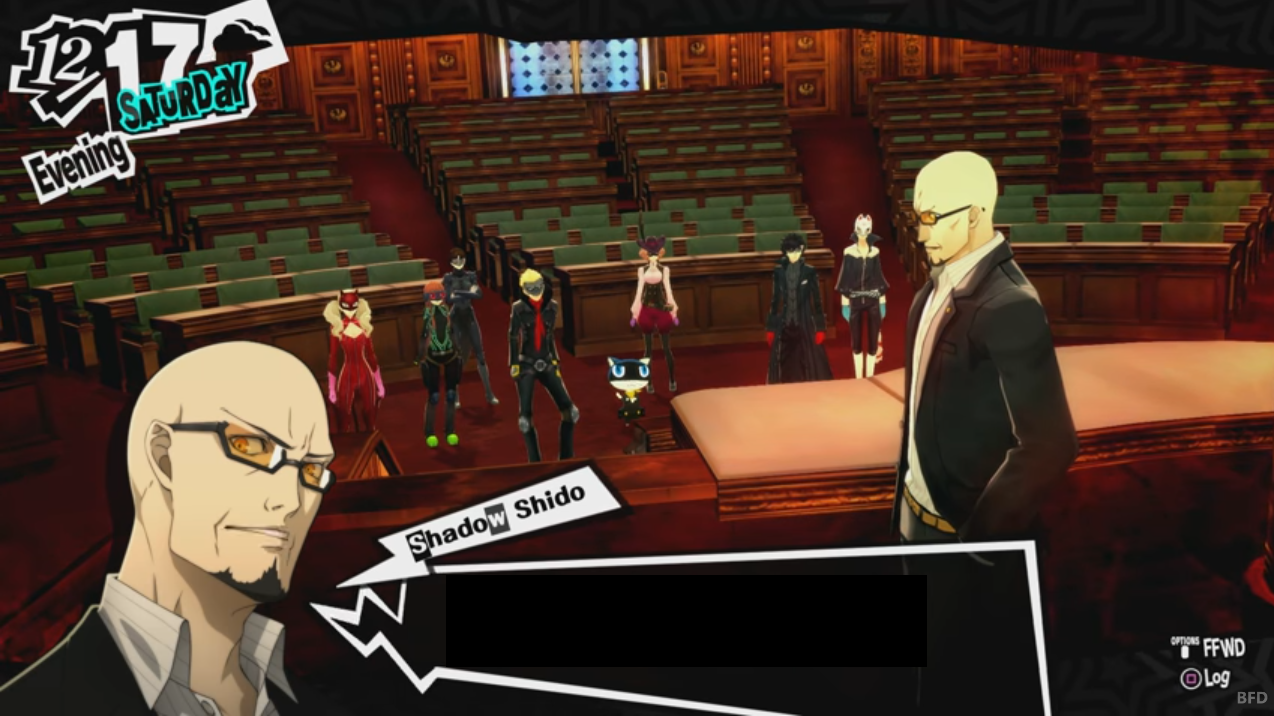
Finally, after many play hours of vigilante action, you take on Shido’s palace. The stakes: the entire country, and vengeance for a life ruined by a false conviction. Tension builds as you fight your way through the palace, defeating progressively harder mini-bosses and wrapping up side-plots, until the final battle is at hand. And then . . . it is just like any other boss battle. Shido’s shadow has a few forms, and then he is defeated. You steal his treasure and escape the palace.

Now at this point, you’re expecting a twist. You know Shido knows about the cognitive realm, and it has been foreshadowed that he has techniques to keep his heart from changing even if his shadow is defeated. However, back in the real world, Shido appears on public TV and starts confessing his crimes and schemes, before the news people cut him off. And then, well, that’s it. All that buildup for him to go out like a whimper.

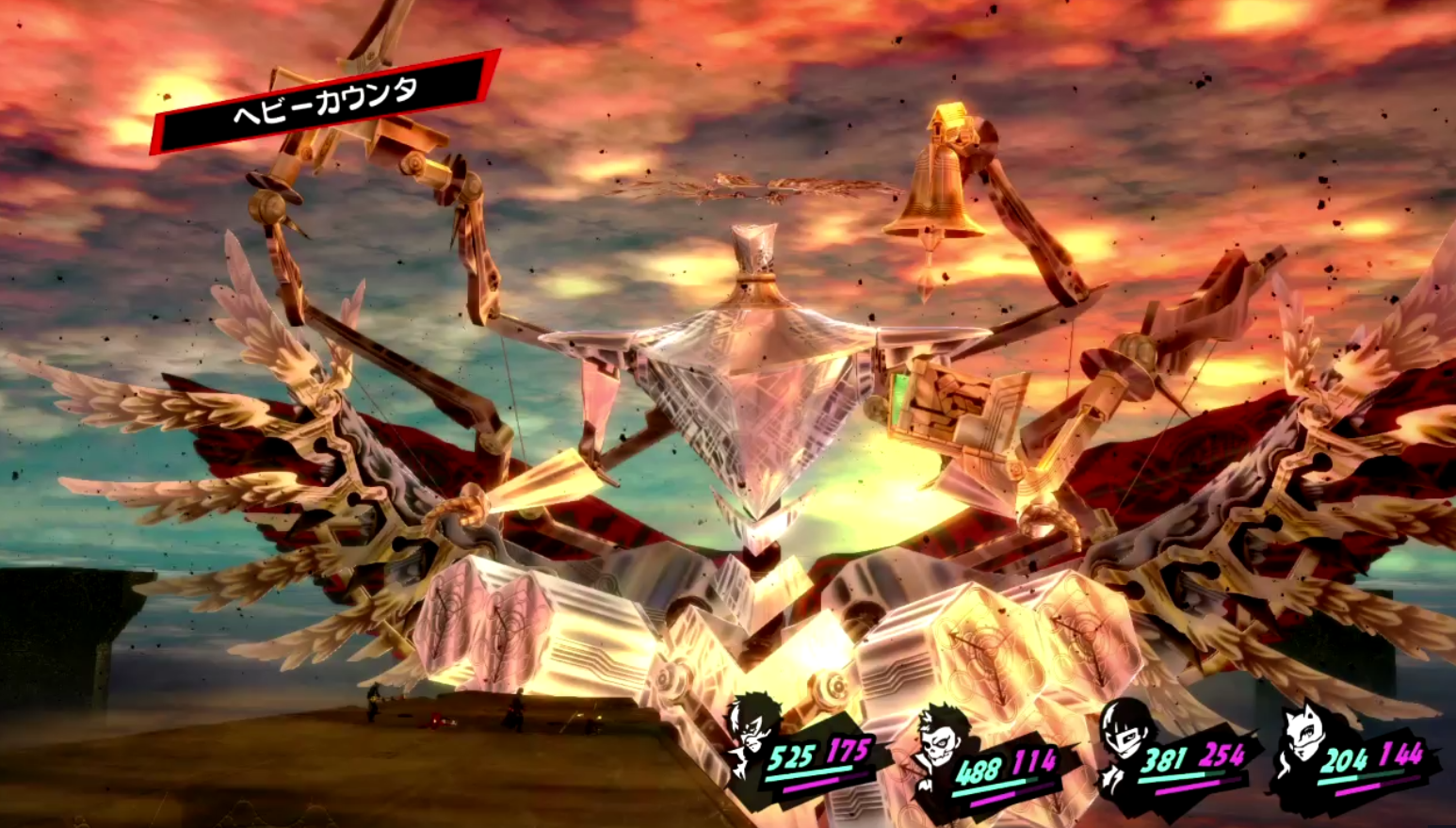
But the game is not over. There is another palace, the palace of the people. Its ruling shadow is Yaldabaoth, not a reflection of a human like the other shadow rulers, but a god born of humanity’s desire to give up their free will and responsibility . . . which would have been cool, except it has nothing to do with the 90-hour-long story you have been playing up to this point. You defeat him because it is what the game wants you to do, not because you have any investment in what is going on anymore. The moment that was supposed to be the climax has already happened, and by now, you have played the game for so long that you just want it to end.


So what went wrong? What could the writers have done differently to deliver that epic, satisfying ending that the players have been excited for the whole time? The answer is to integrate Yaldabaoth and Shido into the same plot. My version of Persona 5’s ending goes like this:

When Shido appears on TV after his shadow has been defeated, he confesses nothing. Instead of being full of sorrow at the atrocities he has committed, he is even more confident than before, boasting that he has the country in his fist. Yet still, the people flock to support him. It appears that the main characters have failed. However, just like in the actual ending, they discover the final palace, the palace of the people, where the shadows of the people huddle in their voluntary prisons moping about there being no hope and giving up their decisions to a ruler. In the actual ending, Shido is among them. In my version, he is not.

When they meet Yaldabaoth in my ending, a distorted version of Shido’s face is stuck to his body. The characters learn that Yaldabaoth has existed for years, plotting to subdue humanity, and has been using Shido as his vessel. The collapse of Shido’s palace allowed Yaldabaoth to take control of Shido’s body, and increase his influence over humanity. Shido’s face cries, “freeeee meeeeee!” suggesting that his heart was indeed changed when his shadow was defeated, but he now has no control over his actions.

When the main characters defeat Yaldabaoth, Shido is freed to confess his crimes. After that, my version ends the same way the actual story does. Shido is put in prison, Akira is acquitted, and all the other threads are tied up. The players are left satisfied with a good twist and a properly-built climax.


I liked most of Persona 5. It was very well-written, and had amazing graphics and music. I know the writers had the skill to make the ending worthy of the rest of the game, but we are left with what we got. So the least I can do is to learn from their mistake, and avoid it in my own stories.