See also:
Work and Purpose
There is no question that life is about more than happiness and easy fun. Eating, drinking, and being merry can get stale really fast. The go-to antidote to this mediocrity is applying ourselves to work. We put our effort into things we might not want to do, and when we are done, we sit back and enjoy the benefits of a job well done, and sometimes a paycheck to boot. But work is not the only way to add purpose to one’s life, and it is often not the most effective way either.
Preparing for a marathon is no walk in the park. Athletes build up discipline, sticking to special diets and pushing themselves to run farther and farther. Then, they join thousands of others in a 26-mile run through the city. Why do millions of people do this every year? It’s not because of the prize money. Rather, it’s because of the challenge, of forming discipline and building oneself up, and the satisfaction of knowing for the rest of your life that you did it. Marathon running and all that goes into preparing for it is an example of what I call hard fun. Other examples of hard fun include things like exercising, learning a language, building relationships, playing games, solving puzzles, contemplating mysteries, creating art, tending a garden, and practicing skills.
Like work, hard fun is hard. But unlike work, which comes from places of necessity and circumstance, hard fun is motivated from within. It is rewarding enough that we make ourselves do it just because of the enrichment it brings to our lives. The key difference here is between external motivations and internal motivations. Work is something we have to do because forces outside ourselves make it necessary. Hard fun is something we push ourselves to do from within, because its intrinsic value to us is just that powerful.
Hard fun can bring as much meaning and purpose into a person’s life as hard work, and often more so. To understand why, we have to look at the reasons why work can be meaningful. It is not because we are forced to do it, nor because it isn’t fun, nor because of the pay. The meaning in work comes from overcoming various types of challenges, rewarding outcomes that are directly related to the activities of the work, and the bonds formed with others through shared efforts. These same things are just as meaningful when we don’t have outside forces nudging us to do them with carrots and sticks. We seek meaning in our lives, crave it with every fiber of our being, and thus push ourselves, challenging ourselves to learn, accomplish, and become better at things. This is the great power and beauty of hard fun, providing meaning and purpose to our lives without being pressured or forced into it.
Sometimes a person’s work is hard fun to them. Whether they came to realize it because outside pressures pushed them into it, or they knew it was what they wanted to do all along, they do their job from the heart, and the paycheck is just a bonus. When this happens, it is a very beautiful thing.
Showing posts with label work. Show all posts
Showing posts with label work. Show all posts
Friday, April 10, 2020

Friday, March 15, 2019
Why Success is Rare
Here in the USA, we are told a story. The story is that if we work hard and persevere, success will be ours. We are bombarded with stories of people who pull themselves up by their bootstraps into their dream lives. Sports players making it to the big league. Coal miners becoming rocket scientists. Homeless people becoming millionaire businessmen. These stories are inspiring, and make us feel that if we just work hard enough, we too can achieve the success we dream about.
Success means different things to different people. For this discussion, we will define it as is how well you are able to achieve whatever you set your life toward.
I, too, hope for success. It is my dream to one day walk into the Sci-fi and Fantasy aisle of a Barnes & Noble and see a book with my name on it. But when I think about the millions of people who write books, or at least want to write books, those shelves in the bookstore start to look very small.
This is an example of the Pareto principle, or the 80/20 rule. The Pareto principle is the observation that, for any measure of success, 80% of it is held by 20% of the people who seek it. This also applies for sub-sections of the distribution, meaning 64% of the success is held by 4% of the people (80% of the 80% is held by 20% of the 20%), and so on. Of course, this is only a general observation across large numbers of people in many different areas of life. Within small groups of people, the numbers may be different. But overall, it shows us that success is rare.
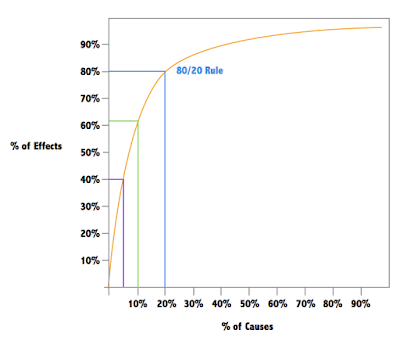
Like any statistical rule, the Pareto principle is not baked into reality, but shaped by a number of different factors. Part of it is because work also follows the Pareto principle; on average, 20% of workers do 80% of the work. But this is not the whole story, and it, too, needs to be explained. So let’s look at some of the reasons these 80/20 rules exist.
We are not born blank slates. Each of us has different personalities, interests, and talents, which affect what we can be good at, and how good we are at them. No amount of hard work is going to turn the average truck driver into a groundbreaking theoretical physicist, or the average biologist into a world-class basketball player. So part of the success equation comes from natural-born talents and interests.
Another thing to consider, and an unfortunate fact of our society, is that the playing field is not level. Many people are born too poor to practice and make use of their talents. Others are born into social minorities, groups of people for whom, by tragic accidents of history, the deck is stacked against. These are roadblocks against success.
We live in a dynamic economy. The opportunities that are available today will be gone tomorrow, taken by those who were in the right place at the right time. In order to find a niche, it helps to know people who can vouch for you and get your name out there. Connections and good marketing are essential for success.
From these four areas; effort, innate qualities, societal factors, and economic environment; we can begin to see the picture of success more clearly. If we were to put success into an equation, it would look something like this:
Each of these things contributes toward one’s probability of success. If one of them is lacking, the others have to make up for it. The amount each part contributes is different for every endeavor.
What can we learn from this? Well, to me it says that we should not judge people for being unsuccessful. Our effort and choices only get us so far. Most people, even if they give life their all, are just going to be average. And if someone is not doing well in life, that does not necessarily mean it is their fault. It gives me an appreciation for the sports player who will never make it into the league. The writer who will never be published. The musician who posts online and gets only five downloads. The hard worker who will never run their own businesses. There is nothing wrong with these people. They are average. Normal. And they should be respected and allowed to live out their lives doing the things that are meaningful to them, even if the world around them does not view their contribution as important.
Success means different things to different people. For this discussion, we will define it as is how well you are able to achieve whatever you set your life toward.
I, too, hope for success. It is my dream to one day walk into the Sci-fi and Fantasy aisle of a Barnes & Noble and see a book with my name on it. But when I think about the millions of people who write books, or at least want to write books, those shelves in the bookstore start to look very small.
This is an example of the Pareto principle, or the 80/20 rule. The Pareto principle is the observation that, for any measure of success, 80% of it is held by 20% of the people who seek it. This also applies for sub-sections of the distribution, meaning 64% of the success is held by 4% of the people (80% of the 80% is held by 20% of the 20%), and so on. Of course, this is only a general observation across large numbers of people in many different areas of life. Within small groups of people, the numbers may be different. But overall, it shows us that success is rare.

Like any statistical rule, the Pareto principle is not baked into reality, but shaped by a number of different factors. Part of it is because work also follows the Pareto principle; on average, 20% of workers do 80% of the work. But this is not the whole story, and it, too, needs to be explained. So let’s look at some of the reasons these 80/20 rules exist.
We are not born blank slates. Each of us has different personalities, interests, and talents, which affect what we can be good at, and how good we are at them. No amount of hard work is going to turn the average truck driver into a groundbreaking theoretical physicist, or the average biologist into a world-class basketball player. So part of the success equation comes from natural-born talents and interests.
Another thing to consider, and an unfortunate fact of our society, is that the playing field is not level. Many people are born too poor to practice and make use of their talents. Others are born into social minorities, groups of people for whom, by tragic accidents of history, the deck is stacked against. These are roadblocks against success.
We live in a dynamic economy. The opportunities that are available today will be gone tomorrow, taken by those who were in the right place at the right time. In order to find a niche, it helps to know people who can vouch for you and get your name out there. Connections and good marketing are essential for success.
From these four areas; effort, innate qualities, societal factors, and economic environment; we can begin to see the picture of success more clearly. If we were to put success into an equation, it would look something like this:
Success = hard work + passion + talent + social status + niche + connections
+ marketing
Each of these things contributes toward one’s probability of success. If one of them is lacking, the others have to make up for it. The amount each part contributes is different for every endeavor.
What can we learn from this? Well, to me it says that we should not judge people for being unsuccessful. Our effort and choices only get us so far. Most people, even if they give life their all, are just going to be average. And if someone is not doing well in life, that does not necessarily mean it is their fault. It gives me an appreciation for the sports player who will never make it into the league. The writer who will never be published. The musician who posts online and gets only five downloads. The hard worker who will never run their own businesses. There is nothing wrong with these people. They are average. Normal. And they should be respected and allowed to live out their lives doing the things that are meaningful to them, even if the world around them does not view their contribution as important.
Friday, October 5, 2018
Work and Purpose

Most people believe that there is some connection between work and a meaningful life. But it is not straightforward, by any means. There are many different kinds of work, and many factors that contribute to or take away from the meaning they provide. Today, we are going to try to better understand where exactly the value of hard work lies, though it is far more complicated than the scope of this single blog post.
There is no question that work in itself does not make life meaningful; everyone knows the life of a slave is anything but. So why do so many people believe that more jobs and harder work will lead to more meaning in people’s lives?
To explore this question, we have to look at the opposite of slavery, total leisure. When people have all they need, and have the option to do only what they feel like, two things can happen. Either they seek out difficult tasks and projects to do, or they become nihilistic and conclude that life is meaningless. A life without work is certainly better than that of a slave, but it is not much more meaningful.
If the two extremes of work, slavery and total leisure, are equally meaningless, it means there is more to the story. That is no surprise, because truth almost never comes in simple yeses and nos. So let’s take a look at some of the factors that go into work, and see if we can distill a recipe for meaning.
Perhaps a little bit of meaning comes from being paid a living wage. Of course it has to be enough to live according to society’s standards of dignity; a job with too little pay is essentially a lesser form of slavery. However, there are other kinds of work that don’t pay, like housework, raising kids, maintaining relationships, volunteer work, and personal projects, and these are very often more meaningful to people than the jobs they do to pay the bills. So although it is nice to earn money, it contributes only a small percentage to the meaningfulness of the work.
Perhaps one element of the sense of purpose people get from hard labor is an illusion. Once, as I walked the mile home from the grocery store in the humid heat of the summer with a bag of groceries slung over my shoulder, I was exhausted. As I surveyed the long stretch of bicycle trail I had yet to get through, my heart sank. But then I had an idea. Instead of thinking of how much I had left to do, I started thinking of myself as a grocery-carrying machine. My purpose in life was to carry groceries, one step at a time, along the hot, humid bike trail. And wonder of wonders, I started to feel better. And the next thing I knew, I was across the road from my apartment. Convincing myself that I was a labor robot helped me in the moment, but I ultimately knew it was a delusion, and left it behind as soon as I got home. I can’t help but wonder if a good portion of society’s praise of hard work is a result of people unaware that they are continually under this delusion themselves.
However, there are other, more real factors that contribute to the sense of purpose in work. For one, we want to contribute to society’s prosperity. The modern world is full of comforts and conveniences, and we feel guilty if we partake in these without contributing our fair share of support.
Yet another possibility comes to mind from my own experience. As NaNoWriMo approaches, I’m reminded that every year I push myself so hard that I bring myself physical pain every day for a month, in order to complete an entire draft of a book that will never be published, no one will ever read, and I will never get paid for. What could drive me and so many others to voluntarily endure such torment? Well for me, the answer is simple; the experience of NaNoWriMo helps me to become a better writer. I find meaning in work that improves my skills and broadens my abilities to appreciate the variety of experiences that life has to offer. Self-improvement, with a sense of having earned it.
In a discussion about work, we cannot forget camaraderie. Shared struggles bring us together like nothing else. No matter what the job, no matter what the circumstances, having others to collaborate with, to share encouragement with, to move forward together with, makes it so much better than going through it alone.
Hard work by itself does not make life meaningful, nor does its absence. For every person, many different factors contribute different amounts. For some, the meaning in work is found in the reward, in the money earned. For others, the meaning is found in contributing to society, in making one’s community a better place. For others, the meaning is in the friendships forged in the flames of the struggle. For those like myself, the meaning is found in improving oneself, gaining skills and knowledge that lead to a greater enjoyment of everything life has to offer (although I wouldn't mind if you decided to click on the orange button on the sidebar). It’s not simple. There is no one answer. So instead of praising hard work for hard work’s sake, let’s remember that it’s the reasons we work that matter, and that everybody’s reasons are a little different from everybody else’s.
Subscribe to:
Posts (Atom)