Showing posts with label relativity. Show all posts

Friday, June 12, 2020

Faster-Than-Light: Antigravity and Exotic Matter

It is almost universally believed among experts that traveling faster-than-light (FTL) is impossible. But if it weren’t, how would we do it?


Relativity and the Speed of Light


The speed of light is special. The reason it is special has nothing to do with light; it is the fixed feature of the universe against which we measure space and time. Our human brains naturally think of space and time as absolute. It makes sense to us to believe that if two things happen at the same place but different times, or two things happen at the same time but different places, then that’s the way it is no matter how you look at them.

But space and time are not absolute, they are relative. Space is easier to comprehend. Suppose you are standing by a train track. As I pass by in a train car, you snap your fingers twice. To you, in the reference frame of the surface of the Earth, the two snaps happen at the same place. But to me, in the reference frame of the train car, the snaps happen at different places.

In the station's frame the snaps happen at the same place, but in the train's frame the snaps happen in different places.

There is no objective reference frame by which to determine whether something is stationary or moving. Everything is stationary from its own viewpoint.

What about time? The relativity of time is harder to wrap our heads around, because it only appears when observers are moving significantly close to the speed of light relative to each other.

Let’s go back to the train example. You hold your arms out to their full length, and snap both your hands at once as I pass by. In my reference frame, however, you snap the fingers of the hand that points forward along the track first, and the hand that points backward second.

We aren’t talking about the difference in how long it takes for sound and light to get to our eyes and ears. The discrepancy is still there after we account for that. In your reference frame, you snap the fingers of both of your hands at once, but in my reference frame, you snap them at different times.

In the station's frame the snaps happen at the same time, but in the train's frame the snaps happen at different times. This is not because of light lag; it is found to be true after we account for light lag.

It is a fact baked into the fabric of the universe that there is no objective “here,” and there is no objective “now.” The speed of light is the absolute which ties together all perspectives of space and time. It does not matter where you are, nor what speed or acceleration you are going, the speed of light is the same for you as it is for everyone else.

Chasing Light Beams


Suppose you turn a flashlight on and off, sending a pulse of light out into space, and then chase after it. You accelerate and accelerate and accelerate, but no matter how fast you go, that light pulse is still retreating away from you at the speed of light. You can never catch it.

What is your trip like in the reference frame of Earth? It is an objective fact that you never catch the flashlight’s pulse. Therefore, in the reference frame of Earth, you speed up and speed up, but the closer you get to the speed of light, the less you speed up. No matter how much you accelerate, you never reach light speed.

This is the trajectory of an object with constant proper acceleration under Special Relativity. The shape is a hyperbola, and it never becomes parallel with the light beam it chases. The dashed line is the asymptote, shown as a visual aid.

However, you can, in fact, travel across the universe. In Earth’s reference frame, you are experiencing time dilation. Time is running slower on your ship than it is on Earth. In your reference frame, the universe is undergoing space contraction. The distance to the stars in front of you is shrinking—not just that you’re getting closer, but there is less total space for you to go through. The distance from Earth to your destination is shorter in the ship’s reference frame than it is in Earth’s reference frame.

In a sense, this can almost feel like traveling faster than light, even though light always races ahead of you. But because of the way the time dilation and space contraction work out, it still takes years to travel light-years according to your departure and destination reference frames. We don’t just want to visit Alpha Centauri, we want to get back in time for work the next week. How do we do that?

Both science fiction writers and scientists have pondered this conundrum. I myself wrote my undergraduate thesis on the topic. There are three families of FTL methods: space warping, wormholes, and hyperspace. Space warping involves shortening the distance between the beginning and end of the journey. A wormhole is a shortcut between points in space. And hyperspace is a hypothetical more-than-three-dimensional space, in which our 3D universe is just a slice. All of these deserve their own discussions, so today we will focus on an essential ingredient for making and using these things, exotic matter.*

Negative Energy and Imaginary Mass


Exotic matter sounds exciting. What is it? If we put the space-time curvature for a warp drive or a traversable wormhole into the Einstein field equations, we find we need to generate antigravity. In order to get antigravity, we need negative energy. You might think negative energy means negative mass, because E = mc2, but that equation is just a special case of the real equation,


As you can see, the mass in this equation is squared, so in order to end up with a negative energy, the mass must be complex. I don’t mean difficult to explain, we’re talking imaginary numbers, the square roots of negative numbers. Yeah, now you know why it’s called exotic matter.

Dark Energy


All right, so how do we make exotic matter? Do we have any clues to suggest it exists? Yes, in fact. Just a hint, but it’s more than nothing (or should I say, less than nothing?). The universe is expanding, and not only that, it is speeding up. Under attractive gravity, it should be slowing down. But because it is speeding up, we know there is a repulsive antigravity, some kind of “dark energy,” pushing everything apart.


We don’t know what this dark energy is. It is one of the biggest unsolved mysteries in physics. It could turn out to be completely useless. Or, it may be that it can be used to create exotic matter, or harnessed directly as negative energy.

Zero-Point Energy


There is one phenomenon people often point to as negative energy in the lab: the Casimir effect. So let’s talk about it, and see if it really is the magic ticket that will get us to the stars.

To begin, a little background knowledge. What we think of as empty space is not, strictly speaking, nothing. It has a number of quantum fields overlapping one another. For a deeper discussion of quantum fields, check out part 1 of our quantum physics series.

As it turns out, even when there are no particles, the quantum fields aren’t at 0 energy. An energy of absolute 0 leads to a contradiction in the math. Thus, the fields always have a buzz of vibrations far smaller than any particle. This is zero-point energy, also known as quantum foam.

The quantum foam is influenced by objects. If, for instance, there are two metal plates with empty space between them, these plates act as boundary conditions for the zero-point waves in the quantum fields. It’s like the harmonics of a guitar string, except instead of a string, it’s empty space. In empty space without the plates, there are no limits on the frequencies allowed in the quantum foam, but between the plates, only the harmonics are allowed.

If that was confusing, here is the bottom line: between the plates, the energy of the empty space is less than the energy of the empty space surrounding them. This is the Casimir effect.


The argument goes, if there is less energy between the plates than in normal empty space, that’s negative energy, so it should be usable for space warping and stuff like that. Here’s the problem, though. When it comes to gravity, it’s not the relative energy that matters, it’s the absolute energy. The zero-point energy in the Casimir effect may be less than the normal zero-point energy, but it is still more than absolute zero. Thus, although the Casimir effect looks like it creates negative energy, it is really still positive energy, and cannot be used for FTL technology.


As it turns out, getting negative energy is really, really hard. When it comes to FTL travel, we’re pretty much dead in the water. Of course, we don’t have any proof that exotic matter can’t exist, so there’s the possibility it’s hiding out somewhere in what’s left of the unknown. Maybe dark energy can provide a thread to follow, but that’s a big maybe. As things stand, it looks pretty certain that we’ll be stuck taking the slow route. Of course, that doesn’t mean we can’t use our imagination, and you can bet we will return to the topic of FTL in the future.

*We currently have no reason to believe hyperspace exists, nor any idea how to use it if it does. Exotic matter may be necessary, or may not be of any use at all.

Friday, October 4, 2019

Why Faster-Than-Light Travel Allows Time Travel

In our everyday experience, things can always move faster. Give a car a little more gas, and it will speed up from 100 miles per hour to 110 miles per hour. Give a rocket a little more thrust, and it will speed up from 1000 miles per hour to 1050. But weird stuff starts to happen when things get close to the speed of light, and to understand it, we have to talk about space and time.

Our brains automatically think of space and time as absolutes. A yard in a straight line is a yard, no matter who is measuring or calculating it. The present is a special moment in time, and it exists right now all across the universe. A minute is a minute, and it is the same for everyone everywhere. It’s intuitive and obvious. And none of it is true.

To understand why, we have to look at a little theory called Special Relativity. It is one of Einstein’s most famous insights, and one of the reasons he is known worldwide as the face of genius, because he questioned our natural understanding of space and time and found a deeper truth.

The simplest place to start is to draw a coordinate plane, with position going horizontally and time going vertically. As an object moves through time, it moves upward on this graph. We ignore the other two dimensions of space, both because a 4-dimensional diagram is hard to draw and to look at, and because they aren’t necessary for the concepts we’re interested in.

If something is staying still according to its coordinates, its path goes straight up. If something is moving in these coordinates, its path goes up at an angle. If it is accelerating, its path goes up along a curved path. Light travels at 45-degree angles.

Now that we’ve set up our coordinates, we define a term called a reference frame, a set of coordinates where zero is set to a specific location and speed. It might be tailored to an object, or just a point in space. From the origin (0,0), we draw four lines at 45-degree angles. These lines below the x-axis are the paths light from the past takes to reach the object at point 0, and the lines above the x-axis are the paths light takes coming from the object at point 0. These are called light cones.


Let’s look at everyday relativity we all know well. Suppose you’re standing still, your friend is driving by at 50 miles per hour, and a truck is driving in the same direction at 100 miles per hour. If we switch into your friend’s reference frame, they are the ones sitting still in their car, the truck is moving forward at 50 miles per hour, and you are moving backward at 50 miles per hour. In the reference frame of the truck, your friend is moving backward at 50 miles per hour, and you are moving backward at 100 miles per hour.


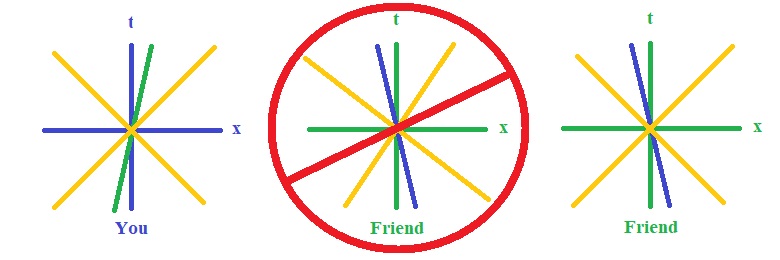
Now you might think, “What’s the big deal? Just speed up until you catch up to light, and then you’ll be going faster than it.” Well here’s where the craziness comes in. You see, light always travels at 45-degree angles on the space-time diagram in every reference frame, no matter how fast you or any other person or object is moving. If you are standing still on the Earth, and your friend takes a bullet train past you at 1000 miles per hour, the speed of light for you is the same in all directions as the speed of light for your friend: c. Your friend does not calculate light in front of them traveling any slower than the light behind them. They calculate both light beams traveling at the same speed, c.

The light cone must always be at 45 degrees, not skewed as it is in the middle diagram.
What does this mean? Well the math is complicated, but in order to get light to travel at c in all reference frames, space and time get messed up. In your reference frame, the time axis points straight forward in time, not any direction in space. Your friend’s time axis points in the direction through space-time as if they are not moving. On our graph, this means your time axis points straight up, but your friend’s time axis points along the path they are going to take though space-time at their current speed. Because the speed of light stays constant, this needs to be counterbalanced by your friend’s space axis changing too. In the transformation between your reference frame and your friend’s reference frame, space and time get rotated toward each other, and vise versa.


This is why nothing can go faster than the speed of light. No matter how much you speed up, light will always be traveling at c ahead of you, and you can never catch up to it no matter how much you accelerate. In the reference frame of someone standing still and watching you, you go closer and closer to the speed of light, but never reach it. This causes your time to slow down, your mass to increase, and your shape to flatten. You of course don’t notice any of this stuff, because it’s not happening in your reference frame.

Make a note of the fact that time passes slower for someone traveling close to the speed of light. This is going to be important later on.

If we look carefully at the way the axes change when we transform between coordinate systems, we’ll see that this means a universal “now” doesn’t exist! To show this, let’s take the x-axis, which is the slice of space-time where t=0, and what we think of as “now” across the universe. But your friend’s x-axis point in a different direction through space-time, meaning their “now” slice is different from yours! Mind blown, right? To drive the point home, let’s suppose there is a firecracker set to go off at a certain time 1000 miles away. According to your “now” slice, the firecracker is about to go off. But according to your friend’s “now” slice, the firecracker has already gone off!


There is no universal “now.” Each point in space-time is its own “now,” both in time and space. “Now” for you is only now for you, everyone and everything else has their own “now.”

There is nothing special about the t-axis in our diagrams. You can move in one direction, and then you can stop and turn around and go the other direction. In the same way, there is nothing special about the x-axis. If something were somehow able to travel faster than light, there would be nothing stopping it from going in a slightly future direction, then turning around and going in a slightly past direction. The fundamental boundaries are the light cones, not the t- or x-axes.


This means, if you were somehow able to make a ship go faster than light, all of the space-time between your future and past light cones would be open to you. This means you could set off going slightly backward in time, then turn around and go slightly backward in time the other direction, and get back to where you started before you began. It doesn’t matter what the method is, if you can travel faster than light, you can go back in time.


If you could go faster than light, all of the space-time outside of your light-cones would be available to you, but you would be locked out of your past light cone, unless you take a roundabout path. However, a past light cone is the same kind of barrier as a future light cone, so if you have the technology to cross the future light cone, that same technology can probably let you cross the past light cone, and you won’t have to go faster than light to time-travel; you’ll be able to do it while staying in the same place.


Warp drive, hyperspace, whatever your method is, the math doesn’t lie; according to Special Relativity, if you can travel faster than light, you can also go backward in time. But what about taking shortcuts? What if you don’t have to travel the vast distance between stars, but can get there in a single step? What if we could use a wormhole?

A wormhole is a theoretical object that comes out of Einstein’s other theory, General Relativity. Wormholes are interesting enough that we might give them their own discussion, but all we need to know today is that a wormhole is a shortcut between points in space-time. You can think of it like a doorway, but instead of leading to another room, it leads to a different planet.

You might think a wormhole is something that picks you up and teleports you away. This is a misconception. As you walk through the wormhole, nothing is happening to you that doesn’t happen when you take a walk down the street. The two ends of the wormhole might be light years apart the normal way, but on a path through the wormhole, they are only separated by a few feet. This isn’t just a metaphor, it’s literally true.

Wormholes, it turns out, also allow for time travel. To demonstrate this, let’s start with a simple setup, a wormhole where the two mouths are five feet away from each other and synchronized in time. If you look through the wormhole, you can see your own back five feet in front of you.

We put one of the wormhole mouths on a spaceship, and fly it around near the speed of light. Remember from earlier, if something is moving near the speed of light, time is slowed down for it. This means time is passing slower for the mouth of the wormhole on the ship than it is for the mouth on Earth—but only on the path through space from Earth to the ship. On the path through the wormhole, time is passing at the same rate on both sides. You could step through, have tea for half an hour with the astronauts, and when you step back, half an hour would have passed on Earth.

Think about this. On a path through space, time is passing slower on the ship than it is on Earth. But on a path through the wormhole, time is passing at the same rate on both sides. What is going on here? It’s a paradox! Two different ways of calculating the same problem give us two different answers. Which is right? Is time flowing at different rates, or isn’t it?

The answer is, both calculations are correct. Time is flowing at different rates on a path outside the wormhole, but it is flowing at the same rate on a path through the wormhole. This means the wormhole is not only connecting two points in space, but also two points in time.

Suppose the astronauts decide to return to Earth. When they land, less time has passed for them than on Earth. Mission control says, “Hey, you’ve finally arrived.” An astronaut says, “What do you mean, ‘finally’?” The astronaut looks through the wormhole, and on the other end, the same mission control member says, “You’ve landed? But we still see you flying around up there!” Outside the wormhole, the mission control member chuckles and says, “I remember having this conversation a week ago.”


By putting one mouth of a wormhole on a spaceship and flying it around near the speed of light, and then landing, the team has created a gateway through time. In our example, the difference between wormhole ends is one week; step through the end that traveled on the ship, and you’ll find yourself a week in the past. Step through the end that stayed home, and you’ll find yourself a week in the future.

What about quantum entanglement? Can’t we send messages instantaneously by measuring one particle and instantly affecting another one light years away? Wouldn’t this achieve faster-than-light communication without time travel? The answer is no, because in order to send information by quantum entanglement, the two parties must compare notes via traditional channels. Also, it’s incorrect to say whose measurement affected whose, because in some reference frames person A measured their particle first, and in other reference frames person B measured their particle first. When measuring entangled particles, there is no causation, only correlation.


In science fiction, we see faster-than-light travel all the time, but time travel usually takes some special magic sauce. This isn’t because of science, but because easy time travel would ruin the plot. Another reminder of the difference between narratives and reality. We may try hard to come up with a loophole that doesn’t allow time travel, but the fact that there is no universal “now,” and all spacelike trajectories are open to a faster-than-light traveler, nails the box shut. I am all for imagination, of course, but when it comes to reality, despite how strange it may be, we should allow ourselves to follow the evidence where it leads.