Showing posts with label science. Show all posts

Friday, June 12, 2020

Faster-Than-Light: Antigravity and Exotic Matter

It is almost universally believed among experts that traveling faster-than-light (FTL) is impossible. But if it weren’t, how would we do it?


Relativity and the Speed of Light


The speed of light is special. The reason it is special has nothing to do with light; it is the fixed feature of the universe against which we measure space and time. Our human brains naturally think of space and time as absolute. It makes sense to us to believe that if two things happen at the same place but different times, or two things happen at the same time but different places, then that’s the way it is no matter how you look at them.

But space and time are not absolute, they are relative. Space is easier to comprehend. Suppose you are standing by a train track. As I pass by in a train car, you snap your fingers twice. To you, in the reference frame of the surface of the Earth, the two snaps happen at the same place. But to me, in the reference frame of the train car, the snaps happen at different places.

In the station's frame the snaps happen at the same place, but in the train's frame the snaps happen in different places.

There is no objective reference frame by which to determine whether something is stationary or moving. Everything is stationary from its own viewpoint.

What about time? The relativity of time is harder to wrap our heads around, because it only appears when observers are moving significantly close to the speed of light relative to each other.

Let’s go back to the train example. You hold your arms out to their full length, and snap both your hands at once as I pass by. In my reference frame, however, you snap the fingers of the hand that points forward along the track first, and the hand that points backward second.

We aren’t talking about the difference in how long it takes for sound and light to get to our eyes and ears. The discrepancy is still there after we account for that. In your reference frame, you snap the fingers of both of your hands at once, but in my reference frame, you snap them at different times.

In the station's frame the snaps happen at the same time, but in the train's frame the snaps happen at different times. This is not because of light lag; it is found to be true after we account for light lag.

It is a fact baked into the fabric of the universe that there is no objective “here,” and there is no objective “now.” The speed of light is the absolute which ties together all perspectives of space and time. It does not matter where you are, nor what speed or acceleration you are going, the speed of light is the same for you as it is for everyone else.

Chasing Light Beams


Suppose you turn a flashlight on and off, sending a pulse of light out into space, and then chase after it. You accelerate and accelerate and accelerate, but no matter how fast you go, that light pulse is still retreating away from you at the speed of light. You can never catch it.

What is your trip like in the reference frame of Earth? It is an objective fact that you never catch the flashlight’s pulse. Therefore, in the reference frame of Earth, you speed up and speed up, but the closer you get to the speed of light, the less you speed up. No matter how much you accelerate, you never reach light speed.

This is the trajectory of an object with constant proper acceleration under Special Relativity. The shape is a hyperbola, and it never becomes parallel with the light beam it chases. The dashed line is the asymptote, shown as a visual aid.

However, you can, in fact, travel across the universe. In Earth’s reference frame, you are experiencing time dilation. Time is running slower on your ship than it is on Earth. In your reference frame, the universe is undergoing space contraction. The distance to the stars in front of you is shrinking—not just that you’re getting closer, but there is less total space for you to go through. The distance from Earth to your destination is shorter in the ship’s reference frame than it is in Earth’s reference frame.

In a sense, this can almost feel like traveling faster than light, even though light always races ahead of you. But because of the way the time dilation and space contraction work out, it still takes years to travel light-years according to your departure and destination reference frames. We don’t just want to visit Alpha Centauri, we want to get back in time for work the next week. How do we do that?

Both science fiction writers and scientists have pondered this conundrum. I myself wrote my undergraduate thesis on the topic. There are three families of FTL methods: space warping, wormholes, and hyperspace. Space warping involves shortening the distance between the beginning and end of the journey. A wormhole is a shortcut between points in space. And hyperspace is a hypothetical more-than-three-dimensional space, in which our 3D universe is just a slice. All of these deserve their own discussions, so today we will focus on an essential ingredient for making and using these things, exotic matter.*

Negative Energy and Imaginary Mass


Exotic matter sounds exciting. What is it? If we put the space-time curvature for a warp drive or a traversable wormhole into the Einstein field equations, we find we need to generate antigravity. In order to get antigravity, we need negative energy. You might think negative energy means negative mass, because E = mc2, but that equation is just a special case of the real equation,


As you can see, the mass in this equation is squared, so in order to end up with a negative energy, the mass must be complex. I don’t mean difficult to explain, we’re talking imaginary numbers, the square roots of negative numbers. Yeah, now you know why it’s called exotic matter.

Dark Energy


All right, so how do we make exotic matter? Do we have any clues to suggest it exists? Yes, in fact. Just a hint, but it’s more than nothing (or should I say, less than nothing?). The universe is expanding, and not only that, it is speeding up. Under attractive gravity, it should be slowing down. But because it is speeding up, we know there is a repulsive antigravity, some kind of “dark energy,” pushing everything apart.


We don’t know what this dark energy is. It is one of the biggest unsolved mysteries in physics. It could turn out to be completely useless. Or, it may be that it can be used to create exotic matter, or harnessed directly as negative energy.

Zero-Point Energy


There is one phenomenon people often point to as negative energy in the lab: the Casimir effect. So let’s talk about it, and see if it really is the magic ticket that will get us to the stars.

To begin, a little background knowledge. What we think of as empty space is not, strictly speaking, nothing. It has a number of quantum fields overlapping one another. For a deeper discussion of quantum fields, check out part 1 of our quantum physics series.

As it turns out, even when there are no particles, the quantum fields aren’t at 0 energy. An energy of absolute 0 leads to a contradiction in the math. Thus, the fields always have a buzz of vibrations far smaller than any particle. This is zero-point energy, also known as quantum foam.

The quantum foam is influenced by objects. If, for instance, there are two metal plates with empty space between them, these plates act as boundary conditions for the zero-point waves in the quantum fields. It’s like the harmonics of a guitar string, except instead of a string, it’s empty space. In empty space without the plates, there are no limits on the frequencies allowed in the quantum foam, but between the plates, only the harmonics are allowed.

If that was confusing, here is the bottom line: between the plates, the energy of the empty space is less than the energy of the empty space surrounding them. This is the Casimir effect.


The argument goes, if there is less energy between the plates than in normal empty space, that’s negative energy, so it should be usable for space warping and stuff like that. Here’s the problem, though. When it comes to gravity, it’s not the relative energy that matters, it’s the absolute energy. The zero-point energy in the Casimir effect may be less than the normal zero-point energy, but it is still more than absolute zero. Thus, although the Casimir effect looks like it creates negative energy, it is really still positive energy, and cannot be used for FTL technology.


As it turns out, getting negative energy is really, really hard. When it comes to FTL travel, we’re pretty much dead in the water. Of course, we don’t have any proof that exotic matter can’t exist, so there’s the possibility it’s hiding out somewhere in what’s left of the unknown. Maybe dark energy can provide a thread to follow, but that’s a big maybe. As things stand, it looks pretty certain that we’ll be stuck taking the slow route. Of course, that doesn’t mean we can’t use our imagination, and you can bet we will return to the topic of FTL in the future.

*We currently have no reason to believe hyperspace exists, nor any idea how to use it if it does. Exotic matter may be necessary, or may not be of any use at all.

Friday, June 5, 2020

Quantum Physics 2: Multi-Particle Waves

Quantum Physics:
Fields, Waves, and Particles
Multi-Particle Waves

Welcome to the second part in our series about quantum physics! If you haven’t read the first part yet, I highly recommend it, as we will build upon the concepts we learned there. This discussion also takes a non-reductionist view, so you may want to take some time to digest last week’s discussion of object metaphysics before reading this one.

Image found here. Cropped.

To recap, last time we discussed how the universe contains a number of overlapping quantum fields, each one of which is present throughout all space. These fields contain quantities like momentum, energy, and electric charge, which travel around the fields in waves. The fields can trade this information through interactions, and the probability of interaction is correlated with the amplitude of the wave. And finally, there is a smallest possible amount a wave in a quantum field can interact by, and this amount must interact all at once and all in the same place. That “smallest amount of interaction” is what we call a particle.

In this post, when we say “particle,” it is understood that we are talking about collections of information within a wave, not little balls bouncing around.

Quantum Superposition


When the waves of two particles overlap, they add together in superposition. When in superposition, two particles are not two separate waves that happen to be in the same place; they are one wave with two particles’ worth of information.

For example, let’s look at the simplest kind of particle, photons. They are simple because they do not interact with other photons. Imagine two photons on a collision course. Before the intersection, they are flying along as normal. After they have crossed paths, they continue to fly along as if nothing happened.

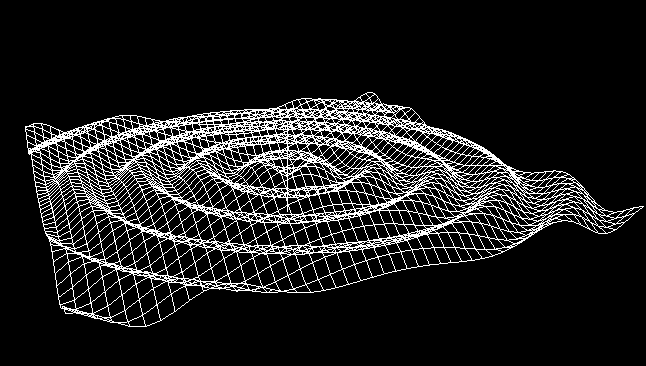
Remember, photons are waves in the electromagnetic field, and there is only one electromagnetic field. At the moment of intersection, when the two photons are in the same place, their wave amplitudes add together to form a superposition wave that contains the information of the two photons, but is not itself a photon. This information causes the wave to split once again as if they had never joined in the first place.

A superposition wave. The final wave contains the information of the first two, yet it is still a single wave. Image found here. Cropped for better framing.

The key concept here is that when two or more particles are in a superposition wave, they aren’t really two particles, they are one wave with two particles’ worth of information. This is where the reductionist view causes problems, and it is the key point of today’s entire discussion. So if you don’t feel like you understand it well, I would strongly recommend lingering on this section, and perhaps rereading last week’s sections on reductionism, holism, and associative equivalence, until you do.

Bosons and Fermions


There is no limit to the number of photons that can superimpose in the same place, but there is for electrons. Electrons cannot superimpose over one another in the same total state. I do not mean that they repel each other due to their negative electric charges. It’s deeper than that.

In the lingo, a particle’s “state” is the total of its information about its properties: its position, momentum, energy, etc. Two electrons can have the same values in some of these, for instance, position and energy, but there must be at least one property that is different between the two. If you try to plug into the Schrodinger equation a superposition wave that contains two electrons with all of the same properties, in the exact same state, you end up with a contradiction, like 0 = 1. This is called the Pauli exclusion principle because electrons exclude other electrons from being in the same state.

Electrons and photons illustrate two categories all particles fall into. Bosons can exist in the same state in the same place. Fermions cannot. Photons are a type of boson, and electrons are a type of fermion. If this is confusing, don’t worry, it will make more sense after we have looked at some examples.

Lasers


Image found on Wikipedia.

We all know lasers, beams of single-color light packed so tightly that the bright spot where it lands is about the same diameter as the aperture it emerges from. A laser is a very strong coherent electromagnetic wave traveling in the same direction. This can be thought of as a vast number of photons all packed into the same place, superimposing on one another, and giving the wave a very high amplitude.

The higher intensity of the laser, the higher the number of photons superimposing into the wave. Can you guess what the limit is for how many photons can be packed into a single laser beam? Because photons are bosons, they never crowd each other out. Thus, we can keep increasing the power until the concentration of the light is so high that its energy creates a black hole! Don’t worry, though, that would take over a billion times more power than the entire world puts out in a year, all concentrated into one laser beam. That’s a lot of superposition.

Atoms


Each element on the periodic table has a smallest unit, an atom. Atoms are formed when electrons bind to positively charged nuclei. The possible states an electron can have within an atom are quantized; there are only certain specific states allowed, anything else gives a contradiction when put into the Schrodinger equation. If this is confusing to you, I recommend reviewing the pixel analogy from Quantum Physics part 1.

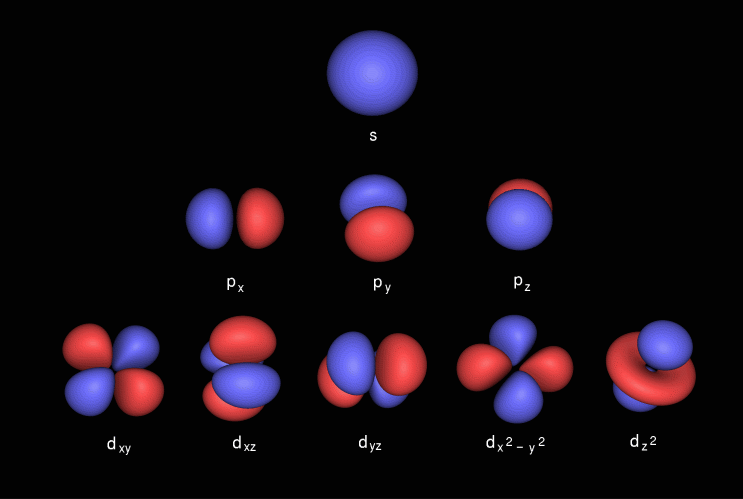
Because electrons are fermions, all electrons in an atom must be in different states. The three things contributing to an electron’s state in an atom are energy, angular momentum, and spin. If you have taken chemistry classes, you have probably heard of the electron states by another name: orbitals. The states with 0 angular momentum are called s orbitals, the states with the smallest non-0 angular momentum are called p orbitals, and then come the d orbitals and the f orbitals. Most of the time, the electrons are in the lowest available energy states.

This image shows the wave modes in the electron field. In real atoms, these get added together in a superposition wave containing all the electrons’ worth of information.

Each orbital letter type has specific energy levels allowed to it. The lowest possible energy for an electron in an atom is the 1s orbital, and the second is the 2s orbital. Then come the three 2p orbitals. There are no 1p orbitals, because trying to put them into the math gives us contradictions. There are one of each s orbital, three of each p orbital, five of each d orbital, and seven of each f orbital. And because electrons have two possible spins, there can be two electrons in each orbital.


Electron Spin


We mentioned something mysterious in the previous section: electron spin. What is it? It’s not angular momentum, as that is a different property. Spin is the property which determines how a particle interacts with magnetic fields. The term is confusing, because nothing is actually spinning; the electron is a spread-out wave with no central point for an axis. It is called spin for historical reasons.

In this section, we will talk about magnetic fields as if they are separate objects from one another, because that makes spin much simpler to explain. Keep in mind, however, that it is more true to say there is one magnetic field with different strengths throughout the universe, and that it is a part of the electromagnetic field.


When an electron interacts with a magnetic field, there are two possible outcomes: the electron’s own magnetic field could be aligned with the external magnetic field, or it could be aligned opposite. These are called “spin up” and “spin down.” Other alignments are impossible, because they give mathematical contradictions.

If you pick an axis, you might think an electron has a set spin, up or down, along that axis. However, it does not. Remember how we talked about electron waves, and the probability of interaction being proportional to the wave’s amplitude? The same thing is true for its spin. If the electron has not yet interacted, then it has an amplitude for spin up and an amplitude for spin down. Just like the electron does not have a single definite position before it interacts, it also does not have a definite spin.

Non-Spatial Probability Amplitudes


Let’s not let what I just said slip by. In an electron wave, there is a position component and a spin component. The position has an amplitude, and the spin also has an amplitude. If the electron interacts in such away that its spin is not involved, the position component of its wave collapses, but the spin component does not. This means an electron can move around and interact with other objects, but keep its spin in a non-determined state.

If I am not mistaken, the wave function of a particle has components for all properties that have more than one value, whether it feels intuitive to conceptualize them as waves or not. Polarization of light is the other well-known example. In a particle interaction, only the components of the wave function for the properties involved in the interaction collapse. The rest remain in superposition.

This means that if something interacts with an electron by its electric field, and not by its magnetic field, its wave will collapse to the position of the interaction, but its spin will still be undetermined.


Quantum Entanglement


Now that we have looked at superposition and the fact that each of a quantum wave’s qualities has its own probability amplitude, we are primed for one of the coolest and most famous aspects of quantum physics: entanglement.

Suppose two electrons are in a helium atom. What we have is a single wave with two electrons’-worth of information. Two units of interaction ability, and two opposite spins. Now we remove the wave from the atom and separate it into two, each with one unit of interaction ability; we can comfortably say that electron A is over there and electron B is over here.

However, if we choose our interactions with the electrons such that their spins are not involved, then the spins are still in superposition. As far as the spin is concerned, the two electrons are still part of the same wave. The only spin information this wave has is that there are two spins, and they are opposite. Which electron has which spin has not been determined, and their probability functions have not collapsed!


This phenomenon, when the position components of a multi-particle wave have separated, but the components of one or more of their other properties has not, is quantum entanglement.

What does this mean? What effects does entanglement have on human experiences? When we measure—cause an interaction with—the entangled property of one of the particles, we know what the other one will be when we measure it too. If we measure the spin of electron A, then we know before measuring the spin of electron B that it will be the opposite.

Most people wonder how the measurement of one electron can affect the properties of another electron instantaneously, ignoring the speed of light. Even Einstein was uncomfortable with it, calling it “spooky action at a distance.” But here’s the catch: the measurement of an entangled property does not affect the other particle. There is no causation between quantum entangled properties, only correlation. If we view entanglement in terms of superposition waves, we find it is not spooky, and it is not action at a distance.

We humans feel that if two things are guaranteed to correlate, then there must be some common cause. Either information is being transferred instantaneously from one particle to the other, or there is some kind of unmeasurable information that determined the outcome when the two particles were together. However, this is nothing more than a human assumption. There is a reason why the spins correlate, but not a cause. The reason entangled properties correlate is because if they didn’t, there would be a contradiction in the math. That is sufficient to make it true. Causation is found almost everywhere within reality, but non-contradiction is absolute.

If you aren’t sold on the connection between math and reality, check out the four-point argument I make at the end of last year’s post on the subject.

A common question people ask is whether quantum entanglement can be used for faster-than-light communication. There has been a lot of discussion about this in the literature, but the bottom line is that no, it cannot. We discussed one of the most compelling reasons to me in a previous post about the relationship between faster-than-light travel and time travel, the paradox that there is no objective way to determine whether the message would go from A to B or B to A.


So there you have it. Between this post and the one that came before, quantum physics explained in 4,500 words. If you understand it, then congratulations! You understand the basics of quantum physics as well as the experts, and perhaps even better than some. You also have a little insight into how the world of our experience emerges from it. If you have questions, feel free to ask them in the comments. There are still things we have not talked about, such as quantum computers, which are interesting enough to get their own discussion. Also, if you take what is said in these two posts at face value, it is known as the Copenhagen Interpretation. There is an alternative view called the Many-Worlds interpretation, which I go back and forth on, as you can see in my argument for it and subsequent argument against it.

So yeah. Quantum physics explained from scratch so that non-experts can understand it. Take that, Feynman!

Friday, May 15, 2020

Broadening our Perspectives with Game Theory

Toolbelt of Knowledge: Theories
Darwinian Evolution
Game Theory

It’s been awhile since we’ve added to the Toolbelt of Knowledge, perhaps because there is so much we can explore in the space of ideas with what we’ve already covered. Today, I’ve decided to add to the longtime-lonely Theories category with another theory that can show us a new perspective on behavior, actions, and ethics: Game Theory.

What is Game Theory?


By its name, we might think Game Theory is a theory of games. It’s not, though. Most commonly, Game Theory is described as a theory of goals, outcomes, and strategies, though it can also be thought of as a theory of acting in accordance with our values. Game Theory is a theory of choices and consequences, actions and effects. The reason it is called “Game Theory” instead of “Strategy Theory” or “Choice Theory” is that games are structured with rules and goals for the players, and so it is easy to apply Game Theory to games. In this blog post, any time we mention “games,” we mean game theoretic systems, unless it is obvious by the context that we are talking about games in the fun-and-games sense.

There are three elements to a game theoretic system: Agents, the people, animals, AI programs, etc. who make decisions; the choices available to them; and the predicted outcomes of each combination of choices. The outcomes are usually written as a list of numbers, such as (3, 10, -1, …). Each number represents how satisfied each person is with the results.

You might see a problem here: in a game, this can represent the number of points each player ends up with, but how does it apply to the rest of life, where outcomes are not so easily quantified?

The answer, in my view, is that Game Theory should not be considered a theory of winning, but a theory of actions and consequences. Instead of numbers, we might put emojis representing how each person feels about the results. Or, we might directly represent the outcomes, rather than trying to quantify them. This can make it more difficult to compare the outcomes, but there are still times when we can comfortably say A is better than B, such as if A includes intense happiness and B includes despair.

Let’s look at some of the concepts of Game Theory, and some of the systems we can apply it to.

Positive-Sum, Negative-Sum, and Zero-Sum


There are three possible ways the total amount of “points” at the end can compare to the total amount at the beginning. If there is more at the end, it is a positive-sum resource; if there is less at the end, it is a negative-sum resource; and if the amount at the end is the same as the beginning, it is a zero-sum resource.

A note on terminology: you have probably heard the terms “positive- etc. sum game” instead of “positive- etc. sum resource.” A _____-sum game is more tied to the way the agents look at the game. For instance, if we say someone is “playing a zero-sum game,” it means they are trying to gain more by taking from others, rather than trying to increase the pot for all.

To illustrate each of these resource types, let’s look at the economy of a hypothetical island nation. This nation is self-reliant, it doesn’t trade or interact with anyone else.

The people of this island want to make it thrive. So they work the farms, build houses, mine for minerals, chop down and plant trees, educate their children, and all the other things a society needs in order to thrive. At the end of the year, they have more seeds, more knowledgeable people, more metal and wood and other resources than when they started with, and they are ready to start the next year and continue to reap increasing returns. This is a positive-sum game.

The land on the island is a zero-sum resource. There is a fixed amount, so if every acre is owned by someone, the only way for a person to acquire more is to get it from someone else.

And finally, the island’s coal supply from the coal mine is a negative-sum resource. The best use for coal is to burn it for electricity, but the more the nation uses, the less there is left to use. In order to continue to thrive in the long term, they must get off the negative sum game of coal power and find a positive sum game with renewable energy sources.

Short, Long, and Infinite Games


There are essentially three ways to strategize about a game-theoretic scenario. Short games are where we try to score as many points (metaphorically or literally) as possible as quickly as possible. A 100-meter dash is a short game; the goal is to get to the finish line before as many of your competitors as possible.

In a long game, the idea is to bide your time, waiting for the right moment to make the pivotal move. In a long game, we make short-term sacrifices for long-term payoffs. Chess is the archetypal example of a long game, as the ultimate goal is to trap the king, and it is common practice to sacrifice one’s own pieces in order to trap the other player in a snare.

An individual person’s life is a long game. The ideal life, according to present-day America and some other places, is to work hard at education, take out some loans for college, get a job, take out some loans for a car and a house, and slowly work off our debts until we break net positive and start accumulating wealth later in life.

An infinite game, on the other hand, is one that doesn’t end. The goal of an infinite game is to stay in the game as long as possible. Those who score points in infinite games are not people, as people have finite lifespans, but longer-lived things like countries, religions, and social causes.

Wars may end. Civil rights may be won. Oppressive regimes may be toppled. But their ripple effects continue, and in order to understand the way things are in the present and move toward a better future, we must study the past. Though the threads of history change, none of them end. History is a collection of infinite games.

Dominant Strategies


Sometimes, a single action can lead to positive results for all possible outcomes. These are called dominant strategies. Let’s look at a few examples.

Suppose we have a scenario where there is one choice: to light a candle or not to light it, and one risk: the candle might fall over. There are four possible scenarios.

1. We do not light the candle, and it does not fall over.
2. We do not light the candle, and it falls over.
3. We light the candle, and it does not fall over.
4. We light the candle, and it falls over.

If the fourth outcome happens, the house catches on fire, but in the other three outcomes it does not. We notice that if we do not light the candle, there is no outcome that results in a house fire. So if our goal is to not have a house fire, the dominant strategy is to not light the candle.

Another example can be found in cooking. If we are cooking a pan full of food, such as stir fried vegetables, we want to cook every piece equally on all sides. The surefire way to do this is to flip each piece individually. But if we do that, it takes too long, and by the time we’re done with the last piece, the first one is burnt. A better way to get it all cooked evenly is to stir the whole pan, making all of the pieces tumble around. Instead of having to plan each time exactly how to deal with each piece of food, stirring the pot or pan works every time. It is a dominant strategy.

Of course, in real-life situations it is often hard to find dominant strategies, since there are usually a very high number of factors and choices. Still, we can use this concept to look for strategies that have high probabilities of leading to good outcomes for a wide variety of ways a scenario might go.

Instrumental Goals and Ultimate Goals


There are two types of goals we might have in game-theoretic scenarios. An ultimate goal is what we are after, the outcome that would give us the most satisfaction from the game. Along the way, we pick up instrumental goals, things that help us achieve our ultimate goals.

Suppose my ultimate goal for today is to finish writing a blog post. In order to do that, I pick up a number of instrumental goals. I make coffee, because caffeine helps me think faster and more clearly. I eat food for similar reasons. I cross the street carefully, because it would be very difficult to finish my post if I am in the hospital or dead.

Of course, there are other reasons to do these things; other games being played. I’m playing the long game of life, in which writing is my major marketable skill, and finishing blog posts is an instrumental goal in service of the goal of making a living as a freelance writer, which is an instrumental goal in service of the goal of pursuing my passion as a science fiction author, which is . . . You get the picture. It’s not always clear what one’s ultimate goals are, or if their web of instrumental goals loops back on itself, or goes on forever.

The distinction between instrumental goals and ultimate goals comes from artificial intelligence research, not Game Theory. But they are useful in the same way as the rest of the ideas we’re looking at today, so I thought it made sense to add them to the Game Theory bundle.

Prisoner’s Dilemmas


Most of us are taught that being selfish is bad, and that we should share and be kind to others. Game Theory has several mathematical models supporting these ideas, the most well-known among them the prisoner’s dilemma. Abstractly speaking, a prisoner’s dilemma is any situation in which people acting in their best interests at the expense of others makes things worse off for everybody.

I won’t use the famous prison example today; you can find a million explanations of it with a quick google search. Instead, let’s look at another example: water rationing. Suppose there is a drought, and a town that usually has plenty of water for everyone starts to run low. The water supplier puts out a public notice, telling everyone that if they don’t limit their water consumption, the supplier will have to start temporarily shutting off the water for several hours at a time.

Each person is faced with the following conundrum:
1. Limit water and there is no shutdown.
2. Limit water and there is a shutdown.
3. Do not limit water, and there is no shutdown.
4. Do not limit water, and there is a shutdown.

In either case, whether or not there is a shutdown, an individual gets to use more water if they don’t limit their own consumption. Therefore, the dominant strategy is to ignore the public advice and use as much water as they want.

However, if too many people make this choice, the water will be rationed by the supplier, making things worse for everyone than if they had all limited their own water consumption. Hence the dilemma: the best possible outcome requires everyone to make the choice that is not the best for themselves.

The way to deal with prisoner’s dilemmas is through trust and self-sacrifice. We have to make the decision that is bad for ourselves, trusting the others to do the same. This is one of the reasons why it is important to treat others well and build relationships, even for people who only care about themselves. If everyone makes the hard choice to do the right thing, everyone ends up better off than if someone makes the selfish choice.


When considering things like political issues, our plans for our own lives, how we treat others, and stuff like that, it can be helpful to consider the questions from a game theoretic perspective. I may feel like this choice is right, but will its consequences actually line up with my values? Am I treating this situation like a zero-sum game, when it could be taken as a positive-sum game? Could a little sacrifice and trust on my part lead to a better outcome for everybody? These questions put things in a new perspective, and can lead to wiser choices and better outcomes.

Friday, April 3, 2020

Earth: Eternal or Vulnerable?

Earth. For most of our history, we have thought of it as The World. The place created for life. The canvas upon which the drama of history takes place. As far as we knew or cared, Earth was pretty much the whole Universe. Sure, the sun, moon, stars, and planets were out there, but they were there to serve as signs and sources of light, and to mark the passage of time. There was a purpose to the world; it was there for us. It was eternal. Sure, we supposed it had been created some time in the forgotten past, and would end sometime in the inscrutable future, but for us, for our grandparents, and for our grandchildren, it was what it was.


Only recently have we begun to wake up from this fantastic dream. New methods of observing the heavens and Earth opened our eyes to the vast context of space and time we exist within. We learned that the Earth and the Universe are not anywhere near as close in size as we thought. The Earth is a planet, one among an uncountable number; the sun, merely another star. And we learned that for every star we can see, there are billions upon billions in our galaxy alone, and our galaxy is just one among billions upon billions. In universal time, all of human history is but a fraction of an eyeblink. And in the eons before us, the world has changed dramatically, many times.

We still usually think of the world as what is real. We say that all that stuff about stars and galaxies is real too, but it feels distant, like it’s somehow less real than the ground we stand on. This is put into words by the phrase, “down-to-Earth,” which describes someone who is focused on the tangible present. It is our natural inclination to pay the most attention to things we can see and touch, and treat everything else as if it is less real. We talk about “the real world,” meaning the place we find ourselves in, with an emphasis on our social and economic environment. And even though we know objectively that Earth is one tiny planet around one middle-sized star, we struggle to break away from the narrative of The World upon which we stand as the foundation of the universe.

From Voyager 1, amongst a background of stars and the glare from the sun, Earth appears as merely a fraction of a pixel.
We have plenty of stories of the world coming to an end, from the gods and demons of mythology, to invasions from aliens, to nuclear war, to giant asteroids, to plagues, to just about anything we can imagine. Yet we know these are just stories—or at least most of us do, anyway—and at the end of the day, The World will still be here. Always has been, always will be.

Except that isn’t so. The sun is heating up, and in about a billion years this will cause Earth to follow in Venus’ footsteps with a runaway greenhouse effect, boiling away the oceans and making the planet inhospitable to any life. Unless our descendants are around for some planetary engineering, The World will end.

In our planet’s history, life has faced several major extinction events and survived. First, there was the Great Oxygenation Event 2.5 billion years ago, when photosynthesis evolved and gave our atmosphere the large amounts of oxygen that keeps us alive today. While that was good for the life that evolved later on, it was toxic to the life at the time, and killed most of it off. During the past billion years, there have been five famous mass extinction events, each of which killed off more than half the species on Earth. And right now, we’re in the middle of another mass extinction, this time caused by a fun little species called homo sapiens, first by lots and lots of hunting, and nowadays by irresponsible pollution.

In the past, despite toxic atmospheres, ice ages, supervolcanoes, and mountain-sized meteorites, life has always bounced back. This has led to the Gaia Hypothesis, which proposes that Earth is a self-regulating system, which always brings itself back to equilibrium when the balance is disturbed, like a living body keeping itself in homeostasis. The Gaia Hypothesis is a prominent theme in David Brin’s 1990 near-future science fiction novel, Earth, which is really good and I highly recommend it.

While the Gaia Hypothesis might help us sleep easier with the belief that we will solve our current global problems and The World is going to be okay, much of the evidence supporting it may be an illusion. Take the Fermi Paradox; the universe has been around long enough that alien civilizations could have gotten billions of years’ head start on us, and enveloped noticeable chunks of the galaxy in Dyson spheres. Yet when we look out into the universe, we don’t see big empty spaces in the Milky Way, nor in any of the other thousands of galaxies we have looked at, suggesting technological life is extremely rare.

One answer for why we see no signs of alien civilizations is the idea of filters, events standing between non-replicating matter and technological civilizations, which most planets never get past. Perhaps it is unimaginably rare for non-replicating matter to form replicating molecules. Perhaps it’s the leap from single-cells to multicellular life. Or maybe, most mass extinctions in the universe wipe out all life on their planet, and we happen to be the one place where life got lucky six times in a row.

This implication of the Fermi Paradox suggests that maybe we shouldn’t let ourselves become complacent about the continuation of the Earth. In addition, we have something today the Earth has never seen before in its 4.5 billion year history: rapid technological progress. Through science and economics, more and more power has become available to the average person. For example, the internet is only a few decades old, and now almost anyone can view the vast stores of human knowledge stored on it, to which the great libraries of the past pale in comparison.

The present-day philosopher Nick Bostrom put forth a thought experiment: imagine the set of all possible inventions as an urn full of balls on a scale from white to black, white being something that can only be used for good, and black being something that can destroy the world. Throughout human history, we have been pulling balls from this urn with varying shades of gray, from airplanes to vaccines to nuclear bombs. But there may be, unknown to us, a possible technology that would be extremely easy for anyone to make and destroy the world with. A black ball technology. Perhaps a self-replicating swarm of drones tasked with destroying all humans, or an unstoppable virus, or an easy method of creating black holes. The fact that we cannot rationally rule out the possibility of a black ball technology 100% has led to an alternative to the Gaia Hypothesis, the Vulnerable World Hypothesis.

The fact that neither humanity nor life on Earth has been wiped out in the past is not sufficient to say it won’t happen in the future. That would be survivorship bias. We cannot rule out the possibility that a large-scale natural disaster or a powerful technology could end it all. However, there is a bright side. The fact that it is possible for The World to end does not mean it is guaranteed. Taking the Vulnerable World Hypothesis seriously could make it a self-defeating prophecy. If we accept that our choices could mean the difference between fading away into nothing and a legacy of life that goes on into the deep future of the universe, then we will be spurred to reduce our existential risks as much as possible. Just like technology has given us more power to destroy the world than ever before, it has also given us unprecedented power to save it.


We need not despair at our impending doom, but neither should we live on as usual, casting our faith blindly at Nature or Fate or God or aliens. We are the caretakers of this world, the sole beings with the ability to rationally assess the risks and design methods to mitigate them. We have strong narrative attachment to The World. But if we want to be faithful to truth, we must treat it analytically, just like everything else. It is our responsibility to learn, to gather information, and to work to preserve our precious home in this vast, empty universe.

Friday, March 6, 2020

How do We Know if Something is Conscious?

Consciousness:
The Hard Problem
Dualism
Physicalism
Idealism
Identifying Consciousness

I know I’m conscious, and you know you’re conscious. But how does each of us know the other is conscious? We have daily interactions with family, friends, acquaintances, and strangers. We assume they are conscious just like us. But how do we know? How does any of us know that other people aren’t just p-zombies, robots programmed to behave in such a way as to deceive us into thinking they are conscious? And beyond humans, how can we know whether animals, insects, plants, or AI programs are conscious?


There is a famous thought experiment called the Turing test, put forth by one of the great pioneering minds of computer science, Alan Turing. The Turing test says if a machine is able to fool people into believing it is a human, that machine is conscious. But this idea has not aged well. The first glaring problem is that one person being conscious does not depend on other people believing they are conscious. Whether or not you are conscious is a fact within reality. Secondly, we have programs today that pass the Turing test, but clearly aren’t conscious. For instance, if an internet chatbot writes a comment on a video or conversation thread with a few key words and some profanity, there is a chance that some people will be fooled into believing it is a human. Yet if you know how these bots are programmed, the idea that they are conscious is laughable. The Turing test was a genius visualization of the future, and extremely important to the history of computer science, but it has not turned out to be a useful tool for determining whether someone or something is conscious.

For this discussion, we will draw heavily on what has been discussed in the first three entries of the consciousness series, so if you haven’t read those, you may want to do so before continuing. We will assume Realism rather than Idealism, because answers in Idealism could go a million different ways, and as I have argued many a time, I think it is far more reasonable to believe Realism is true.

If Dualism is true, the answer is simple: develop technology that can precisely measure the processes going on in the brain. If energy and momentum are not conserved, appearing and disappearing in ways that correlate with the person’s choices, it is evidence that a soul is interfering with the brain. If energy and momentum are conserved, then that person has no soul, and, according to Dualism, is not conscious. This is a way Dualism can be tested; you know you are conscious, so if you turn this machine on yourself and find no violation of conservation of momentum or energy, then Dualism is false.

In order to shine light on how we know anybody else is conscious, we should first ask how we know we ourselves are conscious. This is referred to in philosophy as the meta-problem of consciousness. Each of us can say, “I’m conscious, and I know I am conscious, and I know I am not wrong.” It is not an assumption. It is an observation, something that is directly experienced, and requires explanation.

As far as we can tell, the brain follows the laws of physics, without any interference from dualistic soul stuff. This means all knowledge corresponds to patterns of neurons and electricity in our brains. This leads to the illusionist view mentioned above: the brain is aware of its own awareness. It has a neuro-electrical pattern corresponding with the way its own neuro-electrical patterns work. When translating those patterns into language, the brain makes the mouth call it “consciousness.” Thus, consciousness is something made-up by the brain to describe the neuro-electrical patterns that represent neuro-electrical patterns.


If you understood that, and if you’re like me, that explanation is not satisfying. According to the illusionist, we are p-zombies who think we are conscious, but we are wrong. But that cannot be true. You know you are conscious; that is an indisputable fact. If consciousness is an illusion, then we must ask how is it possible for the illusion to exist. It does not solve the problem, it merely changes the word describing the thing we’re trying to explain.

I have a hypothesis. As of writing this, I do not know if any professional philosopher has explicitly put forth the suggestion I am about to make. If the reason we have a concept of consciousness is because of a neuro-electrical pattern of information within our brains, and that is the end of the physical description of what is going on, explaining our outward behavior completely with no holes, then that pattern of information not only correlates with the concept of consciousness, it is consciousness.

More precisely, that pattern is a quale, a piece of conscious experience. In particular, it is the quale of self-awareness. Other qualia include things like colors, tastes, thoughts, concepts, and elements of imagination. If my hypothesis is correct, then the correlation between qualia and their corresponding patterns of information are not correlations at all; they are equivalent descriptions of exactly the same thing! This would be true no matter what material or substrate the patterns exist in.

If this is true, it answers both the hard problem and the meta-problem. How is it possible for consciousness to exist? Consciousness is patterns of referential information acted out by processes within physical reality. How can we know about consciousness, and ask the hard problem? Because knowing about consciousness is one of many things that are consciousness. And finally, we have discovered a way to know from the outside whether someone or something is conscious. The trick is to look at their information processing structure, be it a brain or a microchip, and see if it has conscious patterns.


Of course, this is merely a hypothesis. It answers all the questions and leaves no logical loose threads, at least as far as I can tell, and it doesn’t require postulating any new elusive features to our theories of physics. Speaking of which, it doesn’t even mention the q-word. Still, it is a hypothesis nonetheless. In order to build a theory incorporating it, we will need instruments that can read individual neurons in conscious human subjects, and build catalogs of qualia and their corresponding neuro-electrical patterns. This will stimulate a cycle of hypotheses and experiments, and the science of consciousness will reach maturity. Then, we may feel as comfortable saying we understand consciousness as we do saying we understand electricity, or sound waves, or the rainbow.

Friday, February 14, 2020

Artificial Gravity

In most space ships in sci-fi movies, people stand on the ground or sit in chairs. This makes sense intuitively on two levels. For one, we all naturally spend almost all of our lives standing, sitting, and lying down. Space travel seems like just another method of transportation, so it feels like it should be similar to what it is like to travel in a car, bus, train, or plane. Secondly, it’s historically been really hard to depict weightlessness on a movie budget.

The Millennium Falcon is designed for walking.
But we know there isn’t a universal “down,” and we aren’t magically stuck to the ground. Instead, mass attracts other mass with a force called gravity, and we are stuck to the ground on Earth because the planet’s giant mass is pulling our relatively tiny masses toward its center. In space, we don’t have that. Instead, small objects orbit large masses like planets, moons, and stars, being pulled in the direction of all the nearest gravitational forces added together. This leads to “free fall,” also called “microgravity,” (or incorrectly, “zero gravity”) in which occupants of a spacecraft float in the air, pulled along the same currents of gravity as the ship they are inside. There is no up or down, no floor nor ceiling.


This leads us to the question, can we create artificial gravity like in the movies? The answer, which might surprise you, is yes. There are in fact several ways, one of which we might see in ten years or less.

The first is to use acceleration to mimic the effect of gravity on the surface of the Earth. The Earth pulls downward on us with an acceleration of 9.8 m/s2, which means if we were freely falling, we would speed up another 9.8 meters per second every second. It is also called 1 g. But we are stopped from falling by the ground, which pushes us upward with the exact force needed to counter gravity, because the Earth is packed full of solid and liquid matter. In space, without this balance of gravity and ground, we could get the same effect by having the ship accelerate at 1 g. The back walls of the ship push on us with the same force as the surface of the Earth, becoming the floor. And there we have it, artificial gravity.

behold my awesome MS Paint skills
Accelerating a space ship at 1 g is really hard. Yes, we do several g’s to get rockets into space, but a rocket’s mass has to be over 90% fuel just to make it to low Earth orbit, so keeping up 1 g even for an hour is beyond us right now, much less the weeks it would take to visit anywhere farther than the moon. A more feasible approach is spin gravity.

Newton’s first law says an object in motion will keep its speed and direction unless acted upon by an outside force. If a force is applied parallel to the direction of motion, the speed will change. If the force is applied perpendicular to the motion, its direction will change. In order for something to move in a circle, a constant force must be pulling it toward the center. Thus, our second method of giving space ships artificial gravity is to make them spin.


The direction of gravity, “down,” is the direction opposite the direction our surroundings push us. The ground pushes us up, therefore on Earth, down is down. A rocket pushes us forward, therefore down is toward its tail. A rotating space station pulls us inward, therefore down is outward. This illusory sense of being pushed away from the center of something spinning is called centrifugal force. So if we set a space station spinning, we get artificial gravity pointing away from the axis of rotation, and can walk around on the rim of the wheel or curved side of the cylinder.


The first problem we’ll have to face is making a ship big enough that standing up won’t make you dizzy. If you’re in a ship with spin gravity, your head experiences less gravity than your feet, because it is closer to the center. The significance of the difference depends on what percentage of the radius your body takes up. The smaller the circle, the greater the difference in gravity between your head and your feet. I don’t know how big it would have to be not to make you sick, but I expect we wouldn’t want a diameter smaller than a 6-story building.

There is one more option, which is much more futuristic. It is, drum roll please, straight up old fashioned gravity. Just cram enough mass into the center of our ship that it has its own gravity. These types of space ships occur naturally, and we call them planets.

Which leads us to the downside of using this type of gravity: it’s really freakin’ hard to get your ship to move. According to Newton’s second law, the more mass something has, the more force is needed to accelerate it. We’re not going to sail Earth around the solar system by pointing a rocket engine at the ground and firing its exhaust into space. We can get around that problem by building our ship around a black hole. A black hole can give an Earth’s worth of gravity to a normal-sized ship, using a whole lot less mass.

Suppose you had a black hole the mass of the Earth, 6*1024 kilograms. How far away from it do you think you would have to be in order to experience 1 g of gravity? The answer: exactly the radius of the Earth. Whether the mass of the Earth is the size of a planet or a marble, the strength of its gravity is the same at the same distance from its center. If we went inside the Earth, gravity would get weaker, because some of Earth’s mass would be above us. But if we got closer to an Earth-mass black hole, the gravity would get stronger, because all of that mass would still be below us. Thus, to have a small space ship with a black hole providing 1 g, much less mass is required.

How much mass? To answer that, we need to know how big our ship is going to be. The tidal force (head-to-foot difference) for a black hole scales differently from spin gravity, so our black hole ship will have to be bigger than 6 stories. Let’s say 10 stories, or 30 meters. Using Newton’s law of gravity (which doesn’t have a number), a radius of 15 meters, and 1 g of gravity, we calculate the mass of the black hole to be 30 trillion kilograms. That seems like a lot, but it is just the mass of a small mountain, 100 billion times less massive than the Earth.

This black hole would be the size of a proton, and give off 400 kilowatts of power in Hawking radiation, which you could use to power your ship’s life support, and have about the same acceleration as an ion thruster on a satellite of normal mass of about .00001 g. So a properly-sized black hole could supply a ship’s artificial gravity its power, and a small amount of thrust.

If we had the technology to make micro black holes, options would become available. The smaller a black hole, the more power it gives off. We could opt for a slow-accelerating ship with a black hole providing gravity, or we could use a much smaller black hole and accelerate at 1 g. Heck, we could even have two black holes in the same ship, one for gravity, and one for thrust. Or more, if we wanted to build a larger ship.

Artificial gravity may seem like pure science fiction, but as we have seen, there are ways to do it in real life, one of which, spin gravity, isn’t even that hard. Someday, perhaps even soon, we will have space stations we can walk around in, almost just like we do on Earth. They won’t look like the space planes or battleships we see in science fiction. Rather, they’ll be something new and unique, wheels and cannisters speeding through the solar system.

From 2001: A Space Odyssey

Friday, January 3, 2020

Substrate-Independence – Abstract Truths Beyond Matter and Space-Time

Toolbelt of Knowledge: Concepts
Algorithms
Equivalence
Emergence
Math
The Anthropic Principle
Substrate-Independence
Significance

Substrate-independence is a term from the philosophy of consciousness, particularly information-based physicalism. It describes the hypothesis that consciousness does not depend on neurons and biology, but will exist anywhere the correct patterns of information exist. According to substrate-independence, the material doesn’t matter. If a computer, or an electrical circuit, or a network of switches, or any other substrate, could do the same thing our brains do, that system would be conscious. If the patterns in your brain were moved into one of these systems, which continued the evolution of the pattern, you would leave your body and go into that system. If this is true, then consciousness is independent of the substrate it rides upon.

I want to take the idea of substrate-independence and make it more general. If we assume consciousness is identified with something to do with information, and works on any substrate that can perpetuate that information, then why not say all information is substrate-independent? If some piece of information is stored as electrical signals on a hard drive, or in a text in a book, or a line of red and white stones, it’s the same information. The substrate doesn’t matter; it’s substrate-independent.

We can take this further, to something even more abstract: scientific models. These models are ideas: organizations or systems that are developed to describe real phenomena. You probably have an intuition for what these are, but here are some examples for clarity: the germ theory of disease, Newtonian gravity, the protoplanetary disk theory of solar system formation, information theory, the canonical ensemble of statistics, and so on.

I should note that it might not be correct to call theories substrate-independent. However, if there is a better term for what I want to describe, I don’t know it. If I come across it, this post will get an update or a revisit. For now, we’ll just go with it.

Note: I have since learned that the general term is "universality." When I get around to it, I will edit or rewrite this post with that term.

For a scientific theory to be substrate-independent, it must be generalizable. This means not all scientific theories are substrate-independent. For instance, there is nothing special about the periodic table of the elements. In another universe, it could be different. A large number of parameters could be changed, such as the charge of an electron or the range of the strong nuclear force, each of which would completely change the periodic table. The periodic table depends on a lot of things being as they are. This is true for all classifications, as far as I can tell, since they all depend on what they are describing.

But theories that describe abstract and generalizable systems are substrate-independent. Information is substrate-independent; it works on anything, in any universe. Evolution by variation and natural selection is substrate-independent. Any system that reproduces itself with changes and subject to selection pressures will follow Darwinian evolution. Life on Earth, instances in a computer program, cultural fads and values, all of these things evolve by variation and natural selection. Darwinian evolution is substrate-independent.

What about math? Addition and subtraction describe any amount of any type of thing where more are added or some are taken away. Circles describe everything whose edge is roughly the same distance from its center at all points. However, I don’t think it makes sense to say math is substrate-independent. Math is meant to describe ideas, which are not material things. Although math can be applied to physical things, it is not particularly designed to do so, and asking whether it is substrate-independent seems like asking whether a rock is too blue for you to lift it. It might make sense if we construe the definitions in just the right ways, but it’s easier to say it doesn’t apply. However, math and substrate-independent theories both apply in every possible universe, meaning they are both families of physically-transcendent truths. So I suppose whether we call math substrate-independent or not depends on personal preference.

If something is substrate-independent, it means it works no matter what material it describes or runs on, nor what universe it exists within. In fact, some substrate independent models may apply to universes themselves. Perhaps consciousness can run on computers, and perhaps it can run in other universes with alternative physics that would render everything inside them unfamiliar to us. It is calming and satisfying to know that some things are true no matter where or when, or even outside of space and time.

Friday, November 22, 2019

Why are Some Things Impossible?

Impossible. We’ve all heard this word. Sometimes it is used as an excuse to give up. Sometimes as a reason to pursue other things with our time. Sometimes in the context of science and technology. When we want to encourage imagination, we tell our kids (and sometimes adults) that nothing is impossible.

If something is impossible, it can’t be done. Seems straightforward enough. But what makes the difference between whether something is possible or impossible? In asking this question, we find there is not one single answer, but several tiers, each nested within the one before.

Logically impossible

At the most bedrock level, we have logical impossibilities. These are things that cannot exist or cannot be done because they contradict themselves. These include mathematical contradictions, as well as things that contradict their own definitions.

For example, suppose among the men in a certain town, there is a barber who shaves those, and only those, who do not shave themselves. Does the barber shave himself? If so, he is not the barber. Does he not shave himself? If so, then he shaves himself. Therefore, a barber who fits this description cannot exist.

Other things that are logically impossible: A square circle in cartesian coordinates. A solution to a 2x2 sudoku puzzle with a 1 in the top left and a 2 in the bottom right. A legal crime. A dry ocean.


Physically impossible

We don’t live in a universe where everything logically consistent is possible. Everything that exists has a nature, described by laws of physics, and these natures render a whole host of things impossible.

I should pause to mention the distinction between the true nature of reality and our current theoretical understanding of it. Science is very much a work in progress, so there are many things we don’t know yet, and many we think we know but are wrong about. Nevertheless, there are things that are logically possible, but impossible within the true laws of physics, whatever they turn out to be at perfect resolution.

With that in mind, we can talk about what would be impossible if our current understanding were correct, and let it be a proof of concept. Some things that are impossible in our universe, but logically acceptable, are perpetual motion, going faster than light or backward in time, getting out of a black hole, and reducing the total entropy of a closed system.


Technologically impossible

Even within the laws of physics, many things are not possible to us yet, because we do not have the technology to do them. This tier is vast and rich, and in considering what is inside it, we can imagine mind-bogglingly bizarre futures.

In the near term, we have things like mind-computer interfaces, autonomous cars, and quantum computers. A little further out, we might expect to invent nuclear fusion power plants, space elevators, superconducting power lines, weather control, conscious artificial intelligence, biological immortality, revival of extinct species, human colonies all over the solar system, and so much more.

These may seem like science fiction magic to untrained ears, but the difference between them and magic is that people can envision a path toward inventing them that makes sense in the context of modern science.

Economically impossible

Even when we know how to do things, we still need the will and the resources for them. As humanity finds new ways to harness energy and resources, especially in space, more and more things become possible. These include things like space ships with spin gravity, particle accelerators that dwarf CERN, interferometer telescopes the size of the solar system, and buildings tens of thousands of meters high.


But when we’re talking about the merely economically impossible, we don’t have to limit ourselves to such small scales. We could build an orbital ring around the Earth’s equator, orbiting just outside the atmosphere, with launch platforms for shuttles and rockets. We could mine asteroids and use their materials to build giant ships in space. We could envelop the sun entirely in solar energy collectors, a Dyson sphere. We could build giant reflectors to direct all of the sun’s light in one direction, effectively a rocket thruster that could move the solar system. All under known science, and with technology that has already been invented.

Cognitively impossible

Here we come to the last, most easily surpassed level of impossibility. These are things which are impossible only because people believe they are. As soon as people put their minds and efforts toward it, it becomes possible. Many of the great inventions of history came about because someone or some group of people decided they were going to do what everyone else assumed to be impossible, from the Wright brothers inventing the airplane, to the USSR sending a man to space, to the US putting boot prints on the moon.

Today, the biggest example of someone challenging the cognitively impossible is Elon Musk. From SpaceX building bigger and better rockets, to the Boring Company digging tunnels under Los Angeles to solve traffic congestion, to Neuralink connecting people’s brains with computers. He, those who work for him, and many other entrepreneurs, bring the cognitively impossible into existence.

Other things that seem cognitively impossible: World peace. Meeting the basic needs of everyone on Earth. Tolerance and good will across political and religious divides. Governments that work for everyone. A business culture that cares about the poor, the workers, and the environment. Cultures where there are no social minorities or majorities. Cities floating on the ocean. Powering civilization and the global economy with sustainable resources.

All of these things are possible and doable given the technology and economic infrastructure we have now. Why don’t we? Well, there are a million reasons, all of which are unique to their particular challenge. But many of them can be overcome if enough people or the right few see through the curtain of the way things are, and aim their sights on achieving what many brush off as impossible. Not everything is possible. But the number of things that are is vast.

Friday, October 4, 2019

Why Faster-Than-Light Travel Allows Time Travel

In our everyday experience, things can always move faster. Give a car a little more gas, and it will speed up from 100 miles per hour to 110 miles per hour. Give a rocket a little more thrust, and it will speed up from 1000 miles per hour to 1050. But weird stuff starts to happen when things get close to the speed of light, and to understand it, we have to talk about space and time.

Our brains automatically think of space and time as absolutes. A yard in a straight line is a yard, no matter who is measuring or calculating it. The present is a special moment in time, and it exists right now all across the universe. A minute is a minute, and it is the same for everyone everywhere. It’s intuitive and obvious. And none of it is true.

To understand why, we have to look at a little theory called Special Relativity. It is one of Einstein’s most famous insights, and one of the reasons he is known worldwide as the face of genius, because he questioned our natural understanding of space and time and found a deeper truth.

The simplest place to start is to draw a coordinate plane, with position going horizontally and time going vertically. As an object moves through time, it moves upward on this graph. We ignore the other two dimensions of space, both because a 4-dimensional diagram is hard to draw and to look at, and because they aren’t necessary for the concepts we’re interested in.

If something is staying still according to its coordinates, its path goes straight up. If something is moving in these coordinates, its path goes up at an angle. If it is accelerating, its path goes up along a curved path. Light travels at 45-degree angles.

Now that we’ve set up our coordinates, we define a term called a reference frame, a set of coordinates where zero is set to a specific location and speed. It might be tailored to an object, or just a point in space. From the origin (0,0), we draw four lines at 45-degree angles. These lines below the x-axis are the paths light from the past takes to reach the object at point 0, and the lines above the x-axis are the paths light takes coming from the object at point 0. These are called light cones.


Let’s look at everyday relativity we all know well. Suppose you’re standing still, your friend is driving by at 50 miles per hour, and a truck is driving in the same direction at 100 miles per hour. If we switch into your friend’s reference frame, they are the ones sitting still in their car, the truck is moving forward at 50 miles per hour, and you are moving backward at 50 miles per hour. In the reference frame of the truck, your friend is moving backward at 50 miles per hour, and you are moving backward at 100 miles per hour.


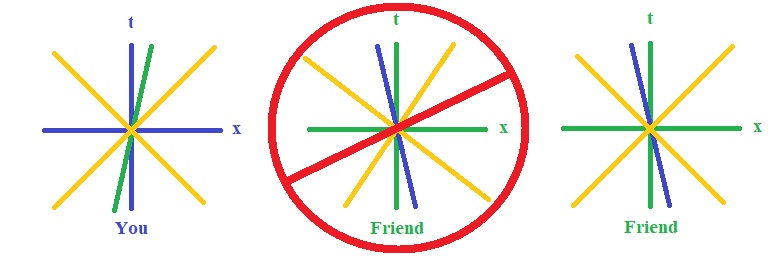
Now you might think, “What’s the big deal? Just speed up until you catch up to light, and then you’ll be going faster than it.” Well here’s where the craziness comes in. You see, light always travels at 45-degree angles on the space-time diagram in every reference frame, no matter how fast you or any other person or object is moving. If you are standing still on the Earth, and your friend takes a bullet train past you at 1000 miles per hour, the speed of light for you is the same in all directions as the speed of light for your friend: c. Your friend does not calculate light in front of them traveling any slower than the light behind them. They calculate both light beams traveling at the same speed, c.

The light cone must always be at 45 degrees, not skewed as it is in the middle diagram.
What does this mean? Well the math is complicated, but in order to get light to travel at c in all reference frames, space and time get messed up. In your reference frame, the time axis points straight forward in time, not any direction in space. Your friend’s time axis points in the direction through space-time as if they are not moving. On our graph, this means your time axis points straight up, but your friend’s time axis points along the path they are going to take though space-time at their current speed. Because the speed of light stays constant, this needs to be counterbalanced by your friend’s space axis changing too. In the transformation between your reference frame and your friend’s reference frame, space and time get rotated toward each other, and vise versa.


This is why nothing can go faster than the speed of light. No matter how much you speed up, light will always be traveling at c ahead of you, and you can never catch up to it no matter how much you accelerate. In the reference frame of someone standing still and watching you, you go closer and closer to the speed of light, but never reach it. This causes your time to slow down, your mass to increase, and your shape to flatten. You of course don’t notice any of this stuff, because it’s not happening in your reference frame.

Make a note of the fact that time passes slower for someone traveling close to the speed of light. This is going to be important later on.

If we look carefully at the way the axes change when we transform between coordinate systems, we’ll see that this means a universal “now” doesn’t exist! To show this, let’s take the x-axis, which is the slice of space-time where t=0, and what we think of as “now” across the universe. But your friend’s x-axis point in a different direction through space-time, meaning their “now” slice is different from yours! Mind blown, right? To drive the point home, let’s suppose there is a firecracker set to go off at a certain time 1000 miles away. According to your “now” slice, the firecracker is about to go off. But according to your friend’s “now” slice, the firecracker has already gone off!


There is no universal “now.” Each point in space-time is its own “now,” both in time and space. “Now” for you is only now for you, everyone and everything else has their own “now.”

There is nothing special about the t-axis in our diagrams. You can move in one direction, and then you can stop and turn around and go the other direction. In the same way, there is nothing special about the x-axis. If something were somehow able to travel faster than light, there would be nothing stopping it from going in a slightly future direction, then turning around and going in a slightly past direction. The fundamental boundaries are the light cones, not the t- or x-axes.


This means, if you were somehow able to make a ship go faster than light, all of the space-time between your future and past light cones would be open to you. This means you could set off going slightly backward in time, then turn around and go slightly backward in time the other direction, and get back to where you started before you began. It doesn’t matter what the method is, if you can travel faster than light, you can go back in time.


If you could go faster than light, all of the space-time outside of your light-cones would be available to you, but you would be locked out of your past light cone, unless you take a roundabout path. However, a past light cone is the same kind of barrier as a future light cone, so if you have the technology to cross the future light cone, that same technology can probably let you cross the past light cone, and you won’t have to go faster than light to time-travel; you’ll be able to do it while staying in the same place.


Warp drive, hyperspace, whatever your method is, the math doesn’t lie; according to Special Relativity, if you can travel faster than light, you can also go backward in time. But what about taking shortcuts? What if you don’t have to travel the vast distance between stars, but can get there in a single step? What if we could use a wormhole?

A wormhole is a theoretical object that comes out of Einstein’s other theory, General Relativity. Wormholes are interesting enough that we might give them their own discussion, but all we need to know today is that a wormhole is a shortcut between points in space-time. You can think of it like a doorway, but instead of leading to another room, it leads to a different planet.

You might think a wormhole is something that picks you up and teleports you away. This is a misconception. As you walk through the wormhole, nothing is happening to you that doesn’t happen when you take a walk down the street. The two ends of the wormhole might be light years apart the normal way, but on a path through the wormhole, they are only separated by a few feet. This isn’t just a metaphor, it’s literally true.

Wormholes, it turns out, also allow for time travel. To demonstrate this, let’s start with a simple setup, a wormhole where the two mouths are five feet away from each other and synchronized in time. If you look through the wormhole, you can see your own back five feet in front of you.

We put one of the wormhole mouths on a spaceship, and fly it around near the speed of light. Remember from earlier, if something is moving near the speed of light, time is slowed down for it. This means time is passing slower for the mouth of the wormhole on the ship than it is for the mouth on Earth—but only on the path through space from Earth to the ship. On the path through the wormhole, time is passing at the same rate on both sides. You could step through, have tea for half an hour with the astronauts, and when you step back, half an hour would have passed on Earth.

Think about this. On a path through space, time is passing slower on the ship than it is on Earth. But on a path through the wormhole, time is passing at the same rate on both sides. What is going on here? It’s a paradox! Two different ways of calculating the same problem give us two different answers. Which is right? Is time flowing at different rates, or isn’t it?

The answer is, both calculations are correct. Time is flowing at different rates on a path outside the wormhole, but it is flowing at the same rate on a path through the wormhole. This means the wormhole is not only connecting two points in space, but also two points in time.

Suppose the astronauts decide to return to Earth. When they land, less time has passed for them than on Earth. Mission control says, “Hey, you’ve finally arrived.” An astronaut says, “What do you mean, ‘finally’?” The astronaut looks through the wormhole, and on the other end, the same mission control member says, “You’ve landed? But we still see you flying around up there!” Outside the wormhole, the mission control member chuckles and says, “I remember having this conversation a week ago.”


By putting one mouth of a wormhole on a spaceship and flying it around near the speed of light, and then landing, the team has created a gateway through time. In our example, the difference between wormhole ends is one week; step through the end that traveled on the ship, and you’ll find yourself a week in the past. Step through the end that stayed home, and you’ll find yourself a week in the future.

What about quantum entanglement? Can’t we send messages instantaneously by measuring one particle and instantly affecting another one light years away? Wouldn’t this achieve faster-than-light communication without time travel? The answer is no, because in order to send information by quantum entanglement, the two parties must compare notes via traditional channels. Also, it’s incorrect to say whose measurement affected whose, because in some reference frames person A measured their particle first, and in other reference frames person B measured their particle first. When measuring entangled particles, there is no causation, only correlation.


In science fiction, we see faster-than-light travel all the time, but time travel usually takes some special magic sauce. This isn’t because of science, but because easy time travel would ruin the plot. Another reminder of the difference between narratives and reality. We may try hard to come up with a loophole that doesn’t allow time travel, but the fact that there is no universal “now,” and all spacelike trajectories are open to a faster-than-light traveler, nails the box shut. I am all for imagination, of course, but when it comes to reality, despite how strange it may be, we should allow ourselves to follow the evidence where it leads.