Friday, July 28, 2017

What is the Darwinian Model?

Toolbelt of Knowledge: Theories
Darwinian Evolution
Game Theory

The word “Darwinian” automatically brings thoughts of Evolution, molecules coming together which turn into fish, which turn into amphibians, which turn into dinosaurs and mammals, which turn into people. But this is only the result of evolutionary theory when applied to life within the context of the scientific puzzle. The theory itself is based on a mathematical model about self-replicating information. As with all science, understanding the model is key to understanding the theory.


Let us start off by putting life and all that baggage aside, and stripping the model down to its basic abstract concepts. We start off with two elements: a population of self-replicating objects, and an environment in which they exist and do their stuff. The objects are completely based on information that they hold within themselves. This information determines how they look, the way they work internally, and how they react to the environment.

If the objects all replicate themselves exactly, nothing interesting happens. But let's look at what happens when we throw in some variation. Perhaps when they replicate they take pieces of their information and splice it together with another of their kind's information, making something new. Variation causes each generation to be different from what came before, and each individual to be unique.

Now we have a bunch of objects, all that look and behave slightly differently from each other. What is going to happen? Well, depending on the environment, some of the objects are going to survive and replicate better than others. The environmental factors that affect this are called selection pressures. As a result, the looks and behaviors that are detrimental to replication in the environment are going to become scarce, perhaps until they are erased, and the looks and behaviors that make it easier to replicate are going to spread over the whole population. This process is called natural selection.


If natural selection were the whole story, the population would lose information over time, and eventually degenerate to the point where it has only the most basic skeleton of what it needs to survive within its environment. When this happens, there can be no more variation, and every object in the population will be exactly the same. But if we add randomness to the variation, either from copying errors or changes in the information before replication, the system flourishes anew. Random variations in the information of replicating objects are called mutations.
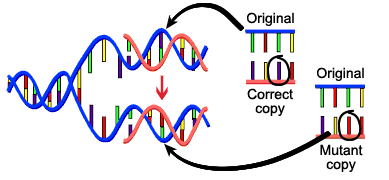

Once a mutation enters the information pool, it behaves according to natural selection, just like any other piece of information. If it is beneficial to replication, it spreads into the population. If not, it disappears. There is nothing special about a mutation after it has occurred; it is just another piece of information at that point. Mutations keep the pool of information fresh with options, so that the population can continue to adapt better to the environment, or readapt if the environment changes.

The union of these two concepts, natural selection and mutation, is Darwinian Evolution. A population of self-replicating, information-based objects, reproducing their information with small random variations, in an environment that causes some traits to be better at replicating than others, leading to information diversity and increasing complexity. There are many parameters that can be tweaked, including changing or adding environments, the methods of replication, the rate and severity of mutations, and many others.

So that is the theory. Does it work? Well, it is an algorithm, which means it is not too hard to test if you know how to program. You can create a bunch of self-replicating virtual objects and a virtual environment to put selection pressures on them, and run it and see what happens. Experiments like this show that the Darwinian model works exactly as predicted.

Okay, Darwinian Evolution works. Does this model apply to life? To find out, we have to ask whether life has all the required features to fit the model. Can life be understood as populations of information-based, self-replicating objects? Yes. The replication, we call reproduction. The information is in life’s DNA, a collection of molecules in every living cell. The information in DNA is in the form of nucleotides (C, G, A, or T), which make up the ladder rungs in the picture we are all familiar with. A single strand of DNA has enough information to fill entire libraries. Does DNA mutate? Yes. DNA mutations can be caused by all kinds of things, and can be as minor as a single different nucleotide, as major as tearing the DNA apart, or anything in between. Does life exist in one or more environments that exert pressure on it and lead to natural selection? Of course. Darwinian Evolution does indeed apply to life, and mountains of evidence from fossil studies to DNA studies to adaptation studies to lab experiments on microbes confirm it.


Darwinian Evolution of life is the theoretical foundation of biology and psychology, the cornerstone upon which everything in the disciplines is built and without which nothing would make sense. But the same model also applies to all kinds of systems, including ideas, cultural values, popular trends, businesses, and computer programs. Even if you never study biology, the Darwinian model is a powerful tool of understanding, and well worth the time and effort to learn.

Friday, July 21, 2017

Moral Theory II: Trust and Obey

Moral Theory:
I. Intuitionism
II. Authoritarianism
III. Divine Command and Attributes
IV. Ethical Egoism
V.  Utilitarianism
VI. Virtue and the Golden Rule

Negative Morality:
Divine Hierarchy

Last time we looked at how the default starting point for moral principles is the conscience, and how, although there is overlap, each person’s conscience is unique. This time, we are going to look at another default starting point, deference to authority. Many times the first thing someone does when they see the failures of the individual conscience is to look for someone wise, with better moral intuition than their own, to instruct them in how to live. There is a responsibility that comes with freedom, responsibility of thought. One has to think for oneself and find the answers through reason. This can, understandably, be frightening, which can drive many to give up their freedom and follow someone else's dictates. This view of morality is called authoritarianism.


Authoritarianism can also be imposed upon people in childhood by an environment of strict rules. These rules might be imposed by parents, a church, or an extortionist corporation or government agency, or more subtly as pressure to conform to the norms of the community. In this way, instead of coming to authoritarianism from a place of intuitionism, a person starts directly at authoritarianism.

Giving yourself completely to an authority can paradoxically feel tremendously freeing. After all, you do not have to go through the trouble and uncertainty that comes from making your own decisions. Working for a cause bigger than yourself, especially if you make a leap of faith because you do not fully understand it, can give you a great drive and sense of purpose. Authoritarianism can be tempting to those who see it from without, and intoxicating to those participating from within.

But authoritarianism has a dark side, and it is deep and filthy. Despite the fact that authorities come in all flavors, the most ardent followers of any of them will believe that they have discovered the one moral truth, and that their rules of right and wrong are absolute, for them, for you, and for everyone over all time. We find among those enthralled with this mentality followers of the worst of causes, from Nazis to Stalinists to Crusaders and Jihadists. Having given their moral judgment wholly to their dear leaders, those people, who may have begun with healthy consciences, participated in the worst of evils.


Of course, authoritarians are only as good or bad as the leaders they follow. Authoritarianism fails to answer the bigger question of morality's objective source, merely deferring it to someone who is assumed to have greater mental ability and better tuned intuitions. When questioned why they hold their moral principles, an authoritarian might say, “I cannot explain it, but I know it is true.” To me, this is a sign of hollow beliefs, devoid of any rational foundation.

Sometimes, those who begin authoritarian come to see the problems with it, and convert to intuitionists, just like those who see intuitionism's problems may try to compensate by giving themselves to authority. However, as we will see soon, there are other options. In the next entry of the Moral Theory series, we will explore one particular case of authoritarianism that attempts to get around its problems, and after that, we will begin to look at basic principles and try to construct an objective moral theory from the ground up, which will rely neither on authority nor intuition.

Friday, July 14, 2017

When Will There be Another Einstein?


A hundred years ago, everything we thought we knew about space and time was turned upside down. Albert Einstein proposed the Special and General theories of Relativity, which described how space and time rotate when something moves close to the speed of light, and how spacetime gets bent and warped by gravity. He also contributed plenty to all kinds of sub-disciplines of physics. Einstein is the iconic genius, instantly recognizable in photographs by his wild cloud of wispy white hair. For someone who made such a visible mark on scientific history, it is natural for us to wonder when someone else like him will come around.

But we have to recognize that extreme intelligence does not automatically lead to paradigm-changing theories. Einstein was in the right place at the right time; all the pieces of the puzzle were in place, and the world of physics was ready to hear what he had to say. After his theories hit the journals, the specific problems he had been worked on were solved. Difficult as it is to turn the world upside down, it is much harder to turn the world upside down again. There simply was not enough information to solve the problems that were left, and the technology to run the necessary experiments was not ready.

So when we ask when the next Einstein will appear, we may just have to look a little harder to find them. Plenty of progress has been made in modern physics since Einstein’s time, some of which has had a comparable level of impact on the theoretical frontier as Einstein’s work. Here are some of the people I know of who might qualify as the next Einstein, some of whom are still alive today.

Leonard Susskind


While pondering the connection between the electromagnetic force and the nuclear forces, Susskind discovered the equations he was working with described the vibrations of strings. These strings, if real, are as small compared to a proton as protons are compared to human beings. He found that this “String Theory” not only explained the electromagnetic force and nuclear forces, but gravity as well. It is a true Theory of Everything. String Theory has never been tested, but it has become incredibly popular among theoretical physicists.
Susskind also had a series of arguments and public debates against Stephen Hawking about what happens when matter falls into a black hole—and he won. He has also made other contributions to theoretical physics.

John von Neumann (NOY-man)


A true polymath. Von Neumann’s name pops up all over the place in physics, mathematics, computer science, and statistics. Among science fiction fans, he is best known for the von Neumann probe, a theoretical model for a robot that can create copies of itself from raw resources. They are often depicted as scourges of the galaxy, but could also be used for peaceful and safe exploration. Von Neumann’s contributions to science have played a significant role in making it the monolith it is in the 21st century.

Stephen Hawking


A theoretical astrophysicist who made a name for himself by his groundbreaking work on black holes, and doing it with a terrible handicap: he cannot move! He has been wheelchair-ridden for most of his life by ALS. He cannot hold a pen or chalk, nor type on a keyboard. He interfaces with his computer by twitching his cheek, and by doing this he writes mathematically intensive papers, books for a general audience, and he participates in high-level intellectual conversations regarding the future of earth, humanity, and technology. Hawking is a living testament to the power of technology and perseverance in the face of extreme challenge.

And these are only a few. Einstein himself was not the only genius of his own time. There were a group of people who pioneered modern physics, and there has been a strong community ever since. Both in science and outside of academia as well, many men and women with Einstein-level intelligence live and have lived. The theoretical frontier keeps moving, poetry gets written, songs get composed, and new and better ways of doing everyday things get discovered. When will there be another Einstein? We have never been without Einsteins. The next great paradigm shift of physics will happen when enough data has been collected, all the puzzle pieces are in place, and the scientific community is ready.

Friday, July 7, 2017

Moral Theory I: Intuition and the Conscience

Moral Theory:
I. Intuitionism
II. Authoritarianism
III. Divine Command and Attributes
IV. Ethical Egoism
V.  Utilitarianism
VI. Virtue and the Golden Rule

Negative Morality:
Divine Hierarchy

Up until now, I have written about looking at things from different perspectives and trying to figure out descriptions of what they are and what they do. We humans are curious, always trying to understand the world and predict future possibilities from our understanding. Yet there is another dimension I have barely touched on, the idea of should. We prefer some actions and outcomes to others. We believe there are a collection of ways of life that all people should follow, and we call the actions that are in accordance with these ways of life, as well as their consequences and things that encourage these actions, good. And the entire system, we call morality.


As the atom opens the world of physics to chemistry, biology, neuroscience, and beyond, so a study of morality opens wide the space for discussions about humanity, politics, religion, and philosophy. To really get to the meat of these topics, we first need a solid intellectual grounding in the many colors and facets of morality. That is why I am starting this series, which will take us through the landscape of ideas and establish my own views so that you may understand where I am coming from.

In my second year of college, my class had a discussion. I don’t remember what it was about, but I remember raising my hand and saying something that I believed was so obvious that it did not need to be said, “what is wrong is wrong.” Everyone turned to look at me with strange expressions, and the professor said, “that is a bold statement. Can you back it up?” I was taken aback. I had believed it was logically trivial, the law of identity, that a thing is itself. The possibility that anyone could disagree had not even entered my mind.

So what did I miss? Well, I had a subconscious assumption that right and wrong are basic elements of reality, that actions are simply right or wrong, and that is the end of the story. I did not realize that there was more, that nuance, context, and circumstance change the game.

This was an example of the most common and naive theory of morality, Intuitionism. It is naive because it is what people follow before the philosophical question of morality enters their awareness. Intuitionism is the idea that morality is common sense. Everybody knows it, and simply has to pay attention to their conscience to live a good life and get along with others.

At first glance, there seem to be moral truths that are commonly accepted and understood the world over, like murder. But if you look closer, you will find that we have different ideas on what murder is. Does it count if it is self-defense, military action, abortion, honor killing, suicide, or capital punishment? It seems we don’t agree on the morality of killing after all, but only the semantic statement that the word for “killing that is wrong” should be “murder.”

Ask a random person if some action is right or wrong. For example, drinking alcohol. Some people will say it is good, and some people will say it is bad. But if you ask them why, you may find something intriguing: that they will either fumble around for an explanation they have never bothered to search for before, look at you as if you are stupid for not knowing, or even suspect that you are trying to corrupt vulnerable minds just by asking the question. Few will have made the effort to come to their view by starting from deeper principles.

The fact is, if we look at the way people act and the things they believe, we will see that everyone has different intuitions regarding morality. Should government support go to those who have gambled their lives away? Do men and women have specific roles to play in the household, or should people be free from gender-based constraints? Different people’s consciences tell them different things. Intuitionism as a moral theory leads directly to Relativism, the idea that morality has no objective basis, but depends only on the feelings of the person making a decision.


In light of this, we might be tempted to look down on Intuitionism. But in the heat of the moment when we don’t have time to weigh all the consequences in accordance with rational principles, we are all Intuitionists. If we want to be principled, then we must examine morality from a philosophical perspective in the times when our heads are clear, in order to train our intuition for the moments of decision. To find such a moral theory, we need to ground it in something outside of ourselves, which does not change and is universal to all of humanity. This is what the rest of this series is going to be about.

Friday, June 30, 2017

Reality and Its Images

The Nature of Reality:
Quasi-Realism
Representational Realism
Existence and Natures
Knowledge of Reality
The Language of Reality

A few hundred years ago, a philosopher named René Descartes had a revelation. He realized that he believed many things about the way the world was, but had never thought about why. When he examined his knowledge, he found a complex web of hierarchies and feedback loops, with no clear foundation. So he decided to doubt as many things as possible, to search for the immutable foundation on which true knowledge could be built. What he discovered was revolutionary: his beliefs, his perceptions, and even his very senses might be manipulated, and for all he knew, the very world he lived in could be an illusion.

We live in a world of sight, sound, touch, taste, smell, up and down, hot and cold. These, and more, are our senses, and they work together to paint a picture of a world we accept as real. We see our hand in front of our eyes. We can reach forward and touch the desk, feeling its smooth yet grippy texture. We can walk out the door and see the sky, feel the breeze, smell the summer air. It feels so real. So present. So true.

As I walked along the sidewalk on my way home from the university one day, I was struck by the sight of a tree. It was not unusual, just one of the average variety you can find all over the Midwestern United States. It had a long, thick trunk, branches that spread out like a shelter from the sky, and a shaggy head of leaves. I reached out and touched it, feeling the roughness of the bark, and was hit full force by the fact that this tree as I saw and felt it was a creation in my mind, an image built from nerve signals feeding into my brain. Yet the tree itself has its own existence, independent from and different from the way I perceive it to be.

We unconsciously assume that the world as we see it is reality, but in fact it is not. What we perceive is our mind's picture of reality, constructed from the data our senses bring to it. To illustrate, let's talk about what it means to see something. First, light falls on the object, bouncing off it. Some of that light goes into our eyes, where it is focused onto the retinas in the backs of our eyeballs. The rod and cone cells in our retinas translate the light into electrical signals, which travel up our optic nerves into our brain. Finally, the visual cortex in our brain processes the electrical signals into the colors and shapes that we experience. From object to light to electrical signal to picture, the object and the image that we mistake for the object are four steps removed.

In order for us to perceive something, there must be a representation of it constructed in our mind. This representation is not the thing itself; it is always at least one step removed. The stunning consequence of this is that reality-in-itself cannot be known. It is logically impossible. The only exception to this is experience itself. When we see a flash of light, we can know with absolute certainty that we are seeing a flash of light, but whether it came from a real lightning bolt or the illusion of a lightning bolt is open to question. This is the metaphysical theory of representational realism.

So what is real? If we cannot experience reality-in-itself, if everything including the ideas constructed in your brain about what is written on this page are mere representations, is it possible to know anything? Can truth exist? I would say yes. Even though we can never know anything directly, that does not mean we cannot know it at all. The truth of our picture of reality is proportional to how well we can draw lines between the pieces of our picture and reality. Of course, because we cannot perceive reality directly, neither can we be absolutely sure the connecting lines between our picture and reality actually work. But it does not matter if we know it works, only if it does work. This leaves us with uncertainty, but it can be made small enough that we can justify being pragmatic about it and assuming we know what is true.

Representational realism implies something that we may never have thought of before: any organization of information, be it neural impulses, computer bits, written symbols, frozen magnetic fields, or anything else, as long as it has a systematic correlation with reality, is equally true. This idea of different but equally true ways to represent reality can show us new ways to connect with others. I never feel like I truly understand any idea or concept until I can see it as a picture in my mind's eye. One of the physics professors at my university sees the world entirely in equations. Some of the students I teach think in terms of words. Finding ways to translate between these views lends to richer, more comfortable communication with people, and I even find it to be fun.

Friday, June 23, 2017

The Limit of Philosophy


Philosophy is one of the greatest strengths of humankind. It has given rise to science, ethics, political systems, and cultures. All it really is, is thinking about things and trying to figure them out. For example, if you ask, “what is a house?” you may think of a picture of a building with a door and a window, a roof, and interior walls that separate a living room from a kitchen from a bedroom from a bathroom, and consider the question answered. But philosophy recognizes that this is only part of the answer. Such an organization of matter alone does not make something a house. First, someone must imbue it with a purpose, specifically as a place to spend time in, to form a familiarity with, to store other bits of matter that we call our property in, and more.

But we can’t stop there. Philosophy digs deeper. What is familiarity? What is property? We can try to answer these, but for any answer you can ask a “but what if” question, casting the answer into doubt. Here you might start to get concerned about a problem. Since the answer must be given as another statement, you can ask another “but what if” question about the answer. And another one about the next answer, and so on. It is like when a toddler asks “why” over and over and over again.

Let's take a common sense statement: “reality exists independently of our perceptions.” We can ask, “but what if it’s reality just a projection of our minds?” In response, we can say “okay, we can't know it absolutely, but we can determine from the patterns in which our experiences fit together that the likelihood of an external reality not existing is infinitesimally small.” But we can ask, “but what if this perception of order is an illusion? Our minds might be fooled into thinking random, unrelated sensations are connected.” We can reply, “We can submit our senses and memory to the laws of logic to see that it is so.” And still we can ask, “but what the very laws of logic are one of the things our minds confuse us about, and logic does not actually exist?”


Even “I think, therefore I am” is open to “but what if your mind is only fooling you into believing existence is necessary for experience?” As far as I can tell, the only statement that begs no “but what if” question is “I experience,” because experience itself is the only thing we experience directly. Of course, “but what if you’re wrong” is a catch-all, but it is not useful because it does not present an alternative possibility.

If you are like me, these questions, like the “why” game, sound silly and annoying. Sure I can’t prove it, but like, I know I exist. And we have to assume the universe exists, and a lot of other things, if our lives are going to function. Accepting assumptions for their usefulness like this is called pragmatism. We should always be questioning things and exploring possibilities, but in order to function, we have to do things. The Ancient Greek father of western philosophy Socrates once said, “One thing only I know, and that is that I know nothing.” We would be wise to adopt a similar view ourselves, understanding that everything we know is pragmatic, based on assumptions. We should keep in mind that everything, even the most common sense of facts, even the very methods we use to determine what is true, might actually be wrong. I do not mean that we should throw our hands up and abandon everything, only that we should listen to people with alternative views, and be open to well-reasoned arguments.

Friday, June 16, 2017

The Delight of Waiting

It’s that time of the year again. The world's big video game companies have just gotten together at the Electronic Entertainment Expo, E3, to announce new games and release dates. It is a time of excitement, and the internet is full of hype, talking about all the trailers and teasers. But there is a bittersweet side to all this: we will have to wait for months before we can get our hands on those shiny games. In this era of instant gratification, when we have an unfathomable reservoir of entertainment to amuse ourselves with, it can be frustrating to have something withheld from us.


Sometimes what we want is not available. Perhaps we cannot afford it, like a house big enough for a family, or it has not been released yet, like the next generation of video games we just got an avalanche of trailers for, or you have not been able to find it, like the intimate connection of a romantic relationship. It may seem like the things we desire most are always those which are out of reach. This is not just confirmation bias; the grass on the other side of the river always looks greener. When something catches our eye and it is available right now, we can just order it up with a few clicks, and within a couple of days it is ours. We enjoy it for a little while, and then lose interest, finding ourselves back where we were before, wanting something new again.

Does this mean that we are stuck with an absurd hand of cards, plagued with desires that burn white hot within us but can never be sated? Before we despair, let's try looking at things from another perspective. What if it is not things that we truly crave, but the well-earned payoff of a struggle? We find that the more we have wait, look forward to, or work hard for something, the sweeter it is when it finally comes to us. Waiting a year or two after seeing the trailer for a movie or video game lets it stew and simmer, the aroma readying our appetite for the moment it is ready.

So when the antsy feeling of anticipation comes, we should not look for ways to distract ourselves from it, but embrace it as an essential part of the greater experience of our desire. The longing, looking forward, imagining what it will be like, is the heat of the cooking fire that makes it fulfilling. Once we adopt this view, we may even find that things which are available now might be better if we wait for another time. The new episode of your favorite show can wait until some evening when you are tired and in the mood to sit back and enjoy something. As for now, I am going to patiently wait for the games we saw at E3, soak in the anticipation so that I am ready to fully enjoy each game when it is released, and in the meantime be happy and work on projects that will pay off in the future.