Friday, January 15, 2016

Star Wars Main Event: The Force Awakens

This discussion, of course, contains spoilers. It is highly recommended to have seen the movie before reading further.


At long last, the moment we have been waiting for all this time is here! Star Wars Episode VII: The Force Awakens has hit the theaters, blowing the minds of generations. There are many reasons for its dramatic success: the on-location shooting, the return of the great characters from the original saga, the role the Force played, and that the stormtroopers were shown to be people, not just faceless cannon fodder. It’s hard to nail down any one thing that made the movie great, but to me the feature that outshone all the others was the new characters.

As always, John Williams has come up with some amazing new music. The most notable debut this time is “Rey’s Theme.”

There's also this guy, who became a fan favorite just by existing. He's
kind of like Boba Fett in that regard.                                                           
The first time I saw the movie, I made a huge mistake. I watched it with the intent to critique the director by the standard of the original trilogy, not to experience the continuation of the story of a fantasy world. Because of this I came away disappointed—angry, even—with the large list of things that I would have done differently if I had been in charge. But I recognized this mistake immediately after the screening finished, and two days later when I saw it again and watched it properly, I was utterly swept up in it and all my dark side feelings toward the film melted away.

The new hero, Rey, is awesome. When she is introduced, she has been living secluded from the goings-on of the galaxy, making everything feel new, like it did as we followed Luke in A New Hope. But even though war forces itself upon her she is able to keep her head on her shoulders and come up with a plan of action. Rey seems to be fascinated with the Force, but also to have a strange aversion to it, which can be seen in her encounter with the Skywalker family lightsaber. Both sides of this coin are shown as Rey climbs the stone steps to Luke, where she is clearly afraid of whatever is about to come, but at the same time is driven forward by the need to know and experience it.

The new villain, Kylo Ren, is also awesome. Far from the hardened, controlled instruments of destruction that we saw in the Sith, Ren struggles to keep some some grasp on his emotions, often losing control of them completely. He feels the Light Side pulling on him, which calls into question the Jedi view that the Dark Side is a black hole that swallows and devours anyone who steps too close, a view which all of the previous films have implicitly taught us to believe. Most importantly, though, Kylo Ren doesn’t follow the Dark Side out of a desire for power or revenge, but because he believes it is right. His struggle comes fully to the surface in the fateful scene where he must decide, and act on that decision, to kill his own father, Han Solo.

They all have to have a black cloak, distorted voice, and red lightsaber.
No, I wasn't complaining, I enthusiastically agree!                                     
The Force Awakens is a promising beginning to a new era of Star Wars. Whatever the future will bring, I have no doubts that it will be great. From the revelation that when Luke went missing, he was searching for the first Jedi temple, I suspect the next two episodes will involve the origins of the Jedi and Sith. I don’t know how similar the new history will be to the Legends timeline, but I hope to hear “Duel of the Fates” in episode 8 or 9, perhaps revolving around some unknown embodiment of the Dark Side in some forgotten region of the galaxy. But right now, I am delighted to have been given such a satisfying, adventurous return to the Galaxy Far, Far Away.

Star Wars Countdown:
The Force Awakens

Friday, January 1, 2016

Length of a Written Work

Sometimes, when you sit down to write something, you worry about how long it should be. You wonder what length you should have in your head as a goal. But is this really a significant question? Whether you’re writing a novel, an academic thesis, or a blog post, the rules or recommendations for your word count are really just a guide for how specific and detailed you should be. In the end, what matters is that you achieve your goal with enough detail, but no extra fluff. The best length for anything you write is as long as it needs to be for you to properly express what you are trying to say.

Friday, December 11, 2015

Star Wars Countdown VI: Return of the Jedi

This is it, the final installment of the Star Wars Countdown before the continuation. After watching it this time again, I can still say that it is my favorite Star Wars movie. In fact, it was my favorite movie of all until Avengers 2 came around. With Return of the Jedi, this classic film trilogy closes with a timeless grand finale.

When 900 years old you reach, look this good, you will not.

Notable John Williams music debut: "The Emperor’s Theme"

When Return of the Jedi opens with a view of a second death star, one might at first be concerned that it is going to be a copy of Episode IV. However, it quickly asserts its individuality when it picks up both event-wise and character-wise where the film before it left off. Between rescuing Han Solo from Jabba the Hutt, Luke struggling to come to grips with his heritage, and the emperor’s master plan to turn Luke to the dark side and crush the rebellion once and for all, Jedi takes the story to a whole new level.

For the first and only time in Star Wars, we see a full-scale battle play out beginning to end, strategy included. The rebel fleet attempts to take the second death star by surprise, while a team secretly lands on the moon it’s in orbit around to shut off the shield generator. But the emperor has foreseen this, through the dark side of the force. Unfortunately for the rebels . . .


Speaking of this battle, I have an emotional connection to the forest moon of Endor. It seems like a very simple, peaceful place (usually), and reminds me of the wooded countryside where I grew up. Endor also has the charming and mysterious ewoks, who live their village up in the branches of the trees. Some people find them annoying, but I don’t see why.


But the true reason I love Return of the Jedi is the final confrontation between Luke, Vader, and the emperor. After Luke has gone through the inner struggles, trials, and temptations of the dark side, he must muster not only his courage, but his resolve and belief in who he is, and not fall to the pull of the swift undertow of the dark side. Not only does he have to face his fallen father, but also the man who twisted Luke’s father around his finger, the one responsible for all of the trouble in the galaxy. But if Luke were to strike him out of anger, Luke would become the very thing both he and the entire galaxy fear and hate.

Return of the Jedi is a dramatic conclusion for an epic series, and if Star Wars had stopped there, I would have been satisfied. But now Episode VII is only a few days away, and I am absolutely ready for more!

Star Wars Countdown:
Return of the Jedi

Friday, November 27, 2015

Star Wars Countdown V: The Empire Strikes Back

Like its predecessor, A New Hope, Star Wars V brought many new icons to the sci-fi hall of fame. From snowspeeders to giant walking armored tanks to the little green man with super powers, The Empire Strikes back successfully captured the magic of the first film and more.


Notable John Williams music debut: "The Imperial March" (this track may be more iconic to the franchise than the main theme)

Since we’ve already done a Countdown entry on sci-fi icons, let’s focus this time on something unique to Empire: how good its story is.

For the entire movie, Han, Leia, Chewbacca, and C-3PO are on the run from the Empire, starting at the ice planet Hoth, taking them through a swarm of asteroids, to Cloud City on the gas giant Bespin. Darth Vader himself devotes an astonishing number of resources to catch one rickety YT-1300.

Meanwhile, Luke had left the rebel fleet after escaping Hoth to pursue his own personal path, which led him to Dagobah, where he meets Yoda, the ancient Jedi guru. As Luke’s Force-sensitivity increases, he sees a vision of his friends in trouble, and rushes to help, even though his training is not complete. But this was Darth Vader’s plan all along.

And then this happens.

That is more or less the crux of the story. The rest is pretty much Luke recovering from the shock of that moment. But there’s no question that the story was pulled of exceptionally well.

We get to see how bad Vader is, and it’s not just because he’s in a scary suit. He changes the terms of his deal with Cloud City after Lando fulfills his end of the bargain, and he kills his commanders for not catching one enemy ship.

Darth Vader must run through admirals like Edward Elric runs through prosthetic arms.

Oh, and there’s also this guy, who became an instant fan-favorite:


The Empire Strikes Back is many a fan’s favorite, though for me it takes second place to the final chapter of the original trilogy, which we’ll tackle next time.

Star Wars Countdown:
The Empire Strikes Back

Friday, October 9, 2015

The Poet's Gift


We are a people of symbols. We are wired to recognize patterns and make associations. It is the cornerstone of human learning. From our earliest days, before we can even crawl on our hands and knees, we make connections between the light patterns, air vibrations, and other things that our senses deliver to us. As we grow, the picture these things paint in our minds is edited, with details being filled in and sections being painted over or cut out to form a more coherent whole.

Our symbol-recognizing nature has one effect that is particularly interesting to storytelling: it makes possible the use of metaphor. Through symbolism, we associate all kinds of things: sounds, colors, ideas, emotions, and more. Many of the things we associate seem to have nothing to do with each other, yet somehow most people make the same symbolic connections. This gives us the groundwork to write unimaginably rich stories, immersing the readers in a precisely crafted experience through all of their senses.

We use symbolism to teach each other
different ways of thinking and feeling about the world.
        The Garden of Eden with the Fall of Man
        –Jan Brueghel the Elder and Pieter Paul Rubens

Consider the following two statements:

By feeling and understanding these connections, we can smith our words into sights, smells, and emotions to bring to our readers.

By feeling and understanding these connections, we can forge our words into sights, smells, and emotions to bring to our readers.

Interchanging “smith” and “forge” makes the two sentences feel different. The first speaks of the sounds of metal clanging against metal, of making words into tools to do things. If done well, the result is something to take pride in. The second sentence speaks of heat and creation, letting the words fall together to become a fine work, perhaps with some special value. If done well, the result is something to be deeply satisfied with. It is a subtle difference, but a difference nonetheless, and such a choice of symbols can be the defining feature of a chapter, an act, or an entire story.

Symbolism is the soul of art. It is how the artist can touch our thoughts, whispering things into our subconscious minds. This gift of the poet is the key to the barrier between writer and reader, letting them commune at a level we may have thought impossible with mere words.

Friday, October 2, 2015

Star Wars Countdown IV: A New Hope

Not long ago in this very galaxy . . .

(Opening Fanfare)

It is a time of shaky peace on the planet Earth. Several deluded terrorist groups have attempted to sow fear among the first world citizens, with some success. In addition, the looming global threat of climate change threatens to drive thousands of species to extinction and make life miserable for human beings several generations down the line.

In the interest of securing a bright future for the planet, the Alliance of United Nations prepares for its 70th General Assembly, where the representatives of its countries will try to find peaceful and responsible solutions.

Meanwhile, in a small apartment near a Midwestern university, a young blogger excitedly anticipates the upcoming new Star Wars movie. In celebration of this film, he has decided to watch one of the previous movies and write a brief discussion of it each month leading up to the grand release of Episode VII. Now, he has come to Episode IV: A New Hope, where it all began....

Notable John Williams music debut (besides the opening fanfare): “Binary Sunset

This is the one that started the grand fantasy. When the boy in the desert followed the old hermit on an adventure to the stars, the hearts of millions were captured around the world in a storm that has lasted for generations. It landed science fiction a solid foothold in film, and lit the first spark of science fiction’s passion in my soul. Star Wars brought forth many iconic staples of nerd culture that have only grown stronger with the time that has passed.


Right from the get-go we were treated with the lovable droid duo C-3PO and R2-D2. 3PO’s insisting on proper behavior, based on his protocol programming, clashes brilliantly with R2’s mechanical “get the job done” directive.


Not five minutes later, a half-man, half-machine walks onto the scene in a black life support suit, with a mask that speaks of a life devoted to power and intimidation. He is Darth Vader, the trans-universal symbol of evil.

That's no moon.    
It's a space station.

The terror of the Empire, the death star was the ultimate weapon. Powerful enough to destroy planets, it was the perfect tool of fear to keep anyone who might question the supreme dominance of the Empire in line.

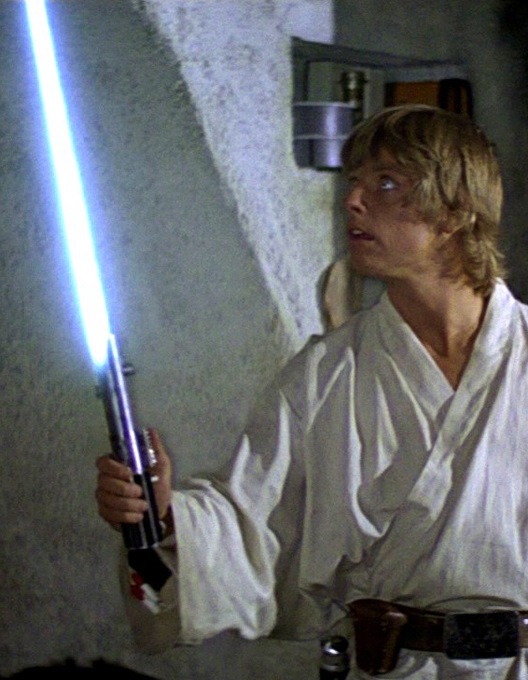
Next up, we’re given the lightsaber, the weapon of the Jedi Knights. Like a sword, but with lasery-like-ness for the blade. Everyone who saw the movie as a kid has dreamed of owning one and dueling some grim-masked bad guy.

And there is the Force itself. Though confined in this movie to the idea of a mystical energy, the Force may be the number one memorable aspect of all of Star Wars. A source of energy and power, with a light side and a dark side, the Force guides events in the galaxy and can be used to obtain superhuman powers.


Of memorable and iconic things in Star Wars Episode IV, many more, there are. If I were to write about each one this post would far too long. Here are a few more of them in one big Force-saturated montage.


It is hardly imaginable that one single movie could bring up so many things that have so thoroughly permeated the culture. Star Wars Episode IV has spawned not only five other movies with three more on the way, but hundreds of novels, comics, and video games spanning tens of thousands of years in the galaxy’s timeline. Heck, “Jedi” is even an official religious affiliation in real life. It is unfortunate that the Legends—that is, all of the media besides the movies and cartoons—have been de-canonized, but they still remain as a testament to the timeless legacy of A New Hope.

Star Wars Countdown:
A New Hope

Friday, September 18, 2015

Science Fiction Can Make You Smarter

It is no secret that many people find scientific concepts hard to understand. If you say “alternate reality” or “wormhole” or “gravitational time dilation,” they will shake their heads and throw up their hands because those concepts are entirely alien to them. On the other hand, science fiction fans can easily pick up on these ideas because they have seen some kind of representation of them in science fiction.

Take the Stargate SG-1 episode, A Matter of Time, where the stargate connects to a planet falling into a black hole, and the black hole’s gravity comes through the gate to earth. The details of what happens in the episode aren’t physically accurate, but it used the general idea of time dilation such that someone could spend hours outside the base while only a few minutes would pass inside. Now suppose I was explaining to someone who had seen A Matter of Time how our GPS satellites need clocks that run a tiny bit slower than the clocks on earth, because time passes a little bit slower on the surface of the earth than in orbit. The other person can ask, “like in Stargate?” to which I’d reply with a nod and a grin, “like in Stargate.”

Unfortunately, the fiction does not always get it right. In fact, most of the time popular science fiction gets something so utterly, fundamentally wrong that it is obvious that the writers did little to no research, nor did they consult an expert. One of the most common examples of this is using the word “dimension” to mean another universe of some kind. But a dimension is a direction, not a place. We do not live in a dimension, but in four: up-down, left-right, fore-back, and past-future. If we want to get to another universe, we might travel through another dimension or two—just like I travel through the fore-back and left-right dimensions to go between my home and school—but not to another dimension.

The counter to problems like this is to keep in mind that fiction is by definition not real. If one wants to know the actual theories of reality, one must look to science fact. To my great satisfaction, there are many scientifically knowledgeable people who counter sci-fi’s many mistakes by discussing the actual science behind the concepts. These discussions can be found in books like The Physics of Star Trek and Physics of the Impossible, and documentaries like BBC’s The Science of Doctor Who and Stargate SG-1: True Science. There is also a growing unification of geekdom and science on youtube, including channels like SciShow Space and PBS Space Time. These people have recognized that science fiction can be used as a learning gateway for science, and are taking advantage of the fact.

I chose to pursue a career in astrophysics because of science fiction. I have little trouble understanding concepts like relativistic time dilation, the various multiverse hypotheses, quantum tunneling, higher dimensions, and so many more. I believe this is in part due to how much science fiction I have seen and read, and the examples of these and similar concepts described and shown in these stories. There is a common conception that nerds are smart, and I, for one, believe it is no accident.