Showing posts with label physics. Show all posts

Friday, June 5, 2020

Quantum Physics 2: Multi-Particle Waves

Quantum Physics:
Fields, Waves, and Particles
Multi-Particle Waves

Welcome to the second part in our series about quantum physics! If you haven’t read the first part yet, I highly recommend it, as we will build upon the concepts we learned there. This discussion also takes a non-reductionist view, so you may want to take some time to digest last week’s discussion of object metaphysics before reading this one.
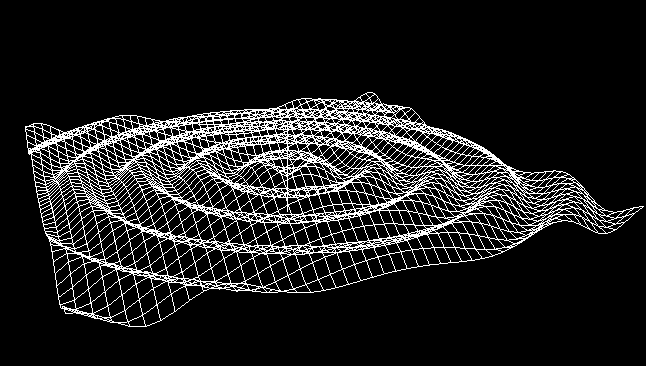
Image found here. Cropped.

To recap, last time we discussed how the universe contains a number of overlapping quantum fields, each one of which is present throughout all space. These fields contain quantities like momentum, energy, and electric charge, which travel around the fields in waves. The fields can trade this information through interactions, and the probability of interaction is correlated with the amplitude of the wave. And finally, there is a smallest possible amount a wave in a quantum field can interact by, and this amount must interact all at once and all in the same place. That “smallest amount of interaction” is what we call a particle.

In this post, when we say “particle,” it is understood that we are talking about collections of information within a wave, not little balls bouncing around.

Quantum Superposition


When the waves of two particles overlap, they add together in superposition. When in superposition, two particles are not two separate waves that happen to be in the same place; they are one wave with two particles’ worth of information.

For example, let’s look at the simplest kind of particle, photons. They are simple because they do not interact with other photons. Imagine two photons on a collision course. Before the intersection, they are flying along as normal. After they have crossed paths, they continue to fly along as if nothing happened.

Remember, photons are waves in the electromagnetic field, and there is only one electromagnetic field. At the moment of intersection, when the two photons are in the same place, their wave amplitudes add together to form a superposition wave that contains the information of the two photons, but is not itself a photon. This information causes the wave to split once again as if they had never joined in the first place.

A superposition wave. The final wave contains the information of the first two, yet it is still a single wave. Image found here. Cropped for better framing.

The key concept here is that when two or more particles are in a superposition wave, they aren’t really two particles, they are one wave with two particles’ worth of information. This is where the reductionist view causes problems, and it is the key point of today’s entire discussion. So if you don’t feel like you understand it well, I would strongly recommend lingering on this section, and perhaps rereading last week’s sections on reductionism, holism, and associative equivalence, until you do.

Bosons and Fermions


There is no limit to the number of photons that can superimpose in the same place, but there is for electrons. Electrons cannot superimpose over one another in the same total state. I do not mean that they repel each other due to their negative electric charges. It’s deeper than that.

In the lingo, a particle’s “state” is the total of its information about its properties: its position, momentum, energy, etc. Two electrons can have the same values in some of these, for instance, position and energy, but there must be at least one property that is different between the two. If you try to plug into the Schrodinger equation a superposition wave that contains two electrons with all of the same properties, in the exact same state, you end up with a contradiction, like 0 = 1. This is called the Pauli exclusion principle because electrons exclude other electrons from being in the same state.

Electrons and photons illustrate two categories all particles fall into. Bosons can exist in the same state in the same place. Fermions cannot. Photons are a type of boson, and electrons are a type of fermion. If this is confusing, don’t worry, it will make more sense after we have looked at some examples.

Lasers


Image found on Wikipedia.

We all know lasers, beams of single-color light packed so tightly that the bright spot where it lands is about the same diameter as the aperture it emerges from. A laser is a very strong coherent electromagnetic wave traveling in the same direction. This can be thought of as a vast number of photons all packed into the same place, superimposing on one another, and giving the wave a very high amplitude.

The higher intensity of the laser, the higher the number of photons superimposing into the wave. Can you guess what the limit is for how many photons can be packed into a single laser beam? Because photons are bosons, they never crowd each other out. Thus, we can keep increasing the power until the concentration of the light is so high that its energy creates a black hole! Don’t worry, though, that would take over a billion times more power than the entire world puts out in a year, all concentrated into one laser beam. That’s a lot of superposition.

Atoms


Each element on the periodic table has a smallest unit, an atom. Atoms are formed when electrons bind to positively charged nuclei. The possible states an electron can have within an atom are quantized; there are only certain specific states allowed, anything else gives a contradiction when put into the Schrodinger equation. If this is confusing to you, I recommend reviewing the pixel analogy from Quantum Physics part 1.

Because electrons are fermions, all electrons in an atom must be in different states. The three things contributing to an electron’s state in an atom are energy, angular momentum, and spin. If you have taken chemistry classes, you have probably heard of the electron states by another name: orbitals. The states with 0 angular momentum are called s orbitals, the states with the smallest non-0 angular momentum are called p orbitals, and then come the d orbitals and the f orbitals. Most of the time, the electrons are in the lowest available energy states.
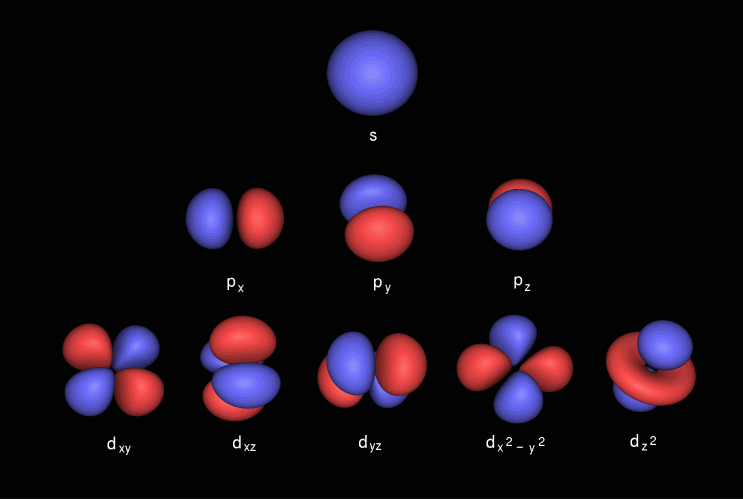
This image shows the wave modes in the electron field. In real atoms, these get added together in a superposition wave containing all the electrons’ worth of information.

Each orbital letter type has specific energy levels allowed to it. The lowest possible energy for an electron in an atom is the 1s orbital, and the second is the 2s orbital. Then come the three 2p orbitals. There are no 1p orbitals, because trying to put them into the math gives us contradictions. There are one of each s orbital, three of each p orbital, five of each d orbital, and seven of each f orbital. And because electrons have two possible spins, there can be two electrons in each orbital.


Electron Spin


We mentioned something mysterious in the previous section: electron spin. What is it? It’s not angular momentum, as that is a different property. Spin is the property which determines how a particle interacts with magnetic fields. The term is confusing, because nothing is actually spinning; the electron is a spread-out wave with no central point for an axis. It is called spin for historical reasons.

In this section, we will talk about magnetic fields as if they are separate objects from one another, because that makes spin much simpler to explain. Keep in mind, however, that it is more true to say there is one magnetic field with different strengths throughout the universe, and that it is a part of the electromagnetic field.


When an electron interacts with a magnetic field, there are two possible outcomes: the electron’s own magnetic field could be aligned with the external magnetic field, or it could be aligned opposite. These are called “spin up” and “spin down.” Other alignments are impossible, because they give mathematical contradictions.

If you pick an axis, you might think an electron has a set spin, up or down, along that axis. However, it does not. Remember how we talked about electron waves, and the probability of interaction being proportional to the wave’s amplitude? The same thing is true for its spin. If the electron has not yet interacted, then it has an amplitude for spin up and an amplitude for spin down. Just like the electron does not have a single definite position before it interacts, it also does not have a definite spin.

Non-Spatial Probability Amplitudes


Let’s not let what I just said slip by. In an electron wave, there is a position component and a spin component. The position has an amplitude, and the spin also has an amplitude. If the electron interacts in such away that its spin is not involved, the position component of its wave collapses, but the spin component does not. This means an electron can move around and interact with other objects, but keep its spin in a non-determined state.

If I am not mistaken, the wave function of a particle has components for all properties that have more than one value, whether it feels intuitive to conceptualize them as waves or not. Polarization of light is the other well-known example. In a particle interaction, only the components of the wave function for the properties involved in the interaction collapse. The rest remain in superposition.

This means that if something interacts with an electron by its electric field, and not by its magnetic field, its wave will collapse to the position of the interaction, but its spin will still be undetermined.


Quantum Entanglement


Now that we have looked at superposition and the fact that each of a quantum wave’s qualities has its own probability amplitude, we are primed for one of the coolest and most famous aspects of quantum physics: entanglement.

Suppose two electrons are in a helium atom. What we have is a single wave with two electrons’-worth of information. Two units of interaction ability, and two opposite spins. Now we remove the wave from the atom and separate it into two, each with one unit of interaction ability; we can comfortably say that electron A is over there and electron B is over here.

However, if we choose our interactions with the electrons such that their spins are not involved, then the spins are still in superposition. As far as the spin is concerned, the two electrons are still part of the same wave. The only spin information this wave has is that there are two spins, and they are opposite. Which electron has which spin has not been determined, and their probability functions have not collapsed!


This phenomenon, when the position components of a multi-particle wave have separated, but the components of one or more of their other properties has not, is quantum entanglement.

What does this mean? What effects does entanglement have on human experiences? When we measure—cause an interaction with—the entangled property of one of the particles, we know what the other one will be when we measure it too. If we measure the spin of electron A, then we know before measuring the spin of electron B that it will be the opposite.

Most people wonder how the measurement of one electron can affect the properties of another electron instantaneously, ignoring the speed of light. Even Einstein was uncomfortable with it, calling it “spooky action at a distance.” But here’s the catch: the measurement of an entangled property does not affect the other particle. There is no causation between quantum entangled properties, only correlation. If we view entanglement in terms of superposition waves, we find it is not spooky, and it is not action at a distance.

We humans feel that if two things are guaranteed to correlate, then there must be some common cause. Either information is being transferred instantaneously from one particle to the other, or there is some kind of unmeasurable information that determined the outcome when the two particles were together. However, this is nothing more than a human assumption. There is a reason why the spins correlate, but not a cause. The reason entangled properties correlate is because if they didn’t, there would be a contradiction in the math. That is sufficient to make it true. Causation is found almost everywhere within reality, but non-contradiction is absolute.

If you aren’t sold on the connection between math and reality, check out the four-point argument I make at the end of last year’s post on the subject.

A common question people ask is whether quantum entanglement can be used for faster-than-light communication. There has been a lot of discussion about this in the literature, but the bottom line is that no, it cannot. We discussed one of the most compelling reasons to me in a previous post about the relationship between faster-than-light travel and time travel, the paradox that there is no objective way to determine whether the message would go from A to B or B to A.


So there you have it. Between this post and the one that came before, quantum physics explained in 4,500 words. If you understand it, then congratulations! You understand the basics of quantum physics as well as the experts, and perhaps even better than some. You also have a little insight into how the world of our experience emerges from it. If you have questions, feel free to ask them in the comments. There are still things we have not talked about, such as quantum computers, which are interesting enough to get their own discussion. Also, if you take what is said in these two posts at face value, it is known as the Copenhagen Interpretation. There is an alternative view called the Many-Worlds interpretation, which I go back and forth on, as you can see in my argument for it and subsequent argument against it.

So yeah. Quantum physics explained from scratch so that non-experts can understand it. Take that, Feynman!

Friday, May 1, 2020

So What Actually Is Quantum Physics?

Quantum Physics:
Fields, Waves, and Particles
Multi-Particle Waves

You may have heard the saying, “No one understands quantum physics.” This is, quite frankly, a lie. When Richard Feynman said the quote, he did not mean no one understood the theory; it is mathematically robust, and makes the most precise predictions out of any theory in science. What Feynman meant is that no one understands its implications on the underlying metaphysical structure of reality, i.e. which interpretation of it is correct. If we are just talking about the physical theory, experts in the field understand quantum physics very well, and I believe you can too. That’s why I’ve started this series explaining quantum physics in a streamlined top-down approach.

What you get out of this series will be up to your expectations. If you go into this with a “can’t understand” mindset, you will not be able to understand it. Failure is a self-fulfilling prophecy. You can understand quantum physics. It may be difficult, and you may not get it on the first read-through, but with enough persistence and perhaps some help from other resources, you can get to the point where you can brag to your friends that you know quantum physics.

Unless you took quantum physics classes, what you know of quantum physics is probably wrong


There are two main things holding people back from understanding quantum physics. First, its reputation for being incomprehensible, which, as I just mentioned, is false. Second, most people’s exposure to quantum physics comes from either science fiction movies or spiritual gurus, both of which use “quantum” as a modern substitute for “magic.” Stories and mystics want to invoke alternative histories, portals to other realms of existence, psychic powers, time travel, and all kinds of uncommon phenomena.

Back in the day, people were more generally open to the existence of the supernatural, and we could get away with calling it magic. If a story had a magic mirror that took curious wanderers to a bizarre world, a reader might entertain the notion that such a mirror might exist somewhere in the reaches of the world untouched by modern society. Nowadays, a magic mirror would be seen as a children’s fancy, not something to be taken seriously in adult fiction. A quantum mirror, on the other hand, crosses the boundary back into the fringes of believability, and it feels like it may be invented someday, or perhaps already has been by some alien civilization out in the universe somewhere.

A timeline-hopping quantum mirror as seen in the Stargate SG-1 episode, “There But for the Grace of God.”

Background Knowledge: Fields and Waves


Before we get to quantum physics, we need to lay a foundation of supporting knowledge, so that the concepts of quantum physics will come more naturally. To start off, let’s look at the concept of a field. In everyday language, a field is a wide open area of land, usually covered by a certain kind of plant or combination of plants. A physical field is similar. It is anything that fills all of space and has some numerical value everywhere.

Temperature, for example, is a field. Pick any spot in the universe, and it has a temperature. Gravity is a field. Pick any spot in the universe, and the total gravity from all masses will have a single direction and strength. The same is true for the electric field. Any spot in the universe has a direction and strength of the electric field from all charged particles added together.

You might have been taught in physics classes that charged objects each create their own electric field, which interacts with other charged particles to cause static electric forces. Similarly, magnets create magnetic fields. However, it is more correct to say there is one electromagnetic field throughout all the universe, and charged particles and magnets create perturbations in this single field. Just like the rest of us, scientists tend to use the language that is most useful for the problem at hand, not necessarily what is most true.

Next, let’s talk about waves in the fields. For an easy example, think about tossing rocks into a lake. From where the rock lands, ripples spread out. The water does not move horizontally, just up and down. Also, aside form the initial splash, the surface doesn’t break.

Physical fields can have waves too. Just like the water’s surface, physical fields don’t “break.” When a point in a field is perturbed, it tugs on all the points around it, and is tugged back in return. This causes a ripple through the field as each point is tugged and tugs on the points after it in turn. Unlike the water’s surface, which is two-dimensional, physical fields fill all three dimensions of space.

What direction is the field pulled in? After all, the surface of a lake is pulled in the third dimension, upward and downward. Fields, on the other hand, are not pulled in any dimension. Rather, they are pulled in the level of their strength. Heat doesn’t have a direction, it has a temperature. A wave of heat is a front of increasing temperature. An electromagnetic wave, also known as light, is a wave of increasing and decreasing electric and magnetic field strength.

Now that we understand fields and waves, we are ready to get quantum.

Definition of Quantum: Limited Allowable Quantities


The word, “quantum,” seems mysterious. But it has a simple meaning: A quantity is quantized if it has a limited number of possible values. A quantum is one of those values. Okay, maybe that doesn’t sound so simple at first glance, but once we start seeing examples it will start to make sense.

One type of quantum is a number of pixels. There is no smaller piece of visual information your screen can produce than a pixel. It cannot display half a pixel, and it cannot display a pixel and a half; the number of pixels it can display is limited to the natural numbers (0, 1, 2, 3, …). Therefore, a natural number of pixels is a quantum of computer graphics display.

Pixels are also a nice example of degeneracy. Degeneracy is when there are multiple possible states for a given quantum level. Again, examples will make this clear. If there are 0 pixels, there is only one state: off. 0 pixels is non-degenerate. For 1 pixel, there is also one state: on. At the 2-pixel level, however, there are two states: one on top of the other, and beside one another. The 2-pixel level has a degeneracy of 2. The 3-pixel level has a degeneracy of 6, as is shown in the diagram below.


Particles: Excitations in Quantum Fields


Now that we have all the background knowledge we need, we can start to learn quantum physics. Let’s begin by putting aside all our notions of matter and particles, and imagine a vast region of empty space with only fields inside it. These fields can interact with one another, but only in certain amounts at once; in other words, the fields are quantized. They are quantum fields.

These fields, like the fields we discussed before, can have waves. But for each wavelength, there is a smallest possible excitation; if you try to put less energy into a quantum field than its smallest possible excitation, nothing will happen.

Image source
In the electromagnetic field, the smallest possible excitation is called a photon. In the electron field, the smallest possible excitation is an electron. In the quark fields, the smallest possible excitations are quarks. What we are getting at here is that fundamental particles are the smallest possible chunks of wave in quantum fields. All forms of matter and energy in the universe are made up of these field excitations and their interactions with one another.

Image source
Let’s look at this in more detail. Imagine a place where the electron field is zero. The field is there, there just aren’t any electrons. Now we put energy into a point on the field, perhaps by shining a high-energy photon through it. If the photon has enough energy, at least twice the amount of energy of an electron’s mass as given by E=mc2, then there is a chance it will interact with the electron field, giving up its energy, and creating two particles, an electron and an anti-electron.* If the light pulse has less energy than that, it will not give any energy to the electron field, because an electron is the smallest possible excitation of the electron field.

If the photon has a lot more energy than necessary to create an electron/anti-electron pair, it will stimulate the second quantum level of the electron field, creating a muon/anti-muon pair. If its energy is anywhere in between, the excess is given to the electron and anti-electron as a burst of speed.


Particles or Waves? The Wave Function


Most of us picture particles as infinitesimally small dots that zip around bumping into things, and waves as ripples that spread out to unlimited size and affect everything they touch. When it comes to fundamental particles, however, both of these pictures are incorrect. Fundamental particles are something new; they move like waves, and interact like particles.

First, let’s talk about the wave part, using electrons as a case study. In empty space, an electron spreads out as a wave in the electron field. As the wave approaches something it can interact with, the probability it will interact correlates with the amplitude of the wave. Where the wave is highest and lowest, the electron has the highest probability of interacting, and where the wave crosses zero, the electron has no probability of interacting.


Now we don’t need any math for the concepts we discuss today, but we should at least mention the Schrödinger equation, because it is an icon of quantum physics. You don’t need to be able to solve the equation, or even understand it, but you should be able to recognize it when you see it.


The most important part of the Schrödinger equation is the wave functionψ. The wave function is a mathematical representation of particle waves, their peaks and valleys, and how they move through space and time.

Every behavior of quantum physics, from the double slit experiment to the quantum eraser behave as expected when the correct values are fed into this equation. It also explains, when understood, why many values are quantized rather than continuous.

Particles or Waves? Exclusive Interactions


As I mentioned above, fundamental particles spread out like waves, but interact like particles. As a wave, it has a probability of interacting everywhere, correlated with its amplitude at that point. But when it interacts, it interacts fully at one location. At that moment, it becomes impossible for any other part of the wave to interact. This is called the collapse of the wave function. After the interaction, the particle once again spreads out as a wave from the point of interaction, ready for its next interaction.


This is where the interpretations come in. The reason people say “no one understands quantum physics,” is because no one knows what happens to the parts of the wave function that don’t interact. If they just disappear, it is called the Copenhagen interpretation. If the interaction causes a split in the universe, and every part of the wave function interacts in one of the branches, it is called the Many-Worlds interpretation. There are other interpretations too, but those are the main contenders.

Summary and Conclusion


Let’s recap what we’ve learned today. Space is filled with substance-like things called fields, including the electromagnetic field, the electron field, and others. Particles are quanta of excitation in these fields (smallest, second-smallest, third-smallest, and perhaps more). These particles behave like waves until they interact, whereby they interact all at once. This causes the wave to collapse and spread out again from the point of interaction.

That’s the basics of the basics in a nutshell. It’s not enough to understand most experiments and technology that use quantum physics—that will have to wait for part two—but it should be enough that when you hear the word “quantum,” you know it relates to subatomic wave-particles and discrete levels of smallest-possible things. It has absolutely nothing to do with love, telepathy, willpower, perception, or anything like that. That’s just misusing the word “quantum” as a substitute for magic.

Next time in the quantum physics series, we will talk about multi-particle waves, finishing up the foundational knowledge necessary to understand quantum physics-based experiments and technology, and taking a glimpse into how atoms work. I hope to see you then!

*Another name for an anti-electron is a positron. For reasons we may talk about in a future blog post, in order for a particle of matter to be created in a quantum field, a particle of antimatter must also be created.

Friday, February 14, 2020

Artificial Gravity

In most space ships in sci-fi movies, people stand on the ground or sit in chairs. This makes sense intuitively on two levels. For one, we all naturally spend almost all of our lives standing, sitting, and lying down. Space travel seems like just another method of transportation, so it feels like it should be similar to what it is like to travel in a car, bus, train, or plane. Secondly, it’s historically been really hard to depict weightlessness on a movie budget.

The Millennium Falcon is designed for walking.
But we know there isn’t a universal “down,” and we aren’t magically stuck to the ground. Instead, mass attracts other mass with a force called gravity, and we are stuck to the ground on Earth because the planet’s giant mass is pulling our relatively tiny masses toward its center. In space, we don’t have that. Instead, small objects orbit large masses like planets, moons, and stars, being pulled in the direction of all the nearest gravitational forces added together. This leads to “free fall,” also called “microgravity,” (or incorrectly, “zero gravity”) in which occupants of a spacecraft float in the air, pulled along the same currents of gravity as the ship they are inside. There is no up or down, no floor nor ceiling.


This leads us to the question, can we create artificial gravity like in the movies? The answer, which might surprise you, is yes. There are in fact several ways, one of which we might see in ten years or less.

The first is to use acceleration to mimic the effect of gravity on the surface of the Earth. The Earth pulls downward on us with an acceleration of 9.8 m/s2, which means if we were freely falling, we would speed up another 9.8 meters per second every second. It is also called 1 g. But we are stopped from falling by the ground, which pushes us upward with the exact force needed to counter gravity, because the Earth is packed full of solid and liquid matter. In space, without this balance of gravity and ground, we could get the same effect by having the ship accelerate at 1 g. The back walls of the ship push on us with the same force as the surface of the Earth, becoming the floor. And there we have it, artificial gravity.

behold my awesome MS Paint skills
Accelerating a space ship at 1 g is really hard. Yes, we do several g’s to get rockets into space, but a rocket’s mass has to be over 90% fuel just to make it to low Earth orbit, so keeping up 1 g even for an hour is beyond us right now, much less the weeks it would take to visit anywhere farther than the moon. A more feasible approach is spin gravity.

Newton’s first law says an object in motion will keep its speed and direction unless acted upon by an outside force. If a force is applied parallel to the direction of motion, the speed will change. If the force is applied perpendicular to the motion, its direction will change. In order for something to move in a circle, a constant force must be pulling it toward the center. Thus, our second method of giving space ships artificial gravity is to make them spin.


The direction of gravity, “down,” is the direction opposite the direction our surroundings push us. The ground pushes us up, therefore on Earth, down is down. A rocket pushes us forward, therefore down is toward its tail. A rotating space station pulls us inward, therefore down is outward. This illusory sense of being pushed away from the center of something spinning is called centrifugal force. So if we set a space station spinning, we get artificial gravity pointing away from the axis of rotation, and can walk around on the rim of the wheel or curved side of the cylinder.


The first problem we’ll have to face is making a ship big enough that standing up won’t make you dizzy. If you’re in a ship with spin gravity, your head experiences less gravity than your feet, because it is closer to the center. The significance of the difference depends on what percentage of the radius your body takes up. The smaller the circle, the greater the difference in gravity between your head and your feet. I don’t know how big it would have to be not to make you sick, but I expect we wouldn’t want a diameter smaller than a 6-story building.

There is one more option, which is much more futuristic. It is, drum roll please, straight up old fashioned gravity. Just cram enough mass into the center of our ship that it has its own gravity. These types of space ships occur naturally, and we call them planets.

Which leads us to the downside of using this type of gravity: it’s really freakin’ hard to get your ship to move. According to Newton’s second law, the more mass something has, the more force is needed to accelerate it. We’re not going to sail Earth around the solar system by pointing a rocket engine at the ground and firing its exhaust into space. We can get around that problem by building our ship around a black hole. A black hole can give an Earth’s worth of gravity to a normal-sized ship, using a whole lot less mass.

Suppose you had a black hole the mass of the Earth, 6*1024 kilograms. How far away from it do you think you would have to be in order to experience 1 g of gravity? The answer: exactly the radius of the Earth. Whether the mass of the Earth is the size of a planet or a marble, the strength of its gravity is the same at the same distance from its center. If we went inside the Earth, gravity would get weaker, because some of Earth’s mass would be above us. But if we got closer to an Earth-mass black hole, the gravity would get stronger, because all of that mass would still be below us. Thus, to have a small space ship with a black hole providing 1 g, much less mass is required.

How much mass? To answer that, we need to know how big our ship is going to be. The tidal force (head-to-foot difference) for a black hole scales differently from spin gravity, so our black hole ship will have to be bigger than 6 stories. Let’s say 10 stories, or 30 meters. Using Newton’s law of gravity (which doesn’t have a number), a radius of 15 meters, and 1 g of gravity, we calculate the mass of the black hole to be 30 trillion kilograms. That seems like a lot, but it is just the mass of a small mountain, 100 billion times less massive than the Earth.

This black hole would be the size of a proton, and give off 400 kilowatts of power in Hawking radiation, which you could use to power your ship’s life support, and have about the same acceleration as an ion thruster on a satellite of normal mass of about .00001 g. So a properly-sized black hole could supply a ship’s artificial gravity its power, and a small amount of thrust.

If we had the technology to make micro black holes, options would become available. The smaller a black hole, the more power it gives off. We could opt for a slow-accelerating ship with a black hole providing gravity, or we could use a much smaller black hole and accelerate at 1 g. Heck, we could even have two black holes in the same ship, one for gravity, and one for thrust. Or more, if we wanted to build a larger ship.

Artificial gravity may seem like pure science fiction, but as we have seen, there are ways to do it in real life, one of which, spin gravity, isn’t even that hard. Someday, perhaps even soon, we will have space stations we can walk around in, almost just like we do on Earth. They won’t look like the space planes or battleships we see in science fiction. Rather, they’ll be something new and unique, wheels and cannisters speeding through the solar system.

From 2001: A Space Odyssey