Showing posts with label quantum. Show all posts

Friday, June 5, 2020

Quantum Physics 2: Multi-Particle Waves

Quantum Physics:
Fields, Waves, and Particles
Multi-Particle Waves

Welcome to the second part in our series about quantum physics! If you haven’t read the first part yet, I highly recommend it, as we will build upon the concepts we learned there. This discussion also takes a non-reductionist view, so you may want to take some time to digest last week’s discussion of object metaphysics before reading this one.
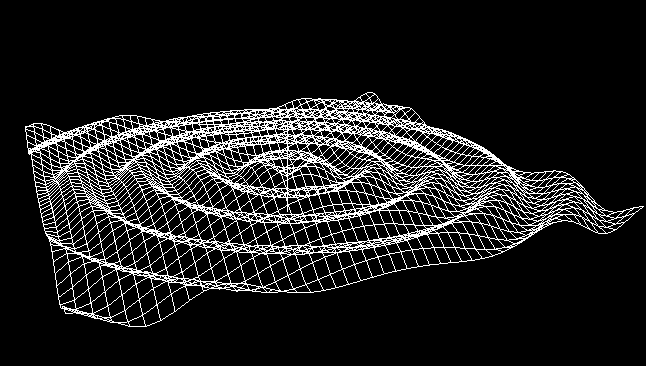
Image found here. Cropped.

To recap, last time we discussed how the universe contains a number of overlapping quantum fields, each one of which is present throughout all space. These fields contain quantities like momentum, energy, and electric charge, which travel around the fields in waves. The fields can trade this information through interactions, and the probability of interaction is correlated with the amplitude of the wave. And finally, there is a smallest possible amount a wave in a quantum field can interact by, and this amount must interact all at once and all in the same place. That “smallest amount of interaction” is what we call a particle.

In this post, when we say “particle,” it is understood that we are talking about collections of information within a wave, not little balls bouncing around.

Quantum Superposition


When the waves of two particles overlap, they add together in superposition. When in superposition, two particles are not two separate waves that happen to be in the same place; they are one wave with two particles’ worth of information.

For example, let’s look at the simplest kind of particle, photons. They are simple because they do not interact with other photons. Imagine two photons on a collision course. Before the intersection, they are flying along as normal. After they have crossed paths, they continue to fly along as if nothing happened.

Remember, photons are waves in the electromagnetic field, and there is only one electromagnetic field. At the moment of intersection, when the two photons are in the same place, their wave amplitudes add together to form a superposition wave that contains the information of the two photons, but is not itself a photon. This information causes the wave to split once again as if they had never joined in the first place.

A superposition wave. The final wave contains the information of the first two, yet it is still a single wave. Image found here. Cropped for better framing.

The key concept here is that when two or more particles are in a superposition wave, they aren’t really two particles, they are one wave with two particles’ worth of information. This is where the reductionist view causes problems, and it is the key point of today’s entire discussion. So if you don’t feel like you understand it well, I would strongly recommend lingering on this section, and perhaps rereading last week’s sections on reductionism, holism, and associative equivalence, until you do.

Bosons and Fermions


There is no limit to the number of photons that can superimpose in the same place, but there is for electrons. Electrons cannot superimpose over one another in the same total state. I do not mean that they repel each other due to their negative electric charges. It’s deeper than that.

In the lingo, a particle’s “state” is the total of its information about its properties: its position, momentum, energy, etc. Two electrons can have the same values in some of these, for instance, position and energy, but there must be at least one property that is different between the two. If you try to plug into the Schrodinger equation a superposition wave that contains two electrons with all of the same properties, in the exact same state, you end up with a contradiction, like 0 = 1. This is called the Pauli exclusion principle because electrons exclude other electrons from being in the same state.

Electrons and photons illustrate two categories all particles fall into. Bosons can exist in the same state in the same place. Fermions cannot. Photons are a type of boson, and electrons are a type of fermion. If this is confusing, don’t worry, it will make more sense after we have looked at some examples.

Lasers


Image found on Wikipedia.

We all know lasers, beams of single-color light packed so tightly that the bright spot where it lands is about the same diameter as the aperture it emerges from. A laser is a very strong coherent electromagnetic wave traveling in the same direction. This can be thought of as a vast number of photons all packed into the same place, superimposing on one another, and giving the wave a very high amplitude.

The higher intensity of the laser, the higher the number of photons superimposing into the wave. Can you guess what the limit is for how many photons can be packed into a single laser beam? Because photons are bosons, they never crowd each other out. Thus, we can keep increasing the power until the concentration of the light is so high that its energy creates a black hole! Don’t worry, though, that would take over a billion times more power than the entire world puts out in a year, all concentrated into one laser beam. That’s a lot of superposition.

Atoms


Each element on the periodic table has a smallest unit, an atom. Atoms are formed when electrons bind to positively charged nuclei. The possible states an electron can have within an atom are quantized; there are only certain specific states allowed, anything else gives a contradiction when put into the Schrodinger equation. If this is confusing to you, I recommend reviewing the pixel analogy from Quantum Physics part 1.

Because electrons are fermions, all electrons in an atom must be in different states. The three things contributing to an electron’s state in an atom are energy, angular momentum, and spin. If you have taken chemistry classes, you have probably heard of the electron states by another name: orbitals. The states with 0 angular momentum are called s orbitals, the states with the smallest non-0 angular momentum are called p orbitals, and then come the d orbitals and the f orbitals. Most of the time, the electrons are in the lowest available energy states.
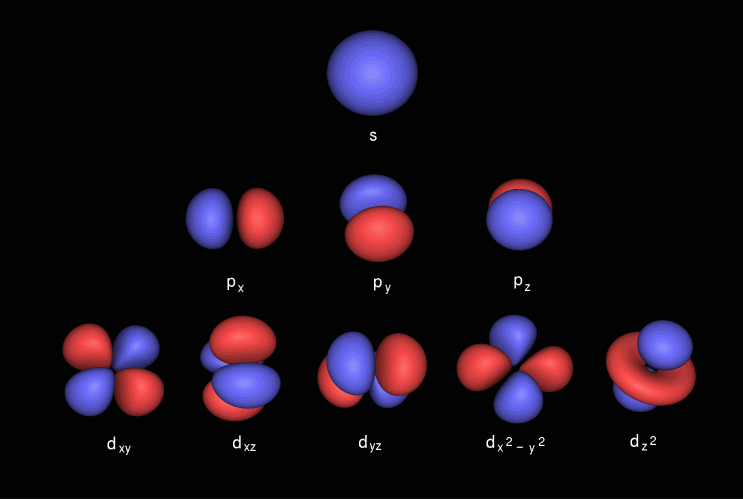
This image shows the wave modes in the electron field. In real atoms, these get added together in a superposition wave containing all the electrons’ worth of information.

Each orbital letter type has specific energy levels allowed to it. The lowest possible energy for an electron in an atom is the 1s orbital, and the second is the 2s orbital. Then come the three 2p orbitals. There are no 1p orbitals, because trying to put them into the math gives us contradictions. There are one of each s orbital, three of each p orbital, five of each d orbital, and seven of each f orbital. And because electrons have two possible spins, there can be two electrons in each orbital.


Electron Spin


We mentioned something mysterious in the previous section: electron spin. What is it? It’s not angular momentum, as that is a different property. Spin is the property which determines how a particle interacts with magnetic fields. The term is confusing, because nothing is actually spinning; the electron is a spread-out wave with no central point for an axis. It is called spin for historical reasons.

In this section, we will talk about magnetic fields as if they are separate objects from one another, because that makes spin much simpler to explain. Keep in mind, however, that it is more true to say there is one magnetic field with different strengths throughout the universe, and that it is a part of the electromagnetic field.


When an electron interacts with a magnetic field, there are two possible outcomes: the electron’s own magnetic field could be aligned with the external magnetic field, or it could be aligned opposite. These are called “spin up” and “spin down.” Other alignments are impossible, because they give mathematical contradictions.

If you pick an axis, you might think an electron has a set spin, up or down, along that axis. However, it does not. Remember how we talked about electron waves, and the probability of interaction being proportional to the wave’s amplitude? The same thing is true for its spin. If the electron has not yet interacted, then it has an amplitude for spin up and an amplitude for spin down. Just like the electron does not have a single definite position before it interacts, it also does not have a definite spin.

Non-Spatial Probability Amplitudes


Let’s not let what I just said slip by. In an electron wave, there is a position component and a spin component. The position has an amplitude, and the spin also has an amplitude. If the electron interacts in such away that its spin is not involved, the position component of its wave collapses, but the spin component does not. This means an electron can move around and interact with other objects, but keep its spin in a non-determined state.

If I am not mistaken, the wave function of a particle has components for all properties that have more than one value, whether it feels intuitive to conceptualize them as waves or not. Polarization of light is the other well-known example. In a particle interaction, only the components of the wave function for the properties involved in the interaction collapse. The rest remain in superposition.

This means that if something interacts with an electron by its electric field, and not by its magnetic field, its wave will collapse to the position of the interaction, but its spin will still be undetermined.


Quantum Entanglement


Now that we have looked at superposition and the fact that each of a quantum wave’s qualities has its own probability amplitude, we are primed for one of the coolest and most famous aspects of quantum physics: entanglement.

Suppose two electrons are in a helium atom. What we have is a single wave with two electrons’-worth of information. Two units of interaction ability, and two opposite spins. Now we remove the wave from the atom and separate it into two, each with one unit of interaction ability; we can comfortably say that electron A is over there and electron B is over here.

However, if we choose our interactions with the electrons such that their spins are not involved, then the spins are still in superposition. As far as the spin is concerned, the two electrons are still part of the same wave. The only spin information this wave has is that there are two spins, and they are opposite. Which electron has which spin has not been determined, and their probability functions have not collapsed!


This phenomenon, when the position components of a multi-particle wave have separated, but the components of one or more of their other properties has not, is quantum entanglement.

What does this mean? What effects does entanglement have on human experiences? When we measure—cause an interaction with—the entangled property of one of the particles, we know what the other one will be when we measure it too. If we measure the spin of electron A, then we know before measuring the spin of electron B that it will be the opposite.

Most people wonder how the measurement of one electron can affect the properties of another electron instantaneously, ignoring the speed of light. Even Einstein was uncomfortable with it, calling it “spooky action at a distance.” But here’s the catch: the measurement of an entangled property does not affect the other particle. There is no causation between quantum entangled properties, only correlation. If we view entanglement in terms of superposition waves, we find it is not spooky, and it is not action at a distance.

We humans feel that if two things are guaranteed to correlate, then there must be some common cause. Either information is being transferred instantaneously from one particle to the other, or there is some kind of unmeasurable information that determined the outcome when the two particles were together. However, this is nothing more than a human assumption. There is a reason why the spins correlate, but not a cause. The reason entangled properties correlate is because if they didn’t, there would be a contradiction in the math. That is sufficient to make it true. Causation is found almost everywhere within reality, but non-contradiction is absolute.

If you aren’t sold on the connection between math and reality, check out the four-point argument I make at the end of last year’s post on the subject.

A common question people ask is whether quantum entanglement can be used for faster-than-light communication. There has been a lot of discussion about this in the literature, but the bottom line is that no, it cannot. We discussed one of the most compelling reasons to me in a previous post about the relationship between faster-than-light travel and time travel, the paradox that there is no objective way to determine whether the message would go from A to B or B to A.


So there you have it. Between this post and the one that came before, quantum physics explained in 4,500 words. If you understand it, then congratulations! You understand the basics of quantum physics as well as the experts, and perhaps even better than some. You also have a little insight into how the world of our experience emerges from it. If you have questions, feel free to ask them in the comments. There are still things we have not talked about, such as quantum computers, which are interesting enough to get their own discussion. Also, if you take what is said in these two posts at face value, it is known as the Copenhagen Interpretation. There is an alternative view called the Many-Worlds interpretation, which I go back and forth on, as you can see in my argument for it and subsequent argument against it.

So yeah. Quantum physics explained from scratch so that non-experts can understand it. Take that, Feynman!

Friday, May 1, 2020

So What Actually Is Quantum Physics?

Quantum Physics:
Fields, Waves, and Particles
Multi-Particle Waves

You may have heard the saying, “No one understands quantum physics.” This is, quite frankly, a lie. When Richard Feynman said the quote, he did not mean no one understood the theory; it is mathematically robust, and makes the most precise predictions out of any theory in science. What Feynman meant is that no one understands its implications on the underlying metaphysical structure of reality, i.e. which interpretation of it is correct. If we are just talking about the physical theory, experts in the field understand quantum physics very well, and I believe you can too. That’s why I’ve started this series explaining quantum physics in a streamlined top-down approach.

What you get out of this series will be up to your expectations. If you go into this with a “can’t understand” mindset, you will not be able to understand it. Failure is a self-fulfilling prophecy. You can understand quantum physics. It may be difficult, and you may not get it on the first read-through, but with enough persistence and perhaps some help from other resources, you can get to the point where you can brag to your friends that you know quantum physics.

Unless you took quantum physics classes, what you know of quantum physics is probably wrong


There are two main things holding people back from understanding quantum physics. First, its reputation for being incomprehensible, which, as I just mentioned, is false. Second, most people’s exposure to quantum physics comes from either science fiction movies or spiritual gurus, both of which use “quantum” as a modern substitute for “magic.” Stories and mystics want to invoke alternative histories, portals to other realms of existence, psychic powers, time travel, and all kinds of uncommon phenomena.

Back in the day, people were more generally open to the existence of the supernatural, and we could get away with calling it magic. If a story had a magic mirror that took curious wanderers to a bizarre world, a reader might entertain the notion that such a mirror might exist somewhere in the reaches of the world untouched by modern society. Nowadays, a magic mirror would be seen as a children’s fancy, not something to be taken seriously in adult fiction. A quantum mirror, on the other hand, crosses the boundary back into the fringes of believability, and it feels like it may be invented someday, or perhaps already has been by some alien civilization out in the universe somewhere.

A timeline-hopping quantum mirror as seen in the Stargate SG-1 episode, “There But for the Grace of God.”

Background Knowledge: Fields and Waves


Before we get to quantum physics, we need to lay a foundation of supporting knowledge, so that the concepts of quantum physics will come more naturally. To start off, let’s look at the concept of a field. In everyday language, a field is a wide open area of land, usually covered by a certain kind of plant or combination of plants. A physical field is similar. It is anything that fills all of space and has some numerical value everywhere.

Temperature, for example, is a field. Pick any spot in the universe, and it has a temperature. Gravity is a field. Pick any spot in the universe, and the total gravity from all masses will have a single direction and strength. The same is true for the electric field. Any spot in the universe has a direction and strength of the electric field from all charged particles added together.

You might have been taught in physics classes that charged objects each create their own electric field, which interacts with other charged particles to cause static electric forces. Similarly, magnets create magnetic fields. However, it is more correct to say there is one electromagnetic field throughout all the universe, and charged particles and magnets create perturbations in this single field. Just like the rest of us, scientists tend to use the language that is most useful for the problem at hand, not necessarily what is most true.

Next, let’s talk about waves in the fields. For an easy example, think about tossing rocks into a lake. From where the rock lands, ripples spread out. The water does not move horizontally, just up and down. Also, aside form the initial splash, the surface doesn’t break.

Physical fields can have waves too. Just like the water’s surface, physical fields don’t “break.” When a point in a field is perturbed, it tugs on all the points around it, and is tugged back in return. This causes a ripple through the field as each point is tugged and tugs on the points after it in turn. Unlike the water’s surface, which is two-dimensional, physical fields fill all three dimensions of space.

What direction is the field pulled in? After all, the surface of a lake is pulled in the third dimension, upward and downward. Fields, on the other hand, are not pulled in any dimension. Rather, they are pulled in the level of their strength. Heat doesn’t have a direction, it has a temperature. A wave of heat is a front of increasing temperature. An electromagnetic wave, also known as light, is a wave of increasing and decreasing electric and magnetic field strength.

Now that we understand fields and waves, we are ready to get quantum.

Definition of Quantum: Limited Allowable Quantities


The word, “quantum,” seems mysterious. But it has a simple meaning: A quantity is quantized if it has a limited number of possible values. A quantum is one of those values. Okay, maybe that doesn’t sound so simple at first glance, but once we start seeing examples it will start to make sense.

One type of quantum is a number of pixels. There is no smaller piece of visual information your screen can produce than a pixel. It cannot display half a pixel, and it cannot display a pixel and a half; the number of pixels it can display is limited to the natural numbers (0, 1, 2, 3, …). Therefore, a natural number of pixels is a quantum of computer graphics display.

Pixels are also a nice example of degeneracy. Degeneracy is when there are multiple possible states for a given quantum level. Again, examples will make this clear. If there are 0 pixels, there is only one state: off. 0 pixels is non-degenerate. For 1 pixel, there is also one state: on. At the 2-pixel level, however, there are two states: one on top of the other, and beside one another. The 2-pixel level has a degeneracy of 2. The 3-pixel level has a degeneracy of 6, as is shown in the diagram below.


Particles: Excitations in Quantum Fields


Now that we have all the background knowledge we need, we can start to learn quantum physics. Let’s begin by putting aside all our notions of matter and particles, and imagine a vast region of empty space with only fields inside it. These fields can interact with one another, but only in certain amounts at once; in other words, the fields are quantized. They are quantum fields.

These fields, like the fields we discussed before, can have waves. But for each wavelength, there is a smallest possible excitation; if you try to put less energy into a quantum field than its smallest possible excitation, nothing will happen.

Image source
In the electromagnetic field, the smallest possible excitation is called a photon. In the electron field, the smallest possible excitation is an electron. In the quark fields, the smallest possible excitations are quarks. What we are getting at here is that fundamental particles are the smallest possible chunks of wave in quantum fields. All forms of matter and energy in the universe are made up of these field excitations and their interactions with one another.

Image source
Let’s look at this in more detail. Imagine a place where the electron field is zero. The field is there, there just aren’t any electrons. Now we put energy into a point on the field, perhaps by shining a high-energy photon through it. If the photon has enough energy, at least twice the amount of energy of an electron’s mass as given by E=mc2, then there is a chance it will interact with the electron field, giving up its energy, and creating two particles, an electron and an anti-electron.* If the light pulse has less energy than that, it will not give any energy to the electron field, because an electron is the smallest possible excitation of the electron field.

If the photon has a lot more energy than necessary to create an electron/anti-electron pair, it will stimulate the second quantum level of the electron field, creating a muon/anti-muon pair. If its energy is anywhere in between, the excess is given to the electron and anti-electron as a burst of speed.


Particles or Waves? The Wave Function


Most of us picture particles as infinitesimally small dots that zip around bumping into things, and waves as ripples that spread out to unlimited size and affect everything they touch. When it comes to fundamental particles, however, both of these pictures are incorrect. Fundamental particles are something new; they move like waves, and interact like particles.

First, let’s talk about the wave part, using electrons as a case study. In empty space, an electron spreads out as a wave in the electron field. As the wave approaches something it can interact with, the probability it will interact correlates with the amplitude of the wave. Where the wave is highest and lowest, the electron has the highest probability of interacting, and where the wave crosses zero, the electron has no probability of interacting.


Now we don’t need any math for the concepts we discuss today, but we should at least mention the Schrödinger equation, because it is an icon of quantum physics. You don’t need to be able to solve the equation, or even understand it, but you should be able to recognize it when you see it.


The most important part of the Schrödinger equation is the wave functionψ. The wave function is a mathematical representation of particle waves, their peaks and valleys, and how they move through space and time.

Every behavior of quantum physics, from the double slit experiment to the quantum eraser behave as expected when the correct values are fed into this equation. It also explains, when understood, why many values are quantized rather than continuous.

Particles or Waves? Exclusive Interactions


As I mentioned above, fundamental particles spread out like waves, but interact like particles. As a wave, it has a probability of interacting everywhere, correlated with its amplitude at that point. But when it interacts, it interacts fully at one location. At that moment, it becomes impossible for any other part of the wave to interact. This is called the collapse of the wave function. After the interaction, the particle once again spreads out as a wave from the point of interaction, ready for its next interaction.


This is where the interpretations come in. The reason people say “no one understands quantum physics,” is because no one knows what happens to the parts of the wave function that don’t interact. If they just disappear, it is called the Copenhagen interpretation. If the interaction causes a split in the universe, and every part of the wave function interacts in one of the branches, it is called the Many-Worlds interpretation. There are other interpretations too, but those are the main contenders.

Summary and Conclusion


Let’s recap what we’ve learned today. Space is filled with substance-like things called fields, including the electromagnetic field, the electron field, and others. Particles are quanta of excitation in these fields (smallest, second-smallest, third-smallest, and perhaps more). These particles behave like waves until they interact, whereby they interact all at once. This causes the wave to collapse and spread out again from the point of interaction.

That’s the basics of the basics in a nutshell. It’s not enough to understand most experiments and technology that use quantum physics—that will have to wait for part two—but it should be enough that when you hear the word “quantum,” you know it relates to subatomic wave-particles and discrete levels of smallest-possible things. It has absolutely nothing to do with love, telepathy, willpower, perception, or anything like that. That’s just misusing the word “quantum” as a substitute for magic.

Next time in the quantum physics series, we will talk about multi-particle waves, finishing up the foundational knowledge necessary to understand quantum physics-based experiments and technology, and taking a glimpse into how atoms work. I hope to see you then!

*Another name for an anti-electron is a positron. For reasons we may talk about in a future blog post, in order for a particle of matter to be created in a quantum field, a particle of antimatter must also be created.

Friday, March 20, 2020

The Best Argument Against the Quantum Multiverse

Recommended Pre-Reading:
The Quantum Multiverse

Some time ago, I argued in favor of the Many-Worlds interpretation of quantum physics, explaining how I had misunderstood it before, and why I changed my mind. I recommend reading that post for the full story, but the short version is, the Many-Worlds interpretation (or more accurately, the Universal Wave Function interpretation) is the straightforward interpretation of quantum physics, explaining the weird paradoxes without adding any extra assumptions to the theory. All other interpretations require adding something; either a collapse condition, where a measurement causes the wave function to immediately change shape all at once, ignoring the speed of light, or some kind of hidden variables we can’t measure. The Many-Worlds interpretation says the wave function described by the Schrodinger equation is correct, and that is all. Everything else, the multiple universes and such, are deduced from that single statement.

However, there is one thing that bugs me, one loose end Many-Worlds doesn’t explain. That is why today, I am going to continue the Best Arguments Against series, and put forth my best argument against the quantum multiverse.

Most people who argue against Many-Worlds don’t understand it. Some dismiss it out of hand as too weird. Others get Occam’s Razor backward and think Many-Worlds has branching universes as a postulate, rather than a deduction. These are not good arguments.

The best argument has to do with probabilities. If we look only at the math, it makes sense that the wave function can split into two worlds, one with an amplitude three times stronger than the other. Think of a pile of sand. Someone splits it into two, one of which is three times bigger than the other. Where there was one pile, there are now two of differing heights. That’s an apt analogy for the splitting of universes, and it’s quite easy to visualize. Nothing confusing or difficult to believe there.

However, when we do an experiment, the outcome with the higher amplitude has a 90% chance of happening, and the outcome with the lower amplitude has a 10% chance of happening. If the universe splits into two equally real branches, as Many-Worlds claims, where does this probability come from? Many-Worlds says there will be two universes, each of which will have an equally real version of us. Thus, before the experiment, it would be natural to think there would be a 50% chance of finding ourselves in each universe after the measurement. But it’s not; it’s 90-10. This is a contradiction, and a currently unresolved paradox in the Many-Worlds theory.


This is important, because we rely on quantum probabilities all the time. The nuclear fusion that powers the sun and gives the Earth energy uses quantum probability. The half-lives of unstable elements, used in various technologies and geological dating methods, rely on quantum probability. And most conspicuous of all, quantum computers work by minimizing the quantum probabilities of the wrong answers and maximizing the quantum probability of the right answer. If there were simply one universe for each possible outcome, our intuition says none of these should work!

There is one way to resolve this conceptually. Suppose instead of two worlds, there are a large number of them, and 90% of them go in the direction of higher amplitude, and 10% of them go in the direction of lower amplitude. Those 90% are completely identical to each other, as are the 10%. This would square off the probabilities. Instead of there being two of you, one in the low amplitude world and one in the high amplitude world, there would be many of you, split between the worlds 90-10.

However, this takes away the straightforward purity of Many-Worlds. The math does not say there will be lots of identical universes, it says there will only be one for each possibility. Resolving this conflict by proposing large numbers of identical universes adds extra fluff to the theory, taking away its advantage over the other interpretations!

This could mean Many-Worlds is the wrong interpretation of quantum physics. Or it could be that we just don’t understand quantum probability yet, and we will find a satisfactory resolution to the paradox. Many-Worlds is still the tidiest interpretation so far, since it explains all the other phenomena of quantum physics, like entanglement and the measurement problem, so neatly. For now, I still rank it as the most plausible, leaving the door open for something else to come in and explain it all.

I don’t like the quantum multiverse. I want there to be only one course of history. It feels cheap if everything that is physically possible happens in one timeline or another. But, as mentioned at the beginning of the post, the fact that it is weird is not valid evidence. I hope Many-Worlds is wrong, but as a truth seeker, I cannot let that hope influence what I believe. The truth is the truth, whatever it turns out to be. Maybe there are a near-infinite number of universes splitting off from one another every moment, or maybe there is just this one. All we can do is follow the logic and evidence where it leads us.

Friday, August 24, 2018

Why I Changed My Mind about the Quantum Multiverse

Recommended Pre-Reading:
Quantum Entanglement
Multiverses (Quantum Many Worlds section)

A truth seeker must always be open to new evidence. The new evidence must be added to the old, and all of it re-evaluated together. Sometimes the evidence in its greater context points in a direction other than what you thought was true, and when this happens, the wise person adjusts their beliefs accordingly. As a case in point, we’ll look at something I have had a strong opinion about on this blog, the quantum multiverse.

By Paul Anglada on Flickr
If you’ve read a lot of my science posts, you know I’ve been pretty hard on the quantum multiverse, also called the Many Worlds Hypothesis. In the multiverses discussion, I said I thought it was the least likely to be true out of the hypothetical multiverse types that come from physical theories. Since then, however, I have learned more about the arguments for its existence, most importantly the story of how the hypothesis came to be, and now I think it is reasonable to believe it exists.

Before we go any further, though, let’s remind ourselves what we are talking about. When quantum physics is mentioned, the layperson might think of the science of consciousness, or of parallel realities where events that were important to individual people or to human history played out differently. These are not quantum physics, they are purely science fiction, playing to our human bias that the universe revolves around us, and where “quantum” is used as a sneaky replacement for “magic.” Quantum physics, the real science, is the study of matter and energy at the scale of molecules and atoms and smaller.

When enough quantum particles interact together (millions, billions, trillions, and more), we get the classical physics that we know in our everyday life. We says that classical physics emerges from quantum physics. But classical physics is not the only thing that can emerge from quantum physics. Any property of quantum physics, when scaled up, can affect the macroscopic realm. Because of this, scientists and inventors have come up with technologies that use the unusual properties of quantum physics in technology, the most well-known example being the laser. Our experience of reality comes from the deeper reality of quantum physics, not the other way around. If quantum physics has implications that are counter-intuitive, we have every reason to take those implications seriously.

We’re going to talk about interpretations of quantum physics, so first things first, what exactly needs to be interpreted? It comes down to why we say quantum physics is weird: a quantum-sized particle can be in two states at once. What does that mean? Well, for example, an electron can be 50% spin up and 50% spin down at the same time. This is called superposition of states. It is like saying a basketball is spinning both clockwise and counterclockwise at the same time. It seems like a contradiction, and for macroscopic objects like basketballs it is, but for subatomic particles, it is normal. If you measure the electron’s spin, you will find it to be 100% either spin up or spin down, and then it will behave differently. But it was not 100% up or down before the measurement; the very act of measurement has changed the particle’s properties. This is called “collapsing the wave function,” and it is what needs interpreting.

For the Copenhagen Interpretation, that is the end of the story. The universe has probability baked into it, and measurements roll the dice. But the Copenhagen Interpretation has a problem: what counts as a measurement? If you try to measure the property of a particle by using another particle, the wave function does not collapse. Instead, the particles become entangled, that is, they are both in a combined superposition of states. For example, if you try to measure an electron’s spin using another electron, then both electrons will end up 50% spin up and 50% spin down. But here is where things get interesting. By using more traditional measuring devices, when we measure the electrons’ spins, we will find that one of them is spin up and the other one is spin down. We can’t know which is which beforehand, because there isn’t an answer beforehand. The only thing that is set in reality before the measurement is the fact that their spins will turn out to be opposite.

But what makes a traditional measuring device different from a particle? All measuring devices are made out of particles themselves, after all. So shouldn’t the machine we use become entangled with the electron as well? The machine only shows us one answer, not a superposition of answers, so that seems not to be the case. Why not? This is the famous measurement problem.

One proposed resolution for the measurement problem is that the collapse of the wave function happens when the experiment is observed by a conscious being. That is, the instrument used to take the measurement registers both spin up and spin down until someone looks at it, whereafter the entangled wave function of the particle and the device measuring it collapses, showing just one result. In other words, perception defines reality. However, this requires substance dualism, the idea that consciousness is fundamentally different from the rest of reality, that mind and matter are completely different things. People have had a dualistic view of mind and matter for all of recorded history. It is intuitive; our DNA comes pre-loaded with a disposition toward believing it. It just feels true. But feeling true has no bearing on whether something actually is true, and the lack of scientific evidence in support of dualism suggests that there is some kind of equivalence between consciousness and matter, which would mean the conscious observation interpretation of quantum physics is impossible.


One day in the late ‘50s, physicist Hugh Everett came onto the scene with a radical suggestion: what if the wave function does not collapse at all? What if any interaction between particles makes them entangled? This would mean that two interacting electrons become entangled; when they are measured, the instrument that measures them becomes entangled; when the scientist interacts with the instrument, the scientist becomes entangled; and when the scientist interacts with the rest of the world, the rest of the world becomes entangled. This would mean that after the measurement, the entire world exists in a superposition state, which is 50% reality where the electron is spin up, and 50% reality where the electron is spin down. Put simply, it can be thought of as if there is one universe where the scientists observe the electron to be spin up, and another universe where they observe the electron to be spin down. This is the essence of the Many Worlds Interpretation.

This sounds weird, and it’s only going to get weirder. As they say, extraordinary claims require extraordinary evidence. So what made me change my mind? What makes the Many Worlds Interpretation more reasonable than any other? It all comes down to consistency. When particles only interact with one another, they get entangled. This is a well-documented scientific phenomenon. The larger the number of entangled particles, the harder it is to control all of them, so the easier it is for something external to the experiment to “mess up” the entanglement. But what would it mean to “mess up” an experiment? It’s just more particles interacting with the entangled system. And we know that when particles interact with other particles, they get entangled. So we could think of it as the external world coming in and messing up the experiment, but if we want to be consistent, we should say the entanglement is escaping to the rest of the world, including the brain of the person doing the experiment.

This is extremely counter-intuitive. I certainly feel like I am in one specific state, not a superposition. But what would being in a superposition feel like in the first place? We might imagine two images playing over our eyes, like a transparent movie playing over another movie. But that would only happen if the information from both states came together in the same brain. Remember, our brain is also in a superposition, not working as a single machine in both states. So a person in quantum superposition would feel completely normal, as if they and the objects they see and interact with are in state A, and not state B. And they would also feel as if they and the objects they interact with are in state B, and not in state A. Both are true, and they would notice nothing weird at all, because the states of their brain are completely cut off from each other. In effect, the universe has split in two, and that is where the “multiverse” idea comes in. More generally, as I argued in the multiverses discussion, it is not the splitting of distinct universes, but an infinite-dimensional smear of universe-ness.

By Maria Morri on Flickr
And now, when I look back at my former self, I see a hypocrite. In the multiverses discussion, I said people are drawn to the Many Worlds Hypothesis because the idea that reality is simply probabilistic at the quantum scale is too weird. But I got it backward. The reason that people like my former self cling to the Copenhagen Interpretation is because the Many Worlds Hypothesis is too weird. But weird as it is, it is the only interpretation that solves all the puzzles of quantum physics and leaves no loose ends behind. It is the natural logical conclusion of entanglement, and it makes the measurement problem go away. Out of all the interpretations of quantum physics, those we discussed and those we did not, I now think Many Worlds is the most likely to be true.

But it’s just an interpretation, isn’t it? If it can’t be tested, then what is the point of debating it? Well first of all, here on A Scientist’s Fiction, we search for truth in whatever way we can, and if that means using pure logic, that is what we use. However, in this case, we don’t have to. We can test the quantum multiverse. After all, it’s not just parallel realities. That’s TV sci-fi. The quantum multiverse is an extension of regular old quantum entanglement, which we see in the lab all the time. It makes a prediction: if we have the right kind of experiment, we should be able to put a human being in quantum superposition. Researchers keep finding quantum properties in larger and larger systems, so it should be theoretically possible.

I don’t know how the exact details of such an experiment would play out, but it might go something like this. Imagine we send a human test subject into a room that is 100% soundproof, vibration-proof, and heat-proof. After we close the door, the subject sees either a red light or a blue light, triggered by the measurement of an electron’s spin within the room. To all outside observers, the subject would be in a superposition state of red + blue. Suppose this person was instructed to lightly touch one of two sensors, which connected to a second electron, telling it to either be spin up or spin down. The experimenters outside the room would then do tests on the two electrons, to see if they are in a superposition of states. If they are, then the human test subject is also in a superposition of states. Then they open the doors, the test subject walks out, and tells the researchers what color of light he or she saw. They then measure the particles, and indeed their spin is oriented in accordance with the prediction. This would mean that the test subject was entangled with the electrons, in a superposition of states, and now there are two universes, one where the subject saw red, and one where the subject saw blue. The quantum multiverse hypothesis would be supported by evidence from a prediction of its own.

Schrödinger's Cat
Changing my mind due to more complete evidence is something I am well-practiced at, so when it came time for the quantum multiverse, it was no big deal for me. However, for those less practiced, it can be frightening. Maybe after reading this you are not convinced that the quantum multiverse exists, and that’s fine. Skepticism is healthy, especially for topics as complicated as quantum physics. But it is also healthy to direct your skepticism toward the beliefs you already hold, and I encourage you as a fellow truth seeker to reexamine your beliefs every now and then. Whether you find them to be valid or in need of replacement, I can guarantee the practice will make you wiser and bring you closer to the truth.

Friday, April 13, 2018

A Multitude of Multiverses

Long ago, we believed the Earth, the World, and the Universe were just about the same thing. The heavens were above, and the watery abyss below, and the Earth stood in the middle on its immovable foundations. In the more scholarly parts of the world, the Earth was known to be a sphere, but still thought to be the center of the Universe, with the sun, moon, and stars revolving around it. Since then, a series of world-changing scientific revolutions showed that the Earth revolves around the sun, the sun and all the visible stars are just a tiny section of the Milky Way galaxy, which is one of 50 in the Local Group, which is one of 100 galaxy clusters in the Virgo Supercluster. Yet the observable universe is so vast that 10 million superclusters fit inside it.

Click to enlarge.

The observable universe is as far as we have been able to see. However, there is no reason to believe reality ends there. Time and again, the Universe has been discovered to be bigger than we thought, so why should it be any different now? Perhaps if we could look far enough in space, back in time, through another dimension, or outside of the space-time continuum, we would find the whole of physical reality to be as much bigger than we think it to be now as our current picture is to the view that Earth is most of reality—many universes, or a multiverse.

How would a multiverse come to be, and how could we know about it? You might think that if something is outside of what is observable to us, then by definition we cannot observe it. However, most multiverse hypotheses are not theories themselves, but the logical conclusions of other theories, which make other, more testable predictions. It actually turns out to be very difficult to come up with a theory that encompasses the entire observable universe throughout space and time without getting a multiverse or two on the side.

Today, we will look at several possible reasons why multiverses might exist, including physical and philosophical. We will also examine the arguments for why this universe might be the only one.

Arguments for a multiverse:

Quantum Many Worlds
The multiverse that most people are familiar with from science fiction is the Many-Worlds interpretation of quantum physics. There have been many a Star Trek episode where a hole opens up in space in front of the Enterprise, and another Enterprise emerges, complete with all of the crew members, but everything is just a little bit different. It is a handy way to write a “what if” story, where in the other universe a key moment for the story played out differently.


Let’s look at the science behind the Many-Worlds hypothesis. Now the average person gets exposed to quantum physics either from science fiction or from modern mystics, both of whom use the word “quantum” as a substitute for “magic;” an empty term meant to convince people the speaker knows what they are talking about. Quantum physics is often described as strange and weird, the same adjectives that are used to describe consciousness, supernatural creatures, spooky coincidences, etc. But just because the same words are used does not mean they have anything to do with each other. Matter can be solid, liquid, gas, or plasma, but that does not mean all matter is made of earth, water, air, and fire. Quantum physics is a real science, the study of the basic building blocks of matter and energy at the scale of atoms and their parts. So let’s leave all of our preconceptions behind and take a look at the real weirdness of quantum physics.

Before quantum physics, the Universe was thought to be deterministic. There was a thought experiment called “Laplace’s Demon,” in which it was imagined that if there were a mind that knew the positions and velocities of every particle in the Universe with infinite precision, that mind would be able to use Isaac Newton’s laws of motion to predict everything that happened in the Universe until the end of time. Everything was thought to be determined ahead of time—not planned or fated, but flowing naturally by the laws of physics with no possibility of changing course.

The essence of the weirdness of quantum physics is that it throws determinism out the window. With classical physics, if you set up two experiments exactly the same, they give you exactly the same result every time. That’s determinism. But in a quantum experiment, you can set up two systems exactly the same, and they can give you different results. For instance, sodium-24 is an unstable atom that decays into magnesium-24, with a half-life of 15 hours. This means that if you have a bunch of sodium-24 atoms, then in 15 hours, roughly half of them will have turned into magnesium-24. This means that if you look at an individual sodium-24 atom, there is a 50% probability that it will decay within 15 minutes, and a 50% probability that it will not. This probability is baked into the fabric of reality, and does not depend on some internal clockwork of the nucleus. Rather than deterministic, quantum physics suggests that at the fundamental level, the Universe is probabilistic.

For myself, I am perfectly happy with accepting quantum physics as probabilistic, that reality itself has an element of chance that cannot be explained away. This view is known as the Copenhagen interpretation of quantum physics. But many people see this as ignoring the question, and insist that there must be some explanation that resonates with a deterministic intuition (or a consciousness-based reality intuition, but that is a topic for another time). One of the most popular explanations is what we have been waiting for, the Many-Worlds interpretation.

The Many-Worlds interpretation of quantum physics says that every time a particle does something that is probabilistic, a new universe branches off in which each possibility happens. If there is a 50% chance that a particle goes to the right and a 50% chance that it goes to the left, then there will be two universes, one in which the particle goes to the right, and one in which it goes to the left.

Schrodinger's Cat. The release of the poison is triggered by the radioactive decay of an atom, so according to the Many-Worlds hypothesis, there are two universes, one in which the cat is alive, and one in which the cat is dead.

The Many-Worlds hypothesis is often explained in terms of choices. It will be said that when you get up in the morning, there will be one universe in which you have cereal for breakfast, and one universe in which you have toast. But this is a misrepresentation. It is not merely choices that cause branching universes, but any time any particle does anything probabilistic. Few people pause to consider the massive implications of this. There are 10^27 atoms in your body alone. That is more than the number of stars in the observable universe. According to the Many-Worlds hypothesis, these atoms are creating branching universes all the time, sometimes at rates much shorter than seconds. The sheer number of universes that would exist under the Many-Worlds hypothesis is beyond comprehension, even for someone like me who spends a lot of time thinking about the size and scope of the universe.

I personally don’t subscribe to the Many-Worlds interpretation, because particles do not behave according to discrete probabilities, but probability densities. To explain what that means, I’ll take us back to the unstable sodium-24 atom. With a 50% chance it will decay within 15 hours and a 50% chance it will decay after 15 hours have passed, that means there will be two universes, right? Not so fast. If we change the time frame—say, 30 hours—then there is a 75% chance it will decay before, and 25% chance it will decay after. This would mean there are three universes in which the atom decays before 30 hours, and one universe in which it decays afterward. But we can change the time again, say 20 hours, 15 minutes, and 22 seconds, and run the probabilities again. In fact, we can set up our time windows to be arbitrarily small, each with its own infinitesimal probability. This would mean that for a single atom, an infinite number of universes would be created. In 50% of these infinite universes, the atom decays before 15 hours, in 25% of the universes, it decays after 30 hours, etc.


Following the Many-Worlds interpretation to its logical conclusion, we don’t end up with a set of discrete universes, but a continuous infinite-dimensional smear of universe-ness. This does not mean it is not true, but if the reason to consider the Many-Worlds interpretation was because the idea of probability being an inherent feature of reality was too weird, it fails, because the explanation it provides is even weirder.

Hubble Volumes
Now for something that is definitely true, but may or may not count as a multiverse depending on your definition. Far off in the depths of space, there are two distances that could be considered the edge of the universe. These distances are spheres that are centered around the Earth, or rather, centered around whoever is doing the observing no matter where in the universe they are. The first is the particle horizon, which is the distance light has had time to travel in the age of the universe. Our universe began 13.8 billion years ago, which means that from 13.8 billion light years away, light from the beginning of the universe is reaching us now. As time goes on, the particle horizon expands at the speed of light. This makes sense, because when the universe was a million years old, the particle horizon was a million light years in radius, and when the universe is a trillion years old, it will be a trillion light years in radius.

But there is another sphere which is important too. The universe is not just sitting still, but it is expanding. The farther away two points are from each other, the faster they are moving apart (assuming they aren’t held together by gravity or other forces). This means there is a distance from Earth at which space is moving away at the speed of light, which is called the cosmic event horizon. Because nothing can travel faster than light, nothing that passes across the cosmic event horizon can ever affect Earth or send signals that could affect Earth.

Whichever is smaller at any given time, the particle horizon or the cosmic event horizon, contains the observable universe. Right now, the cosmic event horizon is around 16 billion light years away, so we have a couple more billion years of new light reaching us before things start vanishing across it.


There isn’t one single observable universe. Rather, every point in space has an observable universe centered around it. Our observable universe is centered on Earth, 13.8 billion light years in all directions. But if we went to the Andromeda galaxy next door, its observable universe would be 13.8 billion light years in all directions centered on it. When talking about the observable universe centered on a point other than the Earth, it becomes confusing, so instead we will call it a Hubble volume, after Edwin Hubble who discovered the expansion of the universe. A galaxy on the edge of our Hubble volume would have its own Hubble volume centered on it, and we would be at the edge of its Hubble volume. Now imagine a galaxy on the opposite side of that Hubble volume. We now have two Hubble volumes that do not overlap. In a sense, we have two different universes. And since we have no indication that there is an end to space, there may be an infinite number of non-overlapping Hubble volume universes. If you interpret this as a multiverse, there is no question that a multiverse exists.

Inflation
During the first Planck-time moments of the big bang, our present cosmological paradigm says the universe expanded at insane speeds many times faster than light. This is called inflation. Within the inflation, a small volume crystallized into what we know as normal space, the parameters of physics freezing into place. This volume continued to expand to become our universe, including everything within our Hubble volume and far beyond.

It might be that elsewhere, far away from us during the inflation era, other universe seeds crystallized into universes with different physical parameters. It could even be that inflation happens forever in space and time, constantly birthing new universes in its infinite expanding alternative-space. Each of these bubbles within inflation would contain many Hubble volumes, and so each of them would be its own Hubble volume multiverse.

Theory of Everything
The universe as we know it had a beginning, the big bang. It might have been the beginning of time, or it may have been a transition from another kind of universe. Either way, when we try to calculate back in time to the earliest moments of the big bang, our current understanding of physics doesn’t work. That’s fine; after all, we have two theories, Quantum Field Theory and General Relativity, and they don’t fit together. Although in this era of the universe they respectively describe the extremely small and the extremely large, the instant of the big bang falls under both of their domains.

In order to understand the beginning of the universe, we need to bridge the gap between Quantum Field Theory and General Relativity. Right now we have two major contenders for such a Theory of Everything: String Theory and Loop Quantum Gravity, though neither of them have been tested. Both theories predict the existence of a multiverse, so if either of them is true, our universe is not alone.

But let’s consider the possibility that both String Theory and Loop Quantum Gravity are false, and some other Theory of Everything that we have not thought of yet is correct. Such a theory must be able to describe the beginning of the universe, either from Nothing or from another universe.  No matter what it is, whatever principle or substance caused our universe to come to be would logically cause a multitude of other universes to be created for the same reason. In fact, I think it would be quite difficult, if not impossible, to formulate a theory of how the universe began that did not leave us with a multiverse.

Metaphysics
If truly no physical law acts upon a State of Nothing, then Nothing cannot remain as it is, nor can there be any limit on what would come from it, because such a limit would count as a law of physics. If that is true, then everything that is logically and mathematically possible must exist, though in completely separate spacetime continua. These possible-made-real universes would range from those with the conditions for life like our own to emerge, to many kinds of universes where life is impossible, to universes that blink out of existence the moment they appear, to the really bizarre, like universes where a single particle corkscrews through space eternally, or where time loops back on itself and events repeat in an eternal cycle.


Arguments against a multiverse:

It is untestable
The most common criticism against the existence of any kind of multiverse is that it can never be tested. If these other universes are disconnected from ours, how could we possibly be able to measure them? It is a fair point, and reminds us to approach the topic with due skepticism, but it isn’t really an argument against a multiverse’s existence. Furthermore, there are some kinds of multiverses that we might, in fact, be able to detect. Gravitational wave detectors might be able to pick up signals from before the big bang, which would confirm that our universe was born from another universe. If String Theory is true, then we might be able to see signs that our 3-brane universe bumped into another 3-brane universe traveling through a fourth dimension. So while some types of multiverses really are untestable, like the physical existence of all things possible, there are some types of multiverses that we simply do not have the technology to test yet.

Strong Anthropic Principle
If our universe is the only one, then there are no other spacetime continua, no extra dimensions, and nothing at all, including space and time, before the big bang. However, in the laws of physics there are several physical constants, which describe the relative scales of things. For instance, the speed of light links space and time, the fine structure constant determines the strength of the electromagnetic force, and Planck’s constant sets the size of atoms. The number of possible combinations of physical constants that can support life is massively dwarfed by the number of combinations that prohibit life from existing. If there is only one universe, then it would be ridiculously unlikely for that one universe to be able to support life. This problem doesn’t have an official name, but I call it the Teleological Paradox, meaning the paradox of apparent design.

If there is a multiverse, then everything that can happen does happen, and the Teleological Paradox goes away. But if there is only one universe, there must be another resolution. One possibility is the Strong Anthropic Principle, the hypothesis that it is impossible for conscious, intelligent minds not to exist. If this is the case, then it is not correct to say the Universe came into being with the conditions for life, but rather the necessity of intelligent minds caused the Universe to come into being.

The Strong Anthropic Principle breaks causality as we know it. In all the rest of our experiences, causality goes from past to future. The Strong Anthropic Principle, on the other hand, says that future events (the existence of intelligent minds) cause the past (the beginning of the universe). The claim that intelligent minds must exist is also arbitrary; there is no more reason that intelligent minds necessarily exist than that elm trees necessarily exist, or that ringed planets necessarily exist. The only reason intelligent minds are chosen as the basis is to patch the Teleological Paradox. Furthermore, we might expect the Strong Anthropic Principle to make a much smaller universe, perhaps just a dwarf galaxy or star cluster, because the rest of the universe isn’t necessary for life. So although the Strong Anthropic Principle has no logical contradictions, it is a very weak explanation for why the universe can support life.

Intelligent Design


Another possible way for our universe to be the only one is if it was created intentionally so that we might exist by a personal God who exists independently of physical reality. But consider this: we have seen through our telescopes that the Universe is vast beyond comprehension. Remember, the universe is expanding, which means the farther something is from us, the faster it is moving away. Almost all of the trillions of galaxies scattered all over the observable universe will be pushed farther and farther away, until they cross the cosmic event horizon, which, remember, is the distance at which the expansion is faster than light. Once this happens, it will be physically impossible to reach them, or even see them anymore. If the Universe was created for us by an intelligent designer, we would either expect these galaxies to be reachable someday, or to not exist. If the goal was to create a universe where intelligent life would arise, it would be far easier to create a single galaxy, or even a single solar system, because that is all that is needed.

Perhaps God created all of those far-off galaxies to show his grand splendor, that the more technologically advanced we get, the greater we find the universe to be, and the more awe we feel for its creator. That makes sense, but let’s follow it through to its full implications. If God created multitudes of galaxies beyond the Virgo Supercluster to display his majesty, then why not for the same reason create a multitude of equally splendorous universes? I think that, even if the cause of the universe was that it was designed by a God, we still have good reason to believe there is a multiverse.

Instinctive Design
Finally, there is the option of some kind of unconscious mind, like the Force or a sleeping God, which created the universe with the right conditions for life out of instinct rather than intent. It may be that this kind of being would create one universe, since one is all that is needed for life. Being instinctive rather than intelligent, it might end up filling the universe with galaxies as a by-product. However, I would expect a universe created by such a being to be teeming with life on every planet, moon, and asteroid, and so far we have found no evidence of life from anywhere besides Earth.

Conclusion:

There are many physical and philosophical theories that hint toward the idea that our universe is not the only one, that there may be several universes, or an infinite number, all with different properties, dimensions, and contents. If this universe is the only one, we run into the Teleological Paradox, that the conditions being right for intelligent life to exist is too improbable to be coincidence. Each of the Teleological Paradox’s possible resolutions predict either that we would more likely find ourselves in a universe that looks quite different from this one, or that we have a multiverse anyway. There is no evidence that a multiverse exists, but with all the possibilities, I would not be surprised if one day we discover, in the depths of time and space or in the hearts of black holes, other universes lying hidden.

Friday, January 26, 2018

The Nature of Natures

The Nature of Reality:
Quasi-Realism
Representational Realism
Existence and Natures
Knowledge of Reality
The Language of Reality


In the past, I’ve argued for the metaphysical theory of Representational Realism, the belief that Reality exists objectively, on its own, and that what we perceive is not reality, but a copy of reality constructed in our brains from the information provided by our senses. This raises the question, what is Reality really like? If our perception is just a translation of data from our senses and memories, prone to error and bias, how can we know what is really true?

Even though we can never directly perceive Reality, we can learn some things about it through reasoning. If something is objectively real, it must be well-defined. I don’t mean in terms of word definitions, but that it has a “way that it is,” also known as a nature. This is true independently of whether we know what it is or not, or even whether there is anyone in existence to do the knowing. The mysteries of science have an answer now, and that answer has always been true. Gravity followed Newton’s formula before Newton. DNA existed before Watson and Crick. The natures of things, even those which do not yet exist, are already set within Reality, and have been since the beginning of time.

So what are these natures, and what do we know about them? The most successful process for trying to figure them out is science, particularly modern physics. The nature of gravity is best described by General Relativity, and the natures of pretty much everything else in the universe, bar some as-of-yet unexplained phenomena like consciousness, are emergent from Quantum Field Theory. This is where we get the idea of the laws of physics, mathematical representations of the natures of real things. There are laws of physics for the fundamental level of nature, as well as approximations for larger systems like fluids, solids, electricity, and all kinds of stuff.

The Einstein field equation (top) and the Schrodinger equation (bottom) together describe almost all of physics as we know it.

When we talk about the laws of physics in the context of the nature of Reality, we mean the most fundamental. Quantum Field Theory and General Relativity work for the most part, but there are still places they don’t, like the centers of black holes and the first instant of the big bang. It is thought that at the base of everything there is a single true law of physics describing one all-encompassing nature of Reality, a Theory of Everything. The two major contending Theories of Everything right now are String Theory, which hypothesizes that all things are made of membranes of various dimensions and extremely tiny strings; and Loop Quantum Gravity, which hypothesizes that space and time are emergent from a certain type of mathematical connections. Neither of these theories has any evidence backing them up, so it is still an open question.

But let’s back up. How do we know everything has a nature? It may seem like I’ve sped through the logic and left a lot of room for error. So let’s think about what would happen if things did not behave according to their natures. It would mean that their existence, properties, and everything about them would be fuzzy and undefined. This is what I call quasi-real, the worldview, often unnoticed by those who have it, that reality only exists as it is understood, and anything outside of our understanding does not have a definite state of existence yet. In a quasi-realist view, scientists do not discover facts through their experiments, rather they conjure them into existence from a sort of fuzzy pool of potential realities.

One might ask whether quantum physics provides evidence of quasi-realism, and against the idea of natures. After all, you can do an experiment where you prepare two or more electrons or other particles exactly the same way, and end up with different results. But this apparent lack of a nature is just an illusion. Run the experiment enough times, and you will see that the results follow a clear distribution of probability. Take the famous double-slit experiment. When photons—light particles—are shone through two tiny openings, they will land on what seem to be random places on the other side, bending when they pass through the slits. But let enough photons through, and a clear pattern of alternating dark and light fringes appears. This pattern always appears when you shine enough light through two slits of the right size, no matter where or when you do the experiment. So although it may seem that there is something inherently non-natural about the unpredictability of individual photons, they are actually following their nature.


What about abstract things, like love, a symphony, or the appreciation of beautiful art? How can these things have a well-defined nature? The answer is tricky, because these words are used in ways that are not well-defined. But if you zoom in and isolate one concrete part of it, like how seeing the painting affects your brain and body chemistry, we can begin to see how it might be possible, that these abstract constructs are emergent from level upon level of complexity. We cannot describe a Shakespeare play at the level of quantum physics, not because it’s impossible, but because there is not enough computing power in the world to do it. The higher up the chain of emergence, the more difficult it is. When we talk about something that concretely exists, it is well-defined, whether or not its nature is possible to compute or understand in fundamental terms.

What about free will? Doesn’t the existence of choice challenge the idea of natures? You might be surprised, but free will is actually an emergent property of determinism. Think about it, you never make a decision without a reason. Sometimes you don’t know the reason, and it was your brain and body working automatically in their deterministic way. Sometimes you have an idea of the reason, partially the values you were taught as a child, which you were reminded of by a stranger smiling at you as you walked past each other, and a thousand other things adding up. The often misunderstood point of free will is that we have the ability to do things for good reasons, not for no reason at all. Now you might say there is a loophole, as we choose between actions that have good reasons and those that have bad reasons. But this choice is also based on reasons. No matter how you slice it, it’s reasons all the way down. Of course I am not saying that we don’t have free will. I’m just pointing out that free will is not a basic-level principle of reality, and it has a well-defined nature.

Many people believe in the idea of the supernatural, a layer of reality that is not bound by natural laws, but nonetheless exists. This simply doesn’t make sense. Anything that exists must have a way that it is, which is another term for nature. The average person, however, does not think about the supernatural at the philosophical level, but rather uses it to describe a collection of phenomena like ESP, ghosts, demons, angels, and God. However, the line between the supernatural and the natural is arbitrary. Many things that were once called supernatural, like the weather and the motion of the objects in the sky, were later understood by science, and so lost their supernatural status. Nowadays, the ides of the supernatural is quite different from what it was back then, and I think it safe to bet it will be more different still in the future.


Anything that exists, whether you call it supernatural or natural, has a nature, a way that it exists and interacts with the rest of reality. This does not close the door to the possibility of God or demons; quite the contrary, it brings these things into the realm of serious consideration rather than quasi-realist speculation. I don’t disbelieve in the supernatural. Rather, I don’t see the division between natural and supernatural as having any meaning. It all comes back to the fact that anything that exists must have a way that it is, a well-defined nature. For each “supernatural” thing, we can ask whether it exists, and test it empirically just like every “natural” thing. And for each, there is a definite answer that is already true.

But enough of case examples, let’s get to the center of the issue. What would it mean for something not to have a nature? Remember, an object’s “nature” in this conversation means the “way that it is.” Suggesting that something exists without having a way that it is simply makes no sense. That would mean there is no true well-defined statement that you could say about it. For instance, does it explode when wet? If yes, there must be something about its physical properties that causes it to explode, which would be part of its nature. If it does not explode, that would also be explained by its nature. But what if it only explodes sometimes? Even then we will be able to calculate the probability of it exploding in a certain amount of time based on its nature. In order for it not to have a nature, it must not act according to probability, which means it should have the same chance of exploding in the next three seconds as it does in the next ten minutes or in the next hundred trillion years. This lack of probability would not be because of our lack of information, but inherent in the object’s very being. Of course, this would apply not just to exploding, but to turning blue, transforming into a pizza, growing arms and legs and break dancing, blowing up the Earth, and every other possible thing that can happen. All this because it would have no nature preventing it from doing so, because not being able to do something is a well-defined statement about the way that it is. The fact that we have a Universe where it is possible for things to make sense is evidence that everything has a well-defined nature.

But what if something had a nature that was not well-defined? Could something deviate from its nature in small amounts, following its nature most of the time, but just once in awhile doing other things? The answer is no, because as we discussed, even having a probability counts as a nature, so the real truth would be that we are wrong about its nature, and its true nature really does explain everything it does. Take gravity for example. Newton’s theory explained planets and moons most of the time, but not all of the time. Newton predicted that all planets should orbit the sun in perfect ellipses, but the planet Mercury’s ellipse swiveled so that the point where it was farthest from the sun moved each year. Then Einstein came along with his General Theory of Relativity, a theory of gravity which worked like Newtonian gravity in weak fields, but differently in strong fields. General Relativity predicted Mercury should precess exactly as it did. Ultimately, it wasn’t that Mercury behaved in a way slightly different from its nature, but instead we weren’t quite right about what its nature was.

The key to all this is the difference between knowledge and fact. It is easy to believe that we know a lot more than we do, and therefore the vast plunges of the unknown must be inherently unknowable. However, this can be overcome if we acknowledge that no matter how certain we are about what we think we know, there is always at least a small chance that we may someday find ourselves to be not quite right, and have to amend our beliefs to better reflect the truth. Fundamental facts about natures are always true, always have been, and always will be regardless of whether we agree about them, or if anyone knows them at all. It all comes down to one simple tautology, that everything that exists has a way that it is. Though true by definition, its vastly powerful implication for knowledge and understanding goes unnoticed by so many.