Showing posts with label astronomy. Show all posts

Friday, February 14, 2020

Artificial Gravity

In most space ships in sci-fi movies, people stand on the ground or sit in chairs. This makes sense intuitively on two levels. For one, we all naturally spend almost all of our lives standing, sitting, and lying down. Space travel seems like just another method of transportation, so it feels like it should be similar to what it is like to travel in a car, bus, train, or plane. Secondly, it’s historically been really hard to depict weightlessness on a movie budget.

The Millennium Falcon is designed for walking.
But we know there isn’t a universal “down,” and we aren’t magically stuck to the ground. Instead, mass attracts other mass with a force called gravity, and we are stuck to the ground on Earth because the planet’s giant mass is pulling our relatively tiny masses toward its center. In space, we don’t have that. Instead, small objects orbit large masses like planets, moons, and stars, being pulled in the direction of all the nearest gravitational forces added together. This leads to “free fall,” also called “microgravity,” (or incorrectly, “zero gravity”) in which occupants of a spacecraft float in the air, pulled along the same currents of gravity as the ship they are inside. There is no up or down, no floor nor ceiling.


This leads us to the question, can we create artificial gravity like in the movies? The answer, which might surprise you, is yes. There are in fact several ways, one of which we might see in ten years or less.

The first is to use acceleration to mimic the effect of gravity on the surface of the Earth. The Earth pulls downward on us with an acceleration of 9.8 m/s2, which means if we were freely falling, we would speed up another 9.8 meters per second every second. It is also called 1 g. But we are stopped from falling by the ground, which pushes us upward with the exact force needed to counter gravity, because the Earth is packed full of solid and liquid matter. In space, without this balance of gravity and ground, we could get the same effect by having the ship accelerate at 1 g. The back walls of the ship push on us with the same force as the surface of the Earth, becoming the floor. And there we have it, artificial gravity.

behold my awesome MS Paint skills
Accelerating a space ship at 1 g is really hard. Yes, we do several g’s to get rockets into space, but a rocket’s mass has to be over 90% fuel just to make it to low Earth orbit, so keeping up 1 g even for an hour is beyond us right now, much less the weeks it would take to visit anywhere farther than the moon. A more feasible approach is spin gravity.

Newton’s first law says an object in motion will keep its speed and direction unless acted upon by an outside force. If a force is applied parallel to the direction of motion, the speed will change. If the force is applied perpendicular to the motion, its direction will change. In order for something to move in a circle, a constant force must be pulling it toward the center. Thus, our second method of giving space ships artificial gravity is to make them spin.


The direction of gravity, “down,” is the direction opposite the direction our surroundings push us. The ground pushes us up, therefore on Earth, down is down. A rocket pushes us forward, therefore down is toward its tail. A rotating space station pulls us inward, therefore down is outward. This illusory sense of being pushed away from the center of something spinning is called centrifugal force. So if we set a space station spinning, we get artificial gravity pointing away from the axis of rotation, and can walk around on the rim of the wheel or curved side of the cylinder.


The first problem we’ll have to face is making a ship big enough that standing up won’t make you dizzy. If you’re in a ship with spin gravity, your head experiences less gravity than your feet, because it is closer to the center. The significance of the difference depends on what percentage of the radius your body takes up. The smaller the circle, the greater the difference in gravity between your head and your feet. I don’t know how big it would have to be not to make you sick, but I expect we wouldn’t want a diameter smaller than a 6-story building.

There is one more option, which is much more futuristic. It is, drum roll please, straight up old fashioned gravity. Just cram enough mass into the center of our ship that it has its own gravity. These types of space ships occur naturally, and we call them planets.

Which leads us to the downside of using this type of gravity: it’s really freakin’ hard to get your ship to move. According to Newton’s second law, the more mass something has, the more force is needed to accelerate it. We’re not going to sail Earth around the solar system by pointing a rocket engine at the ground and firing its exhaust into space. We can get around that problem by building our ship around a black hole. A black hole can give an Earth’s worth of gravity to a normal-sized ship, using a whole lot less mass.

Suppose you had a black hole the mass of the Earth, 6*1024 kilograms. How far away from it do you think you would have to be in order to experience 1 g of gravity? The answer: exactly the radius of the Earth. Whether the mass of the Earth is the size of a planet or a marble, the strength of its gravity is the same at the same distance from its center. If we went inside the Earth, gravity would get weaker, because some of Earth’s mass would be above us. But if we got closer to an Earth-mass black hole, the gravity would get stronger, because all of that mass would still be below us. Thus, to have a small space ship with a black hole providing 1 g, much less mass is required.

How much mass? To answer that, we need to know how big our ship is going to be. The tidal force (head-to-foot difference) for a black hole scales differently from spin gravity, so our black hole ship will have to be bigger than 6 stories. Let’s say 10 stories, or 30 meters. Using Newton’s law of gravity (which doesn’t have a number), a radius of 15 meters, and 1 g of gravity, we calculate the mass of the black hole to be 30 trillion kilograms. That seems like a lot, but it is just the mass of a small mountain, 100 billion times less massive than the Earth.

This black hole would be the size of a proton, and give off 400 kilowatts of power in Hawking radiation, which you could use to power your ship’s life support, and have about the same acceleration as an ion thruster on a satellite of normal mass of about .00001 g. So a properly-sized black hole could supply a ship’s artificial gravity its power, and a small amount of thrust.

If we had the technology to make micro black holes, options would become available. The smaller a black hole, the more power it gives off. We could opt for a slow-accelerating ship with a black hole providing gravity, or we could use a much smaller black hole and accelerate at 1 g. Heck, we could even have two black holes in the same ship, one for gravity, and one for thrust. Or more, if we wanted to build a larger ship.

Artificial gravity may seem like pure science fiction, but as we have seen, there are ways to do it in real life, one of which, spin gravity, isn’t even that hard. Someday, perhaps even soon, we will have space stations we can walk around in, almost just like we do on Earth. They won’t look like the space planes or battleships we see in science fiction. Rather, they’ll be something new and unique, wheels and cannisters speeding through the solar system.

From 2001: A Space Odyssey

Friday, January 31, 2020

Black Holes are a Thousand Times Weirder than You Think

In the depths of space, there are objects that undermine everything we feel we know about space and time. These objects are black holes.

A realistic depiction of what a black hole would look like up close, using the universe simulator Space Engine.

A black hole forms when an amount of matter is squeezed smaller than its Schwarzschild radius, the size at which its gravity is so strong that nothing, including light, can escape. When this happens, an event horizon forms at the S-radius, and the matter inside collapses to form a singularity. We’ll get a feel for what these mean as this post goes on.

The incredible amount an object must be compressed to form a black hole is staggering. In order to turn the sun into a black hole, we would have to crush it down to 6 kilometers across. That’s the total distance I walked every day to and from my university when I was in graduate school. If you were to compress the Earth into a black hole, it would be the size of a marble. If you didn’t have to worry about it tearing you apart, you could hold it in the palm of your hand.

Why do black holes look the way they do? Let’s start with a lone black hole in the cold depths of space. Since light can’t escape, it looks like a circle of blackness, and because the strength of their gravity is so great that they bend light around them, they distort the stars behind them like a lens.

From the YouTube video, “Colonizing Black Holes,” by Isaac Arthur

When a black hole is feeding on material around it, perhaps from a companion star or an object that came too close to it and was torn apart, it gets an accretion disk. Why does a disk form, rather than all the matter just falling in? There are two reasons working together. First, we have angular momentum. The matter isn’t falling straight into the black hole, but orbiting around it at insanely high speeds. Because of this, any stray matter that collides with the disk becomes part of the disk. Secondly, as the matter gets closer to the black hole, it crams together and can only go in so much at a time, like sand trickling through an hourglass.

An artist's impression of an accreting black hole. From Wikipedia

We can see an example of angular momentum creating a disk in the above artist’s rendition of a black hole accreting matter from a companion star. The star and black hole are revolving around each other, so the stream going from the star to the accretion disk curves in the forward direction, partially because of the star’s inertia, and partially because the black hole moves out of the way and the stream has to catch up.

With all that matter spiraling inward, feeding black holes build up quite the magnetic field. This magnetic field points outward from the poles, so instead of falling into the event horizon, some of the matter gets shot away at extreme speeds by these magnetic fields in two jets, as can be seen in the above picture.

As the matter in the disk crams together, it heats up due to friction, which causes the accretion disk to glow. The closer to the center, the hotter it gets, making it go from red on the outside to white on the inside. Because of how fast it is revolving, the light gets Doppler shifted, brighter and whiter on the side moving toward us, and dimmer and redder on the side moving away from us. This is heightened by the fact that the disk is spinning close to the speed of light.


A realistic depiction of a black hole up close, from the movie, Interstellar

You might notice that there is a halo around the event horizon. That’s an illusion, an image of the accretion disk on the back side of the black hole, which we can see both above and below it because of the light bending around the event horizon.

Up until 2015, we didn’t have direct observations of black holes. Now we do, first by gravitational waves with LIGO, and then a few years later by the Event Horizon Telescope, a composite telescope that uses advanced techniques to put together data from observatories all over the world, giving us an effective dish size as big as the entire Earth. Here is what that image, given artificial color, looks like.

The supermassive black hole at the center of galaxy M87.

The black circle in the center is the shadow, a blown-up view of the entire event horizon, front and back, because of the way light bends around it. If you could see it without any lensing effects, the event horizon would be a fraction of its size. There is a great YouTube video by Veritasium explaining this in more detail.

Black holes look cool, and a lot of interesting science goes into why the look like they do. But there’s more, oh so much more. So now it’s time to get to the good stuff: what black holes do to space and time. In order to discuss this, we have to be comfortable with space-time relativity, the principle that space and time are parts of the same thing, and this space-time can be curved and stretched. We talked about this in our discussion of faster-than-light travel and time travel, but here’s a little refresher.

When drawing space-time diagrams, we draw one dimension of space on the horizontal axis, and time on the vertical axis. An object sitting still will move straight up on the diagram, parallel to the time axis. An object moving will travel at a diagonal angle. We scale the plot so that light beams travel at 45-degree angles.


We choose a point to be the origin of the plot, which we call “here and now.” This could be you, it could be a space ship, a rock, or just a random point in space-time. From this point, we draw the light beams that go out into the future and come in from the past. If you imagine a third axis pointing out of the screen, these light beams circle around the time axis, making cones, which we call the past and future light cones. In reality, there is also a third dimension of space, making it a hypercone, but it is very hard to visualize four dimensions, so we talk about light cones.

From Wikipedia

No matter where you are or what the space-time curvature around you looks like, your light cone looks like this diagram. But someone else’s light cone at a different point in space could be distorted compared to your coordinate system. For instance, if we are in normal space far away from a black hole, then the light cone of something falling into a black hole curves to point toward the event horizon. And after an object has passed the event horizon, its entire light cone points toward the singularity. There is no direction it could go that would not end up at the singularity.


This is confusing, and not good for calculating. A much better and more intuitive way to understand black holes is with a Penrose diagram. To make a Penrose diagram, we use a math trick to change our coordinates so that we compress all of space-time into a diamond. The two bottom edges of the diamond are infinitely far back in time, and the top right is where time reaches future infinity. The top left is the event horizon of the black hole. On the other side of the event horizon, we join another half-diamond, representing the inside of the black hole.


In this diagram, lines of constant position and constant time are curved. Yet light always moves at 45-degree angles, making it easy to tell what observers in each region would see. Imagine two people, person A staying outside, person B falling in, sending signals to each other. To A outside, it would take an infinite amount of time for B to reach the event horizon, and A could keep receiving signals from B forever. However, in B’s reference frame, B passes the event horizon in a finite amount of time no problem. Then, a short time later, B reaches the singularity. Contrary to popular myth, B does not see the entire future of the universe, as we can see from the following diagram.

The paths of A and B exchanging light beams as they go. Everything moves upward, because that is the direction of time. As we can see, once B passes the event horizon, their light beams end at the singularity. B can receive signals from A, but there comes a point when A’s signals reach the singularity without reaching B first.

With a Penrose diagram, we can see a startling conclusion: inside the black hole, space and time have switched places! The singularity is no longer a point in space, but a moment in time, which all things inside the event horizon move inexorably toward. In addition, according to an observer outside the event horizon, everything that happens inside takes place after an infinite amount of time has passed!

Have a moment’s rest before we continue on. What, did you think that was as crazy as it gets? We haven’t even gotten to wormholes yet.

To get there, we first have to talk about spin. Everything floating in free space has a little bit of angular momentum, its outer parts rotating around its center of mass. Black holes are no different; the matter that forms and feeds them spirals in, contributing to their angular momentum. As a result, black holes have a property called spin. This spin prevents the matter from falling all the way to a single point, as the closer it gets the more centrifugal inertia it has to counteract the gravity. What this means is that the singularity is not a point, but a ring of zero thickness. If the spin is so high that the radius of the ring is larger than its Schwarzschild radius, then there is no event horizon, and it is called a naked singularity. Currently, no naked singularities are known to exist.

A simulation of what a naked singularity would look like from above.

If mass distorts space-time, do black holes pull space around them as they spin? Yes, they do. It’s called “frame dragging,” a name as cool as the phenomenon it describes. If we were to drop something directly toward a black hole near its plane of rotation, it would spiral around the black hole as it fell, due to the motion of space itself. There is a region near the event horizon called the ergosphere, where space is pulled so fast that an object has to travel faster than light in the opposite direction just to stay in the same place. The ergosphere is outside the event horizon, so in principle it is possible to send a ship or a probe into it and back out again. Now that would be a trip!

From Wikipedia

All right, now we’re ready to get to wormholes. Since black hole singularities are rings, it stands to reason that it’s possible to go through it. What happens? Well, you might think you just end up on the other side of the ring. After all, that’s what happens when you pass through any other kind of ring. But something weird happens. When you were a child, did you ever imagine you could go around a lamp post or a tree and find yourself somewhere else? That’s what happens when you pass through a ring singularity. Let’s look at the Penrose diagram:


With a path through the singularity, we can see that there is another side. When we get there, instead of the other side of the black hole, we find something called a white hole, an object with repulsive gravity and an event horizon nothing can get into. No one knows if white holes exist, and we don’t know of anything that has repulsive gravity. Thus, we have a one-way wormhole, with a black hole on one side nothing can get out of, and a white hole on the other side nothing can get into. What is on the other side? It could be a different place in the universe, maybe at a different time. Or, it could be another universe altogether, a space-time continuum completely separate from ours except for this one bridge.

We have never seen a white hole. This does not bode well for the possibility of their existence, since they would probably be extremely bright, launching out everything that fell into their black hole partner at relativistic speeds. Except, well, maybe we have. There is one thing that had a singularity and looks kind of what we’d expect a white hole to look like: the big bang. It’s common to think of the big bang as the beginning of everything, including time, but it might not be. Maybe it was the result of a black hole in another universe. This may seem like nothing more than sci-fi fancy, but there are a few high-profile physicists who take the possibility seriously.

So there we go, a glimpse into the depths of the weirdness of black holes. There is one more thing I’d like to say: we don’t actually know much about singularities. When we try to apply our best theories to them, General Relativity and Quantum Field Theory, we get unsolvable problems. In order to be able to model singularities, we need a theory of quantum gravity. Our two major contenders, String Theory and Quantum Loop Gravity, have both made predictions that turned out to be false. So the final tidbit of black hole weirdness I’ll leave you with is that there is still a feature about them, the singularity, that we know basically nothing about. I hope you sleep well tonight. See you next time.

Friday, May 31, 2019

Dead Stars

A month ago, we looked at the varieties of stars that can be found in the universe. But stars have a limited amount of fuel, and when it runs out, stuff happens. Exactly what happens depends on the mass of the star, and some of them are among the weirdest and most interesting things in the universe.


The most common stellar remnant by far is a white dwarf. White dwarfs are what we get when a star stops fusing its atoms and its matter settles down. In a white dwarf, the gravity is so strong and the pressure is so high that it runs into a physical limit called electron degeneracy. You may have learned in chemistry class that atoms have electron orbitals, sometimes called electron shells, which can only hold a certain number of electrons each. This is an example of electron degeneracy. In a white dwarf, the atoms' outer layers of electrons are unbound, moving freely around the material, and they are degenerate because they have the maximum density allowed by the laws of physics. Because of their variety of temperatures, white dwarfs are not necessarily white, but can also be yellow, orange, red, and brown.

Once our sun goes through all of its phases, it will become a white dwarf, slowly cooling down until the end of time.

There are ways to increase a white dwarf's pressure beyond the electron degeneracy limit. One of them is for it to be made of denser material. Some white dwarfs are made of helium, which has two protons and two electrons, neither of which are bound to it. Other white dwarfs are made of various mixtures of carbon, oxygen, neon, and magnesium, each of which is more dense and has more bound electrons not contributing to degeneracy.

The other way to increase the pressure is for gravity to be so strong that the electrons combine with the protons, making neutrons. When this happens, there is no more electrical repulsion, and all of the matter collapses to the density of an atomic nucleus, where neutron degeneracy once again makes things stable. You can probably guess what neutron degeneracy is; if electron degeneracy is what we get when we have the maximum density of electrons, neutron degeneracy is what we get when we have the maximum density of neutrons. A stellar remnant made of neutron degenerate matter is called a neutron star.


White dwarfs do not turn into neutron stars. Instead, we start out with a very massive star, which has enough pressure to fuse its atoms beyond the elements mentioned above. The higher the element number, the faster the fusion happens, until it reaches core collapse, which causes a supernova and leaves behind a neutron star.

When neutron stars are young, they shoot high-energy gets of light and other radiation from their magnetic poles. They are also spinning, and their rotational poles are not lined up with their magnetic poles. This means their jets spiral around in a pair of cones. If Earth is in the path of one of these jets, the neutron star appears to pulsate in the night sky. Because of this, we call this kind of neutron stars pulsars. Most pulsars rotate once every few seconds, but some are as fast as a few milliseconds.

By Kevin Gill on Flickr
Some neutron stars have the strongest known magnetic fields in the uinverse, strong enough to deform atoms. These neutron stars are called magnetars.

If a relatively small supernova makes a neutron star, what happens if we turn up the mass? If we explode progressively heavier supergiant stars, we get heavier and heavier neutron stars, until suddenly . . . there is nothing. The star explodes, leaving only empty space behind. According to supernova theory and observational data, there is a mass gap between neutron stars around three times the mass of the sun and our next type of stellar remnant at five times the mass of the sun. This heavier next type is what I’m sure you have been waiting for this whole blog post: black holes.


An ancient philosophical question goes like this: what happens when an immovable object encounters and unstoppable force? Well it turns out that there is no such thing as an immovable object, but gravity can get strong enough to become an unstoppable force. If enough mass gets crammed into a small enough space, not even neutron degeneracy can prevent it from collapsing down to an infinitesimal point called a singularity. A certain distance away from the singularity, called the event horizon, gravity switches between weak enough to escape from and too strong for anything to resist. The event horizon is the black ball we picture when we think about black holes. Black holes are so mind-bendingly fascinating that they deserve a whole discussion to themselves.

These are all of the stellar remnant types we have evidence for (and as of last month, I might add with pride, we have pictures to back all of them up). However, there are still more which are theorized to exist, either presently unobserved or far in the future.

It may be that between neutron stars and black holes, there is another stopping-off point. Neutrons are made of quarks, so perhaps quark degeneracy can stop the formation of a black hole when neutron degeneracy is not enough. Such an object would, unsurprisingly, be called a quark star. It is unknown whether this is possible; the only hint we have is the small amounts of quark-gluon plasma made in particle accelerators under completely different conditions than we would expect in quark stars.


Remember how we left white dwarfs cooling off indefinitely? One day, many eons in the future, white dwarf stars will have cooled so much that they no longer give off any visible light. Then, they will be called black dwarfs. The time it will take for white dwarfs to cool down this much is orders of magnitude longer than the current age of the universe.

Yet even black dwarfs are not the end state of stellar remnants. To find out why, we have to talk about nuclear fission and fusion. Radioactive materials break apart into lighter elements, each with its own half-life, the time it takes for roughly half of the atoms to decay. This is natural nuclear fission. Fusion happens when atoms fuse together into heavier elements, releasing energy. Now you might notice that I said both fission and fusion release energy. This is only true when the product has less mass per nucleon (less energy density) than what we started out with. Iron has the lightest mass per nucleon of all, so the elements lighter than iron fuse, and the elements heavier than iron fission.

When we talk about radioactivity, we say that some atoms heavier than iron are radioactive, and some are stable. When we talk about fusion, we imagine we need the pressures and temperatures at the core of a star. These are both not entirely true. High temperatures and pressures raise the probability of fusion, but that probability never goes to zero. Similarly, the “stable” heavier-than-iron elements have an extremely long, but not infinite, half-life. For us humans, it is true enough to say fusion requires enormous temperatures and pressures, and many heavy elements are stable.

But if we look ahead in the future, and I mean so far ahead that it might as well be infinite, we get a different story. Given an infinite amount of time, anything with a static non-zero probability is guaranteed to happen, no matter how small that probability is. On a large enough timescale, black dwarfs will fuse their atoms together into iron, and any elements heavier than iron will break apart into iron. Long after even the biggest black holes have evaporated, iron stars will be the last objects left in the universe.

Friday, May 3, 2019

Types of Stars in the Universe

On a clear, dark night, stars fill the expanse of the sky. These tiny dots of light twinkle and shine, as if the canopy between Heaven and Earth were pricked by a million needles and the holy light of God were shining through. Ever since our distant ancestors separated from the chimpanzees, we have gazed at the Milky Way with awe, imbuing it with images and meaning and stories. The stars are among the most wondrous things in existence.


With the dawn of science, we learned that the stars are other suns, each with its own set of planets. Stars come in many sizes and colors, depending on what they are made of and how far along they are in their life cycle. A star’s light comes from its surface temperature, as it radiates its heat energy away. The hotter the star, the brighter it shines, and the higher the peak frequency of its light. It is the same as why metals glow when they are heated. In order of increasing temperature, we get red, orange, yellow, white, and then blue. Because of the distribution of the light radiated, and the way our eyes work, we will never find a green or purple star.

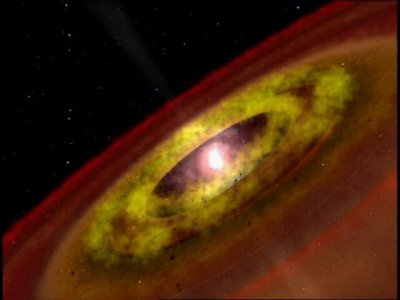
A star forms when the gas (mostly hydrogen) in a region of space becomes dense enough that its gravity causes it to collapse together. As it shrinks, the tiny bits of angular momentum here and there build up, causing it to swirl around and form a protoplanetary disk. Most of the gas clumps in the center, forming the star, and the rest eventually becomes planets, moons, and asteroids. While this is happening, the star is called a protostar.


Once all of the dust has settled, the star officially begins its life, and is called a main sequence star. The mass of the star determines how hot it is, and therefore its color. From low to high, we have red dwarfs, orange dwarfs, yellow dwarfs, and blue . . . giants. A star massive enough to shine blue at birth is too big to be called a dwarf.


Our sun is a yellow dwarf, although it’s actually white, not yellow. The reason it looks yellow, orange, or red when it is low in the sky is because Earth’s atmosphere scatters the shorter wavelengths. this is also why the daytime sky is blue.

There are also brown dwarfs, but they are a little different. Brown dwarfs are objects that ride the fuzzy line between stars and gas giant planets, only hot enough to glow a faint dark red. They are a little over ten times the mass of Jupiter, and a hudredth the mass of the sun.


Stars don’t stay as they are forever. As they fuse up their hydrogen, they expand. A lot. As in, orders of magnitude. Once their hydrogen is spent, they contract until the helium in their cores begins to fuse. As the helium runs low, they expand again. The cycle goes on a few more times. When stars are in their expansion phase, they are called giants, supergiants, or hypergiants depending on their masses, and their color shifts toward the red end of the spectrum. Some stars, however, are so blue that they remain blue even at their largest.


These are all the types of stars that we know about that are around today. However, despite the nearly 14 billion years the universe has been around, it is very young compared to how old it will get. The smaller a star, the slower it fuses its fuel, so the longer every stage of its life lasts. In fact, red dwarf stars are so slow that none of them have used up all of their hydrogen yet. Here’s where things get interesting. It is predicted that red dwarfs don’t expand like other stars. Instead, they get hotter and brighter, turning into blue dwarfs. I find it just amazing that some trillion years in the future, a star type the universe has never seen before will start to appear.


But wait, you say. We can’t be done with stars yet! We haven’t talked about white dwarf stars or neutron stars. And you are correct. The reason we haven’t talked about them today is because they are dead stars, and dead stars are interesting enough that I wanted to give them their own discussion.

Friday, April 12, 2019

The Event Horizon Telescope – Science and the Human Spirit

Black holes are extremely dense. A black hole the mass of the sun would be the size of a small village. They are also extremely dim, giving off no light of their own. The only light that comes from a black hole is from its accretion disk, a swirl of matter bunching together and heating up as it falls into the black hole. All known black holes are extremely far away, in the hearts of star clusters and galaxies. And on Wednesday, the Event Horizon Telescope collaboration released humanity's first photograph of a black hole.

Our first honest-to-God image of a real black hole.
The galaxy the black hole hides in.
The Event Horizon Telescope is one of several modern feats of staggering ingenuity. Eight radio telescopes in Hawaii, Arizona, Nevada, Mexico, Chile, and Antarctica, were synchronized and pointed at the center of the galaxy M87, where a black hole 6.5 billion times the mass of the sun lies. Working together, these telescopes used interferometry to act as a single telescope the size of the entire Earth. This gave them the resolution they needed to collect a long-exposure picture of a supermassive black hole in radio waves.

The universe is stranger and more amazing than we can imagine. From the plains of Africa, to agriculture, to metallurgy, to the industrial revolution, to computers, to supercomputers, we curious humans have explored our world and created new devices of exploration in a cycle that grows ever more impressive. We do things that are bigger than ever before, and then we start on new projects that are even bigger. Someday we will have particle accelerators that go around the sun. Telescopes the size of the solar system. We will resurrect species that have gone extinct. Build artificial minds as versatile as humans, or even more so. Though we cripple ourselves with wars, and greed, and ideological disputes, there is a part of us that sees mystery and just wants to explore. And this spirit of curiosity within us moves us to bridge the gaps, to harness the synergy that arises when many work together for a common goal. And that goal: to learn more about this wonderful, strange, mysterious universe we find ourselves in.

Friday, May 4, 2018

Types of Planets in the Universe

Our world is a planet. This place, where we live our lives and strive for meaning and love, is one large stone among many flying around the sun. But our sun is not alone; there are an uncountable number of stars, and breakthroughs in the past few years have shown us that most if not all stars have their own planets. As of May 5, 2018, over 3700 planets have been found, and the number is growing exponentially. As we learn more about these extrasolar planets, we find that there are many different kinds of planets, some of which are not found in our solar system. So let’s take a look at all of the different and interesting types of planets that can be found around the universe.

For this discussion, I am not going to make any distinction between planets, dwarf planets, and moons. What counts as a moon or dwarf planet in our solar system could easily count as a planet if it were in the right orbit around the right kind of star. In our own solar system, Jupiter’s moon Ganymede and Saturn’s moon Titan are bigger than the planet Mercury, and they would have been planets themselves if they had not been caught by their parents.

Rocky


Starting off with the kind of planet everyone knows about, rocky planets have solid surfaces. Earth is one, as are Mercury, Venus, and Mars. Because Earth is the only planet we know of that has life, we make a guess that the best place to look for life elsewhere in the galaxy is on rocky planets. We have just recently achieved the technology to find them in their host stars’ habitable zones, but we do not yet have powerful enough telescopes to look for life’s signatures in their atmospheres.

Gas giant


These planets are thought to have no surface. They are so big that the pressure from their gravity causes a smooth transition between their gaseous atmospheres and liquid cores. Jupiter and Saturn are our solar system’s representatives of this group. Because they are so massive, they are the easiest type of planet to observe around other stars.

Ice giant


When a planet that would be a gas giant is formed far enough away from its host star, it is formed from the water ice that collects in the outer parts of the stellar system, rather than the hydrogen and metals that collect in the inner regions. Like gas giants, they have no surface, but smoothly transition between gaseous atmosphere and liquid core. In our solar system, Uranus and Neptune are ice giants.

Ice ball

Everyone's favorite.

Like ice giants, planets that are small enough to be rocky but are formed in the outer regions of the solar system where water ice is abundant have a high concentration of ice. Such planets are like Antarctica all the time. Ceres in the asteroid belt, and Pluto and its friends in the Kuiper belt are our neighborhood ice ball planets.

Icy Ocean


There is a special world type that, as far as we know, only exists as moons around gas or ice giants. These moons are far enough from their parent star that their surfaces are covered in thick ice, but the gravity difference across them from the giant planet they orbit causes internal friction, which heats them up inside. These worlds have vast oceans beneath their icy shells, like the Earth’s molten mantle beneath its rocky crust. It is thought that the conditions at the bottom of these oceans might be right for organic molecules to form life, and so they are of interest to exobiologists. Jupiter’s moon Europa and Saturn’s Enceladus are icy ocean worlds.

Tidally locked

Full, half, or crescent, we always see the Man in the Moon.

These are technically not a different kind of planet, but they are interesting enough to have their own mention. When rocky planets are too close to their host stars, the same side always faces the star. They are close enough that the difference between the star’s gravity on one side of the planet and the other is great enough that the heavier density clumps of the planet get stuck pointing toward the star. It is kind of like how balloons float with the tie pointing downward. Our own Moon is tidally locked with Earth, which is why the same face always points toward us. Around stars that are small and dim, like red dwarfs, there can be Earth-sized tidally locked planets in the habitable zone. In fact, the closest star to the sun, Proxima Centauri, has just such a planet. Tidally locked habitable planets have been a hot topic of the astrobiology community, with debates about whether the climate and weather of such places could allow life to exist.

Our sun is not the only star to have planets. In fact, from our various methods of detecting exoplanets in our stellar neighborhood, we have learned that it is extremely rare for a star not to have a few. As with all endeavors to peer into the unknown, the exoplanet search has been a treasure trove of new, exciting knowledge, and we have discovered several exotic planet types that are not found in our solar system.

Hot Jupiter


The first planets we discovered around other stars were larger than Jupiter and had closer orbits than Mercury. This makes sense, because the bigger and closer a planet is to its host star, the more it pulls on that star, and the easier it is to see the signs that it’s there. We used to think gas giants had to be far from their stars, like our solar system’s outer planets, but now we know that inner gas giants are just as common.

Magma


Solar systems are made from collapsing clouds of gas and dust called protoplanetary disks. When this happens, all of the gravitational energy turns into heat, so small enough planets that are close enough to their suns are formed as magma balls. As eons pass, their outsides cool into rocky crusts, becoming the rocky planets with molten cores we are familiar with. Some planets around other stars, however, orbit so close that the heat from the sun keeps their surfaces molten after the formation phase. Magma planets can also be created when gas giants migrate too close to their host stars, and enough of their atmospheres get blown off that the remaining matter forms a molten rock ball.

Ocean

No land.

Our solar system jumps from Earth’s mass to Uranus’s, a 15-fold increase. But there is no reason planets couldn’t form in this mass gap. Indeed, we have found plenty of planets around other stars with multiples of Earth’s mass in the single digits, sometimes called super-Earths. Based on solar system models, we suspect such planets to attract and hold onto more water than Earth, covering their entire surfaces. It is suspected that ocean planets might be far more common than Earth-like worlds with both ocean and land. If this is true, it offers an optimistic solution to the Fermi Paradox: that life is common in the universe, but it almost exclusively arises on ocean planets, where space programs and radio broadcasting are extremely difficult to invent.

Brown dwarf


There is no limit to how big a planet can be; or rather, if it is big enough, it is a star instead of a planet. Because of this, there is a gray area a few times heavier than Jupiter where we are not sure whether to call it a star or a planet. It may have a tiny bit of nuclear fusion in its core, but it is not hot enough to shine. These are called brown dwarfs, following the trend in stars from yellow dwarf, orange dwarf, and red dwarf.

Diamond

Not actually what it looks like.

55 Cancri e is a strange planet. Made almost entirely of carbon, it is eight times the mass of the Earth, but only twice as wide. And what is another name for super-dense carbon? Diamond! That’s right, though extremely rare, there are planets in the universe that are made of diamond, though unfortunately their surfaces are probably covered in graphite. So I guess we could call them pencil planets? Still, 55 Cancri e is a creative spark for writers and artists envisioning a romantic future of humanity in space.

These exotic planets break open the possibility of many more rare planet types waiting to be discovered. Doubtless, this list will be much longer in the future. Heck, our descendants may advance enough someday that they will be able to create custom planets of their own. They might have planets with multiple surfaces, the matter in between carved out like matryoshka dolls. They might have planets covered in computronium, where life has advanced beyond biology and covered the surface with network circuitry, running their own virtual reality universe. For a galactic civilization, such feats of engineering would be child’s play. The universe is strange and wonderful and full of mystery waiting to be uncovered, and possibility waiting to be realized.

Friday, April 13, 2018

A Multitude of Multiverses

Long ago, we believed the Earth, the World, and the Universe were just about the same thing. The heavens were above, and the watery abyss below, and the Earth stood in the middle on its immovable foundations. In the more scholarly parts of the world, the Earth was known to be a sphere, but still thought to be the center of the Universe, with the sun, moon, and stars revolving around it. Since then, a series of world-changing scientific revolutions showed that the Earth revolves around the sun, the sun and all the visible stars are just a tiny section of the Milky Way galaxy, which is one of 50 in the Local Group, which is one of 100 galaxy clusters in the Virgo Supercluster. Yet the observable universe is so vast that 10 million superclusters fit inside it.

Click to enlarge.

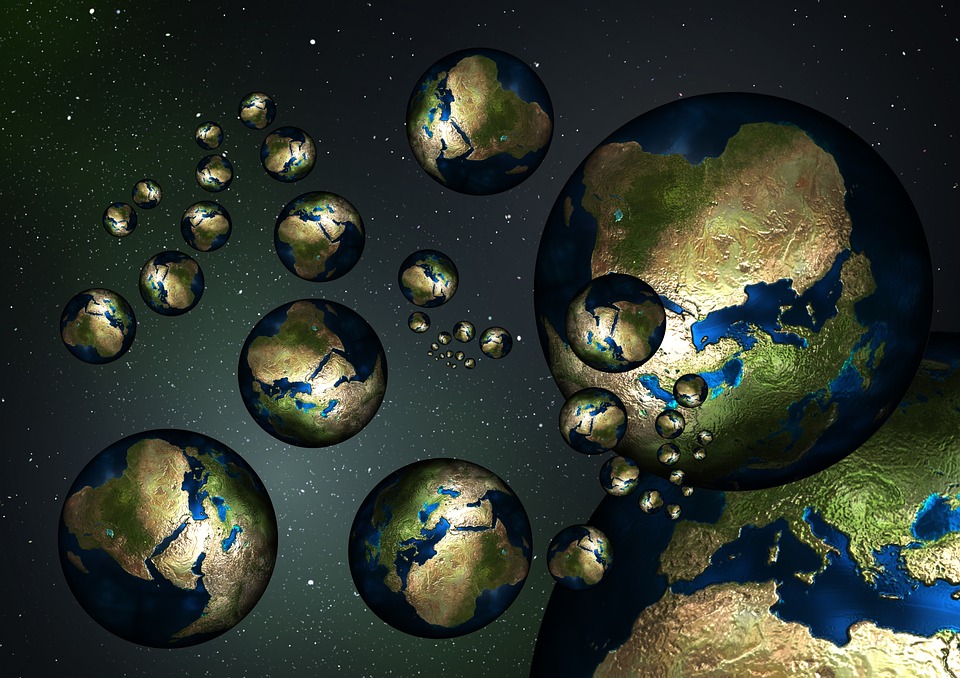
The observable universe is as far as we have been able to see. However, there is no reason to believe reality ends there. Time and again, the Universe has been discovered to be bigger than we thought, so why should it be any different now? Perhaps if we could look far enough in space, back in time, through another dimension, or outside of the space-time continuum, we would find the whole of physical reality to be as much bigger than we think it to be now as our current picture is to the view that Earth is most of reality—many universes, or a multiverse.

How would a multiverse come to be, and how could we know about it? You might think that if something is outside of what is observable to us, then by definition we cannot observe it. However, most multiverse hypotheses are not theories themselves, but the logical conclusions of other theories, which make other, more testable predictions. It actually turns out to be very difficult to come up with a theory that encompasses the entire observable universe throughout space and time without getting a multiverse or two on the side.

Today, we will look at several possible reasons why multiverses might exist, including physical and philosophical. We will also examine the arguments for why this universe might be the only one.

Arguments for a multiverse:

Quantum Many Worlds
The multiverse that most people are familiar with from science fiction is the Many-Worlds interpretation of quantum physics. There have been many a Star Trek episode where a hole opens up in space in front of the Enterprise, and another Enterprise emerges, complete with all of the crew members, but everything is just a little bit different. It is a handy way to write a “what if” story, where in the other universe a key moment for the story played out differently.


Let’s look at the science behind the Many-Worlds hypothesis. Now the average person gets exposed to quantum physics either from science fiction or from modern mystics, both of whom use the word “quantum” as a substitute for “magic;” an empty term meant to convince people the speaker knows what they are talking about. Quantum physics is often described as strange and weird, the same adjectives that are used to describe consciousness, supernatural creatures, spooky coincidences, etc. But just because the same words are used does not mean they have anything to do with each other. Matter can be solid, liquid, gas, or plasma, but that does not mean all matter is made of earth, water, air, and fire. Quantum physics is a real science, the study of the basic building blocks of matter and energy at the scale of atoms and their parts. So let’s leave all of our preconceptions behind and take a look at the real weirdness of quantum physics.

Before quantum physics, the Universe was thought to be deterministic. There was a thought experiment called “Laplace’s Demon,” in which it was imagined that if there were a mind that knew the positions and velocities of every particle in the Universe with infinite precision, that mind would be able to use Isaac Newton’s laws of motion to predict everything that happened in the Universe until the end of time. Everything was thought to be determined ahead of time—not planned or fated, but flowing naturally by the laws of physics with no possibility of changing course.

The essence of the weirdness of quantum physics is that it throws determinism out the window. With classical physics, if you set up two experiments exactly the same, they give you exactly the same result every time. That’s determinism. But in a quantum experiment, you can set up two systems exactly the same, and they can give you different results. For instance, sodium-24 is an unstable atom that decays into magnesium-24, with a half-life of 15 hours. This means that if you have a bunch of sodium-24 atoms, then in 15 hours, roughly half of them will have turned into magnesium-24. This means that if you look at an individual sodium-24 atom, there is a 50% probability that it will decay within 15 minutes, and a 50% probability that it will not. This probability is baked into the fabric of reality, and does not depend on some internal clockwork of the nucleus. Rather than deterministic, quantum physics suggests that at the fundamental level, the Universe is probabilistic.

For myself, I am perfectly happy with accepting quantum physics as probabilistic, that reality itself has an element of chance that cannot be explained away. This view is known as the Copenhagen interpretation of quantum physics. But many people see this as ignoring the question, and insist that there must be some explanation that resonates with a deterministic intuition (or a consciousness-based reality intuition, but that is a topic for another time). One of the most popular explanations is what we have been waiting for, the Many-Worlds interpretation.

The Many-Worlds interpretation of quantum physics says that every time a particle does something that is probabilistic, a new universe branches off in which each possibility happens. If there is a 50% chance that a particle goes to the right and a 50% chance that it goes to the left, then there will be two universes, one in which the particle goes to the right, and one in which it goes to the left.

Schrodinger's Cat. The release of the poison is triggered by the radioactive decay of an atom, so according to the Many-Worlds hypothesis, there are two universes, one in which the cat is alive, and one in which the cat is dead.

The Many-Worlds hypothesis is often explained in terms of choices. It will be said that when you get up in the morning, there will be one universe in which you have cereal for breakfast, and one universe in which you have toast. But this is a misrepresentation. It is not merely choices that cause branching universes, but any time any particle does anything probabilistic. Few people pause to consider the massive implications of this. There are 10^27 atoms in your body alone. That is more than the number of stars in the observable universe. According to the Many-Worlds hypothesis, these atoms are creating branching universes all the time, sometimes at rates much shorter than seconds. The sheer number of universes that would exist under the Many-Worlds hypothesis is beyond comprehension, even for someone like me who spends a lot of time thinking about the size and scope of the universe.

I personally don’t subscribe to the Many-Worlds interpretation, because particles do not behave according to discrete probabilities, but probability densities. To explain what that means, I’ll take us back to the unstable sodium-24 atom. With a 50% chance it will decay within 15 hours and a 50% chance it will decay after 15 hours have passed, that means there will be two universes, right? Not so fast. If we change the time frame—say, 30 hours—then there is a 75% chance it will decay before, and 25% chance it will decay after. This would mean there are three universes in which the atom decays before 30 hours, and one universe in which it decays afterward. But we can change the time again, say 20 hours, 15 minutes, and 22 seconds, and run the probabilities again. In fact, we can set up our time windows to be arbitrarily small, each with its own infinitesimal probability. This would mean that for a single atom, an infinite number of universes would be created. In 50% of these infinite universes, the atom decays before 15 hours, in 25% of the universes, it decays after 30 hours, etc.


Following the Many-Worlds interpretation to its logical conclusion, we don’t end up with a set of discrete universes, but a continuous infinite-dimensional smear of universe-ness. This does not mean it is not true, but if the reason to consider the Many-Worlds interpretation was because the idea of probability being an inherent feature of reality was too weird, it fails, because the explanation it provides is even weirder.

Hubble Volumes
Now for something that is definitely true, but may or may not count as a multiverse depending on your definition. Far off in the depths of space, there are two distances that could be considered the edge of the universe. These distances are spheres that are centered around the Earth, or rather, centered around whoever is doing the observing no matter where in the universe they are. The first is the particle horizon, which is the distance light has had time to travel in the age of the universe. Our universe began 13.8 billion years ago, which means that from 13.8 billion light years away, light from the beginning of the universe is reaching us now. As time goes on, the particle horizon expands at the speed of light. This makes sense, because when the universe was a million years old, the particle horizon was a million light years in radius, and when the universe is a trillion years old, it will be a trillion light years in radius.

But there is another sphere which is important too. The universe is not just sitting still, but it is expanding. The farther away two points are from each other, the faster they are moving apart (assuming they aren’t held together by gravity or other forces). This means there is a distance from Earth at which space is moving away at the speed of light, which is called the cosmic event horizon. Because nothing can travel faster than light, nothing that passes across the cosmic event horizon can ever affect Earth or send signals that could affect Earth.

Whichever is smaller at any given time, the particle horizon or the cosmic event horizon, contains the observable universe. Right now, the cosmic event horizon is around 16 billion light years away, so we have a couple more billion years of new light reaching us before things start vanishing across it.


There isn’t one single observable universe. Rather, every point in space has an observable universe centered around it. Our observable universe is centered on Earth, 13.8 billion light years in all directions. But if we went to the Andromeda galaxy next door, its observable universe would be 13.8 billion light years in all directions centered on it. When talking about the observable universe centered on a point other than the Earth, it becomes confusing, so instead we will call it a Hubble volume, after Edwin Hubble who discovered the expansion of the universe. A galaxy on the edge of our Hubble volume would have its own Hubble volume centered on it, and we would be at the edge of its Hubble volume. Now imagine a galaxy on the opposite side of that Hubble volume. We now have two Hubble volumes that do not overlap. In a sense, we have two different universes. And since we have no indication that there is an end to space, there may be an infinite number of non-overlapping Hubble volume universes. If you interpret this as a multiverse, there is no question that a multiverse exists.

Inflation
During the first Planck-time moments of the big bang, our present cosmological paradigm says the universe expanded at insane speeds many times faster than light. This is called inflation. Within the inflation, a small volume crystallized into what we know as normal space, the parameters of physics freezing into place. This volume continued to expand to become our universe, including everything within our Hubble volume and far beyond.

It might be that elsewhere, far away from us during the inflation era, other universe seeds crystallized into universes with different physical parameters. It could even be that inflation happens forever in space and time, constantly birthing new universes in its infinite expanding alternative-space. Each of these bubbles within inflation would contain many Hubble volumes, and so each of them would be its own Hubble volume multiverse.

Theory of Everything
The universe as we know it had a beginning, the big bang. It might have been the beginning of time, or it may have been a transition from another kind of universe. Either way, when we try to calculate back in time to the earliest moments of the big bang, our current understanding of physics doesn’t work. That’s fine; after all, we have two theories, Quantum Field Theory and General Relativity, and they don’t fit together. Although in this era of the universe they respectively describe the extremely small and the extremely large, the instant of the big bang falls under both of their domains.

In order to understand the beginning of the universe, we need to bridge the gap between Quantum Field Theory and General Relativity. Right now we have two major contenders for such a Theory of Everything: String Theory and Loop Quantum Gravity, though neither of them have been tested. Both theories predict the existence of a multiverse, so if either of them is true, our universe is not alone.

But let’s consider the possibility that both String Theory and Loop Quantum Gravity are false, and some other Theory of Everything that we have not thought of yet is correct. Such a theory must be able to describe the beginning of the universe, either from Nothing or from another universe.  No matter what it is, whatever principle or substance caused our universe to come to be would logically cause a multitude of other universes to be created for the same reason. In fact, I think it would be quite difficult, if not impossible, to formulate a theory of how the universe began that did not leave us with a multiverse.

Metaphysics
If truly no physical law acts upon a State of Nothing, then Nothing cannot remain as it is, nor can there be any limit on what would come from it, because such a limit would count as a law of physics. If that is true, then everything that is logically and mathematically possible must exist, though in completely separate spacetime continua. These possible-made-real universes would range from those with the conditions for life like our own to emerge, to many kinds of universes where life is impossible, to universes that blink out of existence the moment they appear, to the really bizarre, like universes where a single particle corkscrews through space eternally, or where time loops back on itself and events repeat in an eternal cycle.


Arguments against a multiverse:

It is untestable
The most common criticism against the existence of any kind of multiverse is that it can never be tested. If these other universes are disconnected from ours, how could we possibly be able to measure them? It is a fair point, and reminds us to approach the topic with due skepticism, but it isn’t really an argument against a multiverse’s existence. Furthermore, there are some kinds of multiverses that we might, in fact, be able to detect. Gravitational wave detectors might be able to pick up signals from before the big bang, which would confirm that our universe was born from another universe. If String Theory is true, then we might be able to see signs that our 3-brane universe bumped into another 3-brane universe traveling through a fourth dimension. So while some types of multiverses really are untestable, like the physical existence of all things possible, there are some types of multiverses that we simply do not have the technology to test yet.

Strong Anthropic Principle
If our universe is the only one, then there are no other spacetime continua, no extra dimensions, and nothing at all, including space and time, before the big bang. However, in the laws of physics there are several physical constants, which describe the relative scales of things. For instance, the speed of light links space and time, the fine structure constant determines the strength of the electromagnetic force, and Planck’s constant sets the size of atoms. The number of possible combinations of physical constants that can support life is massively dwarfed by the number of combinations that prohibit life from existing. If there is only one universe, then it would be ridiculously unlikely for that one universe to be able to support life. This problem doesn’t have an official name, but I call it the Teleological Paradox, meaning the paradox of apparent design.

If there is a multiverse, then everything that can happen does happen, and the Teleological Paradox goes away. But if there is only one universe, there must be another resolution. One possibility is the Strong Anthropic Principle, the hypothesis that it is impossible for conscious, intelligent minds not to exist. If this is the case, then it is not correct to say the Universe came into being with the conditions for life, but rather the necessity of intelligent minds caused the Universe to come into being.

The Strong Anthropic Principle breaks causality as we know it. In all the rest of our experiences, causality goes from past to future. The Strong Anthropic Principle, on the other hand, says that future events (the existence of intelligent minds) cause the past (the beginning of the universe). The claim that intelligent minds must exist is also arbitrary; there is no more reason that intelligent minds necessarily exist than that elm trees necessarily exist, or that ringed planets necessarily exist. The only reason intelligent minds are chosen as the basis is to patch the Teleological Paradox. Furthermore, we might expect the Strong Anthropic Principle to make a much smaller universe, perhaps just a dwarf galaxy or star cluster, because the rest of the universe isn’t necessary for life. So although the Strong Anthropic Principle has no logical contradictions, it is a very weak explanation for why the universe can support life.

Intelligent Design


Another possible way for our universe to be the only one is if it was created intentionally so that we might exist by a personal God who exists independently of physical reality. But consider this: we have seen through our telescopes that the Universe is vast beyond comprehension. Remember, the universe is expanding, which means the farther something is from us, the faster it is moving away. Almost all of the trillions of galaxies scattered all over the observable universe will be pushed farther and farther away, until they cross the cosmic event horizon, which, remember, is the distance at which the expansion is faster than light. Once this happens, it will be physically impossible to reach them, or even see them anymore. If the Universe was created for us by an intelligent designer, we would either expect these galaxies to be reachable someday, or to not exist. If the goal was to create a universe where intelligent life would arise, it would be far easier to create a single galaxy, or even a single solar system, because that is all that is needed.

Perhaps God created all of those far-off galaxies to show his grand splendor, that the more technologically advanced we get, the greater we find the universe to be, and the more awe we feel for its creator. That makes sense, but let’s follow it through to its full implications. If God created multitudes of galaxies beyond the Virgo Supercluster to display his majesty, then why not for the same reason create a multitude of equally splendorous universes? I think that, even if the cause of the universe was that it was designed by a God, we still have good reason to believe there is a multiverse.

Instinctive Design
Finally, there is the option of some kind of unconscious mind, like the Force or a sleeping God, which created the universe with the right conditions for life out of instinct rather than intent. It may be that this kind of being would create one universe, since one is all that is needed for life. Being instinctive rather than intelligent, it might end up filling the universe with galaxies as a by-product. However, I would expect a universe created by such a being to be teeming with life on every planet, moon, and asteroid, and so far we have found no evidence of life from anywhere besides Earth.

Conclusion:

There are many physical and philosophical theories that hint toward the idea that our universe is not the only one, that there may be several universes, or an infinite number, all with different properties, dimensions, and contents. If this universe is the only one, we run into the Teleological Paradox, that the conditions being right for intelligent life to exist is too improbable to be coincidence. Each of the Teleological Paradox’s possible resolutions predict either that we would more likely find ourselves in a universe that looks quite different from this one, or that we have a multiverse anyway. There is no evidence that a multiverse exists, but with all the possibilities, I would not be surprised if one day we discover, in the depths of time and space or in the hearts of black holes, other universes lying hidden.