Friday, June 14, 2019

Mind-Body Dualism

Consciousness:
The Hard Problem
Dualism
Physicalism
Idealism
Identifying Consciousness

When asking what consciousness is, the first thing we tend to jump to is dualism, the idea that a person’s consciousness is something separate from their body, a soul or a spirit. Sometimes the soul is thought of as an indivisible object, unique for each person, hosting their personality, rationality, perceptions, memories, will, continuing self, and moral worth. Sometimes a soul is thought to be made of a fluid-like substance, which I like to call “soul stuff.” Either way, the soul is thought to be something fundamentally different from the other materials in the universe.


Do souls or soul stuff exist? To explore this, we first have to ask why so many people believe they do. There are two main reasons. The first is because they have been told it is true, by their parents, or religious leaders, or community folk knowledge. The second is because they feel like they are distinct from their body, which can be strengthened if they have had an out-of-body experience. I have had such experiences myself, the most recent of which was only a few months ago. Just as I was waking up one morning, I lifted my hand to scratch my nose, but I didn’t see it. I waved my hand in front of my face, but all I saw was the ceiling above me.

I could have jumped to the conclusion that my soul was moving around outside of my body. But a subjective experience is only evidence that the experience can be had. It is not evidence of anything mystical or metaphysical. Even while I was in the midst of my out-of-body experience, I remembered that the motor cortex in the brain is disconnected from the nervous system during dreams, and what I felt could be explained by the visual part of my brain waking up before my motor cortex, giving me the illusion that I was moving my arm when I was really not.


Of course, my answer is just a hypothesis based on stuff I’ve heard here and there, which is not sufficient evidence to rule out the possibility that I really was waving a spirit arm. So what would be sufficient evidence, either way? Some people believe the existence of a soul is a matter of faith, and it is not testable by scientific means. But does this claim make any sense? It is said that the soul is what makes decisions, controlling the body through the will. If this is the case, then it must exchange energy and momentum with the brain. Even if we grant the possibility that the soul itself is not detectable by any instrument we build, we would still be able to pick up on the bits of energy and momentum spontaneously appearing and disappearing as it exerts its control. Mind-body dualism can, in fact, be tested with the scientific method.


This brings us to a problem I have with the terminology. “Physicalism,” which we will discuss another time, implies consciousness is physical. “Dualism” implies consciousness is separate from physical reality. But if souls or soul stuff exist, and we detect them indirectly as I just mentioned, then scientists will expand the definition of “physical” to include it. The distinction between them is whether consciousness can be explained by what we already know about the universe or something else we haven’t detected yet, not whether it is physical.

There is one way that a soul might affect the brain without messing with its energy or momentum, and that is if we bring in quantum physics. I’ll put the usual disclaimer here: there are a lot of myths about quantum physics and consciousness, and all of them are false. Quantum physics is the study of things the size of atoms and smaller, nothing more. Nevertheless, I am going to talk about a possible way quantum physics and consciousness might be related.

At the size scale where quantum physics is relevant, particles behave probabilistically. Every possible interaction between particles comes with a specific probability, and conserves energy and momentum. We have no evidence to believe the workings of the brain involve quantum physics, but if they do, the soul may be able to exert willpower on the brain by changing the probabilities. Thus, it could control the body without having to worry about physical conservation laws.

This too, however, would be detectable. It would take more advanced technology, but in theory it could be done. If the brain uses quantum physics, we can run simulations to calculate the probabilities of events happening within it. Then, we measure what actually happens. If there is a significant deviation from the probabilities calculated, it is evidence a soul is interfering with them.

If neither of these pan out, there is one final option, which is truly impossible to detect by scientific means. That is if the soul is epiphenomenal, not affecting the brain at all, but just holding a copy of the brain’s perception and memory information. Because an epiphenomenal soul cannot affect the brain, it cannot house one’s personality, rationality, or will. These must instead be completely in the domain of the brain. However, this creates a big problem: if the soul cannot affect the brain, our brains should have no knowledge of it at all, and we shouldn’t be able to have this conversation! The fact that we can think and talk about consciousness suggests that whatever consciousness is, it does indeed affect the brain.


I do not claim to answer whether souls do or do not exist, at least not based on what we have talked about today. Rather, I claim that if souls exist and interact with the brain, then that interaction must be detectable by the scientific method. So much mental effort is expended by philosophers and theologians to hide the soul behind the veil of unfalsifiability, while at the same time insisting it must exist. Let’s stop with this magical thinking and open our minds to the possibility of using experimentation to determine the truth, whichever way it turns out to be.

Friday, May 31, 2019

Dead Stars

A month ago, we looked at the varieties of stars that can be found in the universe. But stars have a limited amount of fuel, and when it runs out, stuff happens. Exactly what happens depends on the mass of the star, and some of them are among the weirdest and most interesting things in the universe.


The most common stellar remnant by far is a white dwarf. White dwarfs are what we get when a star stops fusing its atoms and its matter settles down. In a white dwarf, the gravity is so strong and the pressure is so high that it runs into a physical limit called electron degeneracy. You may have learned in chemistry class that atoms have electron orbitals, sometimes called electron shells, which can only hold a certain number of electrons each. This is an example of electron degeneracy. In a white dwarf, the atoms' outer layers of electrons are unbound, moving freely around the material, and they are degenerate because they have the maximum density allowed by the laws of physics. Because of their variety of temperatures, white dwarfs are not necessarily white, but can also be yellow, orange, red, and brown.

Once our sun goes through all of its phases, it will become a white dwarf, slowly cooling down until the end of time.

There are ways to increase a white dwarf's pressure beyond the electron degeneracy limit. One of them is for it to be made of denser material. Some white dwarfs are made of helium, which has two protons and two electrons, neither of which are bound to it. Other white dwarfs are made of various mixtures of carbon, oxygen, neon, and magnesium, each of which is more dense and has more bound electrons not contributing to degeneracy.

The other way to increase the pressure is for gravity to be so strong that the electrons combine with the protons, making neutrons. When this happens, there is no more electrical repulsion, and all of the matter collapses to the density of an atomic nucleus, where neutron degeneracy once again makes things stable. You can probably guess what neutron degeneracy is; if electron degeneracy is what we get when we have the maximum density of electrons, neutron degeneracy is what we get when we have the maximum density of neutrons. A stellar remnant made of neutron degenerate matter is called a neutron star.


White dwarfs do not turn into neutron stars. Instead, we start out with a very massive star, which has enough pressure to fuse its atoms beyond the elements mentioned above. The higher the element number, the faster the fusion happens, until it reaches core collapse, which causes a supernova and leaves behind a neutron star.

When neutron stars are young, they shoot high-energy gets of light and other radiation from their magnetic poles. They are also spinning, and their rotational poles are not lined up with their magnetic poles. This means their jets spiral around in a pair of cones. If Earth is in the path of one of these jets, the neutron star appears to pulsate in the night sky. Because of this, we call this kind of neutron stars pulsars. Most pulsars rotate once every few seconds, but some are as fast as a few milliseconds.

By Kevin Gill on Flickr
Some neutron stars have the strongest known magnetic fields in the uinverse, strong enough to deform atoms. These neutron stars are called magnetars.

If a relatively small supernova makes a neutron star, what happens if we turn up the mass? If we explode progressively heavier supergiant stars, we get heavier and heavier neutron stars, until suddenly . . . there is nothing. The star explodes, leaving only empty space behind. According to supernova theory and observational data, there is a mass gap between neutron stars around three times the mass of the sun and our next type of stellar remnant at five times the mass of the sun. This heavier next type is what I’m sure you have been waiting for this whole blog post: black holes.


An ancient philosophical question goes like this: what happens when an immovable object encounters and unstoppable force? Well it turns out that there is no such thing as an immovable object, but gravity can get strong enough to become an unstoppable force. If enough mass gets crammed into a small enough space, not even neutron degeneracy can prevent it from collapsing down to an infinitesimal point called a singularity. A certain distance away from the singularity, called the event horizon, gravity switches between weak enough to escape from and too strong for anything to resist. The event horizon is the black ball we picture when we think about black holes. Black holes are so mind-bendingly fascinating that they deserve a whole discussion to themselves.

These are all of the stellar remnant types we have evidence for (and as of last month, I might add with pride, we have pictures to back all of them up). However, there are still more which are theorized to exist, either presently unobserved or far in the future.

It may be that between neutron stars and black holes, there is another stopping-off point. Neutrons are made of quarks, so perhaps quark degeneracy can stop the formation of a black hole when neutron degeneracy is not enough. Such an object would, unsurprisingly, be called a quark star. It is unknown whether this is possible; the only hint we have is the small amounts of quark-gluon plasma made in particle accelerators under completely different conditions than we would expect in quark stars.


Remember how we left white dwarfs cooling off indefinitely? One day, many eons in the future, white dwarf stars will have cooled so much that they no longer give off any visible light. Then, they will be called black dwarfs. The time it will take for white dwarfs to cool down this much is orders of magnitude longer than the current age of the universe.

Yet even black dwarfs are not the end state of stellar remnants. To find out why, we have to talk about nuclear fission and fusion. Radioactive materials break apart into lighter elements, each with its own half-life, the time it takes for roughly half of the atoms to decay. This is natural nuclear fission. Fusion happens when atoms fuse together into heavier elements, releasing energy. Now you might notice that I said both fission and fusion release energy. This is only true when the product has less mass per nucleon (less energy density) than what we started out with. Iron has the lightest mass per nucleon of all, so the elements lighter than iron fuse, and the elements heavier than iron fission.

When we talk about radioactivity, we say that some atoms heavier than iron are radioactive, and some are stable. When we talk about fusion, we imagine we need the pressures and temperatures at the core of a star. These are both not entirely true. High temperatures and pressures raise the probability of fusion, but that probability never goes to zero. Similarly, the “stable” heavier-than-iron elements have an extremely long, but not infinite, half-life. For us humans, it is true enough to say fusion requires enormous temperatures and pressures, and many heavy elements are stable.

But if we look ahead in the future, and I mean so far ahead that it might as well be infinite, we get a different story. Given an infinite amount of time, anything with a static non-zero probability is guaranteed to happen, no matter how small that probability is. On a large enough timescale, black dwarfs will fuse their atoms together into iron, and any elements heavier than iron will break apart into iron. Long after even the biggest black holes have evaporated, iron stars will be the last objects left in the universe.

Friday, May 10, 2019

Mathematics: The Language of the Universe

Nature of Reality:
Quasi-Realism
Representational Realism
Existence and Natures
Knowledge of Reality
The Language of Reality

Toolbelt of Knowledge: Concepts
Algorithms
Equivalence
Emergence
Math
The Anthropic Principle
Substrate-Independence
Significance

In our discussions about the nature of reality, we have come to the view that reality is a thing unto itself, independent of perception, belief, or knowledge. Anything we perceive or think we know about reality is not reality itself, but only a representation we have constructed in our minds. A representation is true to the degree that its logic matches with the logic of the real thing it is describing. Today, we are going to talk about that logic, mathematics.

By WyrdWolf on Deviantart
A lot of people see math as something mysterious that they will never understand. But math is not supernatural. It is not hidden knowledge available only to an elite few. People who know math are not wizards or prophets, they are normal people just like you. I hope that after reading this discussion, you will be convinced that you can learn math too, if you so desire.

To start, let’s forget about numbers and just think about something physical, like air pressure. We know from centuries of experiments that, the pressure in a given volume is proportional to the number of molecules in the volume and the temperature. This may sound complicated, but all it means is if more air is added or the temperature is increased, the pressure increases.

Let’s look at the italicized statement. We have four physical quantities: pressure, volume, number of molecules, and temperature. Let’s shorten each of these to just their first letters: P, V, N, and T. “Is proportional to” means if you change what comes after it, then what comes before it changes by the same percentage. We can represent this by an equals sign and a constant, the letter k. Put this together, and we have,


It’s an equation! We have just done something marvelous; we have taken a fact about reality and written it as a mathematical statement. By doing this, we realize a profound truth: math is not just a tool to work with numbers and get answers to homework problems; it’s a language and a writing system. By becoming math-literate, we break into a higher level of understanding the universe.

Let’s try it again. This time we’ll start with an equation, and figure out what it means.

The first thing we need when trying to read this equation is what the letters mean. In normal languages, letters have mostly the same sounds wherever they appear. In math, it is not so; we must be told what each letter means every time. It is the organization, operations, and numbers that have consistent meaning. So here is what the letters in our new equation mean: capital T stands for temperature, small t stands for time, and k is a constant.

What operations does this equation have? The first thing we notice is d/d. This means, the rate at which the thing on top changes as the thing on the bottom changes. So for us, it would be the rate the temperature changes over time. Next, we notice a triangle before the T on the right. This triangle means the difference between two of what comes after it. So in our case, ΔT means the difference between the temperatures of two objects.

Putting all this together, we can read the equation. It says, “The rate at which temperature flows between two touching objects is proportional to the difference in temperature between the two objects.” This means if two touching objects have very different temperatures, heat will flow quickly between them, but if their temperatures are near each other, the heat will flow slowly.

There is one final piece to the equation, and that is the minus sign. This tells us that the temperatures are changing closer to one another, not running away to extremes. This makes sense. Cold things heat up when they touch hot things, and hot things cool down when they touch cold things. Heat always flows toward equilibrium.

The ability to read equations is only one small part of math. There is also geometry, group theory, set theory, vectors, tensors, and much more. All of these fields of study are called the same thing, math, so what do they all have in common? The answer is that mathematics is the set of all well-defined abstract ideas that follow the principle of non-contradiction. To create math, we must declare one or more axioms, statements that define an imaginary object.


Let’s take an example. "A circle is a shape where every point on its boundary is the same distance from its center." Based on this axiom, we can figure out all kinds of things about lines drawn through circles, intersecting circles, circles in curved space, and more. Everything in math is like this; we start with axioms, and then use logic on them to figure out all that we can about them.


Philosophers and scientists have often wondered at how well math is able to describe the universe. To some, it seems miraculous. However, based on everything we have talked about in the Nature of Reality series, I think it makes perfect sense. Here’s why:

1) A representation is true to the degree that its logic lines up with the logic of the part of reality it is meant to represent.
2) An idea is a representation.
3) Reality is well-defined and always follows the principle of non-contradiction.
4) Every idea that is well-defined and follows non-contradiction is mathematical.
Therefore, everything in reality can be truthfully represented by mathematical ideas.

If we accept the views of reality we have argued for on this blog, this is why Mathematics is the language of the universe.

Friday, May 3, 2019

Types of Stars in the Universe

On a clear, dark night, stars fill the expanse of the sky. These tiny dots of light twinkle and shine, as if the canopy between Heaven and Earth were pricked by a million needles and the holy light of God were shining through. Ever since our distant ancestors separated from the chimpanzees, we have gazed at the Milky Way with awe, imbuing it with images and meaning and stories. The stars are among the most wondrous things in existence.


With the dawn of science, we learned that the stars are other suns, each with its own set of planets. Stars come in many sizes and colors, depending on what they are made of and how far along they are in their life cycle. A star’s light comes from its surface temperature, as it radiates its heat energy away. The hotter the star, the brighter it shines, and the higher the peak frequency of its light. It is the same as why metals glow when they are heated. In order of increasing temperature, we get red, orange, yellow, white, and then blue. Because of the distribution of the light radiated, and the way our eyes work, we will never find a green or purple star.

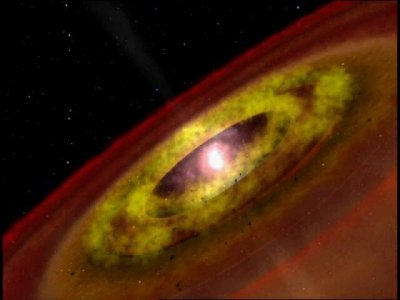
A star forms when the gas (mostly hydrogen) in a region of space becomes dense enough that its gravity causes it to collapse together. As it shrinks, the tiny bits of angular momentum here and there build up, causing it to swirl around and form a protoplanetary disk. Most of the gas clumps in the center, forming the star, and the rest eventually becomes planets, moons, and asteroids. While this is happening, the star is called a protostar.


Once all of the dust has settled, the star officially begins its life, and is called a main sequence star. The mass of the star determines how hot it is, and therefore its color. From low to high, we have red dwarfs, orange dwarfs, yellow dwarfs, and blue . . . giants. A star massive enough to shine blue at birth is too big to be called a dwarf.


Our sun is a yellow dwarf, although it’s actually white, not yellow. The reason it looks yellow, orange, or red when it is low in the sky is because Earth’s atmosphere scatters the shorter wavelengths. this is also why the daytime sky is blue.

There are also brown dwarfs, but they are a little different. Brown dwarfs are objects that ride the fuzzy line between stars and gas giant planets, only hot enough to glow a faint dark red. They are a little over ten times the mass of Jupiter, and a hudredth the mass of the sun.


Stars don’t stay as they are forever. As they fuse up their hydrogen, they expand. A lot. As in, orders of magnitude. Once their hydrogen is spent, they contract until the helium in their cores begins to fuse. As the helium runs low, they expand again. The cycle goes on a few more times. When stars are in their expansion phase, they are called giants, supergiants, or hypergiants depending on their masses, and their color shifts toward the red end of the spectrum. Some stars, however, are so blue that they remain blue even at their largest.


These are all the types of stars that we know about that are around today. However, despite the nearly 14 billion years the universe has been around, it is very young compared to how old it will get. The smaller a star, the slower it fuses its fuel, so the longer every stage of its life lasts. In fact, red dwarf stars are so slow that none of them have used up all of their hydrogen yet. Here’s where things get interesting. It is predicted that red dwarfs don’t expand like other stars. Instead, they get hotter and brighter, turning into blue dwarfs. I find it just amazing that some trillion years in the future, a star type the universe has never seen before will start to appear.


But wait, you say. We can’t be done with stars yet! We haven’t talked about white dwarf stars or neutron stars. And you are correct. The reason we haven’t talked about them today is because they are dead stars, and dead stars are interesting enough that I wanted to give them their own discussion.

Friday, April 19, 2019

Keeping Science Accountable – The Sokal Affair

In 1996, a physicist named Alan Sokal submitted a paper to a non-physics academic journal. The paper argued that the idea of an objective physical reality was a social construct to keep scientific power in the hands of the elites. The paper was accepted and published. Three weeks later, Sokal publicly announced that the paper had been a joke, its logic and technical language either made up or used nonsensically, and the reason he submitted it was to test the integrity of the journal. This became known as the Sokal Affair.

Sokal exposed a fact that can sometimes make scientists uncomfortable: science is not inherently superior to all other collaborative methods of determining truth. It has to earn that status by being intellectually rigorous, which means defining terms clearly, making hypotheses that are falsifiable, accounting for all variables, taking unbiased data, and analyzing the data with the best, most applicable statistical methods available. If a journal allows papers that do not live up to these standards, that journal is no longer a vehicle of science, but of dogma.

After Sokal revealed the paper to be a hoax, there were cries of foul play. He had, after all, intentionally published a paper with false data and results. Fabrication is considered profane among scientists, and can result in the author being ostracized from the scientific community. However, the reason for this is because it spreads false information. Sokal’s purpose was not to spread false information, but exactly the opposite: to expose and prevent the spreading of false information by the journal.

Within the past few years, a team of academics followed in Sokal’s footsteps by submitting several bogus papers to a few different journals. Many of these papers, including a passage from Mein Kampf with key words swapped out, were accepted. Luckily, the Mein Kampf plagiarism wasn’t actually published. This became known as Sokal Squared, and also received blowback. It should be noted that Sokal Squared was not meant to discredit the fields being studied, but to expose the fact that it was being done wrong in these particular journals.

I believe the authors in the Sokal and Sokal Squared affairs did absolutely nothing wrong. In fact, what they did is perfectly in line with the scientific process, which is to continually test ideas from every different angle to see whether they can stand up to it. I think that every academic journal, from the natural sciences to the humanities, from the most prestigious to the peripheral, should be regularly put to a Sokal Test. By this, I mean that people from different fields of study, or who are not professional academics, should write nonsense papers using the journals’ jargon, and see if they get accepted. Anyone writing a hoax paper should be required to reveal the hoax within a reasonable amount of time. Journals that fail the Sokal Test will lose reputation points, and those that pass will gain prestige.

Science is an amazing vehicle for understanding the universe and what happens within it. It is naturally competitive, its scholars each putting forth their own theories and doing their best to prove everybody else wrong. To do this, they use every legitimate trick in the book: making sure all significant variables are accounted for, checking the data collection methods for bias, and many others. But these feedback processes are largely self-contained within each discipline, which means they can become corrupted and watered down. Instituting a Sokal Test would be an effective and equitable way to keep journals accountable to scientists in other disciplines, and to everyone who is interested in true scientific knowledge.

Friday, April 12, 2019

The Event Horizon Telescope – Science and the Human Spirit

Black holes are extremely dense. A black hole the mass of the sun would be the size of a small village. They are also extremely dim, giving off no light of their own. The only light that comes from a black hole is from its accretion disk, a swirl of matter bunching together and heating up as it falls into the black hole. All known black holes are extremely far away, in the hearts of star clusters and galaxies. And on Wednesday, the Event Horizon Telescope collaboration released humanity's first photograph of a black hole.

Our first honest-to-God image of a real black hole.
The galaxy the black hole hides in.
The Event Horizon Telescope is one of several modern feats of staggering ingenuity. Eight radio telescopes in Hawaii, Arizona, Nevada, Mexico, Chile, and Antarctica, were synchronized and pointed at the center of the galaxy M87, where a black hole 6.5 billion times the mass of the sun lies. Working together, these telescopes used interferometry to act as a single telescope the size of the entire Earth. This gave them the resolution they needed to collect a long-exposure picture of a supermassive black hole in radio waves.

The universe is stranger and more amazing than we can imagine. From the plains of Africa, to agriculture, to metallurgy, to the industrial revolution, to computers, to supercomputers, we curious humans have explored our world and created new devices of exploration in a cycle that grows ever more impressive. We do things that are bigger than ever before, and then we start on new projects that are even bigger. Someday we will have particle accelerators that go around the sun. Telescopes the size of the solar system. We will resurrect species that have gone extinct. Build artificial minds as versatile as humans, or even more so. Though we cripple ourselves with wars, and greed, and ideological disputes, there is a part of us that sees mystery and just wants to explore. And this spirit of curiosity within us moves us to bridge the gaps, to harness the synergy that arises when many work together for a common goal. And that goal: to learn more about this wonderful, strange, mysterious universe we find ourselves in.

Friday, April 5, 2019

Economics: Motivations and Incentives

[Retrospective note: this post is more of a case study of the modern American economy, and not as general as I would like. To see an updated version of this discussion, click here.]

In order for an economy to run, work must be done. Producing and distributing goods and services takes labor and organization. So naturally, the question arises, what motivates people to do these things?

The most common motivation for individuals throughout history, past and present, is the threat of poverty and starvation. You work, you get paid, you pay your bills. But given the opportunity, people will also work for other reasons. Some like the promise of wealth and moving up in the hierarchies of company and society. Others work because it provides joy and purpose to their lives. Still others have a strong sense of duty, and cannot rest unless they have given their fair share of effort toward supporting society. Others see problems in society, and their compassion moves them to help.

People also generally like to do what is right, especially if it is easy. For instance, if recycling means taking a load of trash in your car to a facility twenty miles away, not very many people will recycle. However, if there are conveniently-placed blue bins all over the place that somebody else takes care of, almost everybody will recycle.

The economy does not primarily run on individual people, though. The real power behind an economy is in its businesses. Yes, businesses are run by people, but the businesses themselves can be looked at as if they have their own motivations. It is an emergent phenomenon. If we want to understand the driving force of an economy, it is businesses’ motivations we have to look at.

Like people, businesses have a variety of motivating forces. Some businesses want to provide high-quality services. Some aim to solve problems for humanity. But by far, the most significant driver for businesses is profit. Money allows businesses to grow and become more powerful, so the biggest, most powerful, most economically significant companies are the ones who orient their capacities toward making more money.

Naturally, profit-oriented companies want to increase their prices and lower their wages as much as they can, while still having people buy from and work for them. This is not aligned with the purpose of the economy, which is to meet people’s needs and provide an environment in which they can pursue meaningful lives. The most commonly championed counter-force to these self-centered practices is competition. In a competitive market, more workers apply for the companies with the highest-paying wages, and more customers buy from the companies with the lowest prices.

However, because competition makes wages higher and prices lower, companies don’t like it. So they try to get around the competition, by either putting the other companies out of business, or buying them out. Thus, competitive markets are unstable, because if one company pulls ahead a little bit, they have an advantage that grows at an accelerating rate. This leads to monopolies, companies that control a product’s entire market.

Companies are also prone to causing collateral damage. Pollution, for instance, as well as other kinds. If it is more cost-effective to dump your chemicals in the river than to properly dispose of them, you’re going to dump them in the river. Of course, it is best for all companies together if they don’t pollute, but for each company individually, it is more advantageous to pollute no matter what other companies do. This an example of the Prisoner’s Dilemma.

It is also a senescent behavior. Senescence is a term from biology, which refers to the deteriorative processes of aging. In economics, senescent behaviors are actions that give short term gains, but have negative effects that build up in the long run. The quintessential example of a senescent behavior in the economy today is carbon dioxide emissions, which build up slowly in the atmosphere over time, only causing problems after many years.

Luckily, there are ways to mitigate or guide the profit incentive so that it serves human interests. If a large number of people come together in a social movement and refuse to buy a certain company’s product, the company will lose out on profit unless they change their behavior. Workers can band together in unions to demand more reasonable wages and benefits. And the government can add incentives, like minimum wages, taxes, subsidies, regulations, and plenty of others.

Of course, companies will fight against anything that would reduce their profits. Not all companies, of course, but a significant fraction. They will try to use the government to reduce taxes, limit unions, repeal important regulations, and otherwise turn the tables in their favor.

It is important to note, however, that things are not black and white. It is not simply the good people versus the bad companies. Many companies do a lot of good for humanity, and we want the Elon Musks of the world to be free to do their thing. The key is smart legislation. It is not enough to simply be “for people.” When coming up with policies, it is important to make decisions based on the numbers and the science, so that we know it will help, and not accidentally make things worse.

Finally, we must remember that companies love to replace workers with machines, because a machine costs a whole lot less than a human. As robotics and artificial intelligence continue to get better, the space of economically relevant human tasks continues to shrink. This is both good and bad. Good, because companies can offer their goods and services for even cheaper. Bad, because people are having a harder and harder time finding work. We will talk more about this in discussions to come.