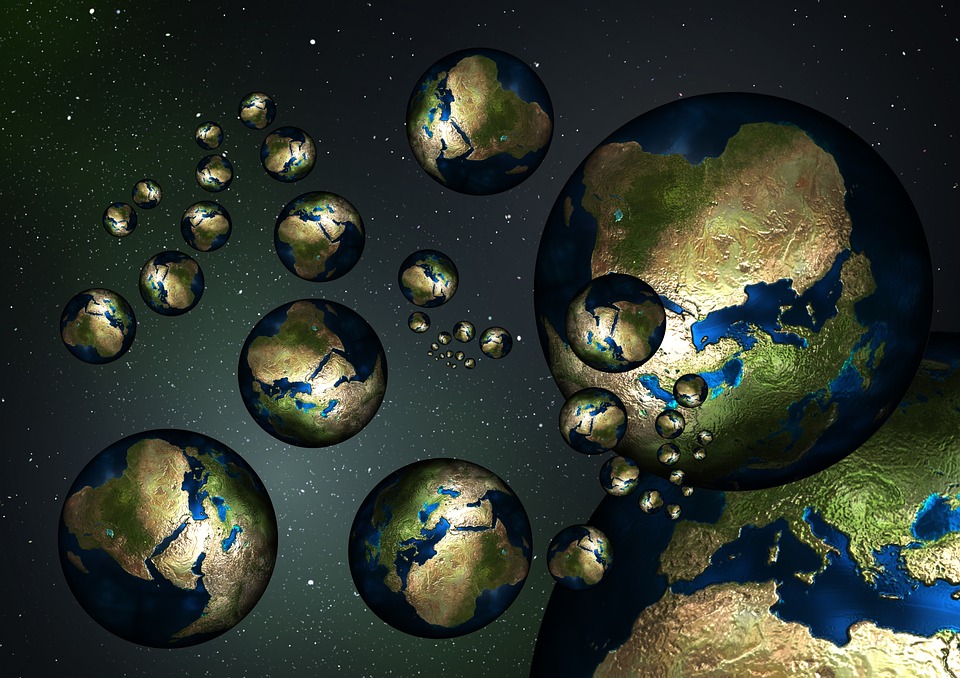
Long ago, we believed the Earth, the World, and the Universe were just about the same thing. The heavens were above, and the watery abyss below, and the Earth stood in the middle on its immovable foundations. In the more scholarly parts of the world, the Earth was known to be a sphere, but still thought to be the center of the Universe, with the sun, moon, and stars revolving around it. Since then, a series of world-changing scientific revolutions showed that the Earth revolves around the sun, the sun and all the visible stars are just a tiny section of the Milky Way galaxy, which is one of 50 in the Local Group, which is one of 100 galaxy clusters in the Virgo Supercluster. Yet the observable universe is so vast that 10 million superclusters fit inside it.
 |
| Click to enlarge. |
The observable universe is as far as we have been able to see. However, there is no reason to believe reality ends there. Time and again, the Universe has been discovered to be bigger than we thought, so why should it be any different now? Perhaps if we could look far enough in space, back in time, through another dimension, or outside of the space-time continuum, we would find the whole of physical reality to be as much bigger than we think it to be now as our current picture is to the view that Earth is most of reality—many universes, or a multiverse.
How would a multiverse come to be, and how could we know about it? You might think that if something is outside of what is observable to us, then by definition we cannot observe it. However, most multiverse hypotheses are not theories themselves, but the logical conclusions of other theories, which make other, more testable predictions. It actually turns out to be very difficult to come up with a theory that encompasses the entire observable universe throughout space and time without getting a multiverse or two on the side.
Today, we will look at several possible reasons why multiverses might exist, including physical and philosophical. We will also examine the arguments for why this universe might be the only one.
Arguments for a multiverse:
Quantum Many Worlds
The multiverse that most people are familiar with from science fiction is the Many-Worlds interpretation of quantum physics. There have been many a Star Trek episode where a hole opens up in space in front of the Enterprise, and another Enterprise emerges, complete with all of the crew members, but everything is just a little bit different. It is a handy way to write a “what if” story, where in the other universe a key moment for the story played out differently.

Let’s look at the science behind the Many-Worlds hypothesis. Now the average person gets exposed to quantum physics either from science fiction or from modern mystics, both of whom use the word “quantum” as a substitute for “magic;” an empty term meant to convince people the speaker knows what they are talking about. Quantum physics is often described as strange and weird, the same adjectives that are used to describe consciousness, supernatural creatures, spooky coincidences, etc. But just because the same words are used does not mean they have anything to do with each other. Matter can be solid, liquid, gas, or plasma, but that does not mean all matter is made of earth, water, air, and fire. Quantum physics is a real science, the study of the basic building blocks of matter and energy at the scale of atoms and their parts. So let’s leave all of our preconceptions behind and take a look at the real weirdness of quantum physics.
Before quantum physics, the Universe was thought to be deterministic. There was a thought experiment called “Laplace’s Demon,” in which it was imagined that if there were a mind that knew the positions and velocities of every particle in the Universe with infinite precision, that mind would be able to use Isaac Newton’s laws of motion to predict everything that happened in the Universe until the end of time. Everything was thought to be determined ahead of time—not planned or fated, but flowing naturally by the laws of physics with no possibility of changing course.
The essence of the weirdness of quantum physics is that it throws determinism out the window. With classical physics, if you set up two experiments exactly the same, they give you exactly the same result every time. That’s determinism. But in a quantum experiment, you can set up two systems exactly the same, and they can give you different results. For instance, sodium-24 is an unstable atom that decays into magnesium-24, with a half-life of 15 hours. This means that if you have a bunch of sodium-24 atoms, then in 15 hours, roughly half of them will have turned into magnesium-24. This means that if you look at an individual sodium-24 atom, there is a 50% probability that it will decay within 15 minutes, and a 50% probability that it will not. This probability is baked into the fabric of reality, and does not depend on some internal clockwork of the nucleus. Rather than deterministic, quantum physics suggests that at the fundamental level, the Universe is probabilistic.
For myself, I am perfectly happy with accepting quantum physics as probabilistic, that reality itself has an element of chance that cannot be explained away. This view is known as the Copenhagen interpretation of quantum physics. But many people see this as ignoring the question, and insist that there must be some explanation that resonates with a deterministic intuition (or a consciousness-based reality intuition, but that is a topic for another time). One of the most popular explanations is what we have been waiting for, the Many-Worlds interpretation.
The Many-Worlds interpretation of quantum physics says that every time a particle does something that is probabilistic, a new universe branches off in which each possibility happens. If there is a 50% chance that a particle goes to the right and a 50% chance that it goes to the left, then there will be two universes, one in which the particle goes to the right, and one in which it goes to the left.
 |
| Schrodinger's Cat. The release of the poison is triggered by the radioactive decay of an atom, so according to the Many-Worlds hypothesis, there are two universes, one in which the cat is alive, and one in which the cat is dead. |
The Many-Worlds hypothesis is often explained in terms of choices. It will be said that when you get up in the morning, there will be one universe in which you have cereal for breakfast, and one universe in which you have toast. But this is a misrepresentation. It is not merely choices that cause branching universes, but any time any particle does anything probabilistic. Few people pause to consider the massive implications of this. There are 10^27 atoms in your body alone. That is more than the number of stars in the observable universe. According to the Many-Worlds hypothesis, these atoms are creating branching universes all the time, sometimes at rates much shorter than seconds. The sheer number of universes that would exist under the Many-Worlds hypothesis is beyond comprehension, even for someone like me who spends a lot of time thinking about the size and scope of the universe.
I personally don’t subscribe to the Many-Worlds interpretation, because particles do not behave according to discrete probabilities, but probability densities. To explain what that means, I’ll take us back to the unstable sodium-24 atom. With a 50% chance it will decay within 15 hours and a 50% chance it will decay after 15 hours have passed, that means there will be two universes, right? Not so fast. If we change the time frame—say, 30 hours—then there is a 75% chance it will decay before, and 25% chance it will decay after. This would mean there are three universes in which the atom decays before 30 hours, and one universe in which it decays afterward. But we can change the time again, say 20 hours, 15 minutes, and 22 seconds, and run the probabilities again. In fact, we can set up our time windows to be arbitrarily small, each with its own infinitesimal probability. This would mean that for a single atom, an infinite number of universes would be created. In 50% of these infinite universes, the atom decays before 15 hours, in 25% of the universes, it decays after 30 hours, etc.

Following the Many-Worlds interpretation to its logical conclusion, we don’t end up with a set of discrete universes, but a continuous infinite-dimensional smear of universe-ness. This does not mean it is not true, but if the reason to consider the Many-Worlds interpretation was because the idea of probability being an inherent feature of reality was too weird, it fails, because the explanation it provides is even weirder.
Hubble Volumes
Now for something that is definitely true, but may or may not count as a multiverse depending on your definition. Far off in the depths of space, there are two distances that could be considered the edge of the universe. These distances are spheres that are centered around the Earth, or rather, centered around whoever is doing the observing no matter where in the universe they are. The first is the
particle horizon, which is the distance light has had time to travel in the age of the universe. Our universe began 13.8 billion years ago, which means that from 13.8 billion light years away, light from the beginning of the universe is reaching us now. As time goes on, the particle horizon expands at the speed of light. This makes sense, because when the universe was a million years old, the particle horizon was a million light years in radius, and when the universe is a trillion years old, it will be a trillion light years in radius.
But there is another sphere which is important too. The universe is not just sitting still, but it is expanding. The farther away two points are from each other, the faster they are moving apart (assuming they aren’t held together by gravity or other forces). This means there is a distance from Earth at which space is moving away at the speed of light, which is called the
cosmic event horizon. Because nothing can travel faster than light, nothing that passes across the cosmic event horizon can ever affect Earth or send signals that could affect Earth.
Whichever is smaller at any given time, the particle horizon or the cosmic event horizon, contains the
observable universe. Right now, the cosmic event horizon is around 16 billion light years away, so we have a couple more billion years of new light reaching us before things start vanishing across it.
There isn’t one single observable universe. Rather, every point in space has an observable universe centered around it. Our observable universe is centered on Earth, 13.8 billion light years in all directions. But if we went to the Andromeda galaxy next door, its observable universe would be 13.8 billion light years in all directions centered on it. When talking about the observable universe centered on a point other than the Earth, it becomes confusing, so instead we will call it a
Hubble volume, after Edwin Hubble who discovered the expansion of the universe. A galaxy on the edge of our Hubble volume would have its own Hubble volume centered on it, and we would be at the edge of its Hubble volume. Now imagine a galaxy on the opposite side of that Hubble volume. We now have two Hubble volumes that do not overlap. In a sense, we have two different universes. And since we have no indication that there is an end to space, there may be an infinite number of non-overlapping Hubble volume universes. If you interpret this as a multiverse, there is no question that a multiverse exists.
Inflation
During the first Planck-time moments of the big bang, our present cosmological paradigm says the universe expanded at insane speeds many times faster than light. This is called
inflation. Within the inflation, a small volume crystallized into what we know as normal space, the parameters of physics freezing into place. This volume continued to expand to become our universe, including everything within our Hubble volume and far beyond.
It might be that elsewhere, far away from us during the inflation era, other universe seeds crystallized into universes with different physical parameters. It could even be that inflation happens forever in space and time, constantly birthing new universes in its infinite expanding alternative-space. Each of these bubbles within inflation would contain many Hubble volumes, and so each of them would be its own Hubble volume multiverse.
Theory of Everything
The universe as we know it had a beginning, the big bang. It might have been the beginning of time, or it may have been a transition from another kind of universe. Either way, when we try to calculate back in time to the earliest moments of the big bang, our current understanding of physics doesn’t work. That’s fine; after all, we have two theories, Quantum Field Theory and General Relativity, and they don’t fit together. Although in this era of the universe they respectively describe the extremely small and the extremely large, the instant of the big bang falls under both of their domains.
In order to understand the beginning of the universe, we need to bridge the gap between Quantum Field Theory and General Relativity. Right now we have two major contenders for such a Theory of Everything: String Theory and Loop Quantum Gravity, though neither of them have been tested. Both theories predict the existence of a multiverse, so if either of them is true, our universe is not alone.
But let’s consider the possibility that both String Theory and Loop Quantum Gravity are false, and some other Theory of Everything that we have not thought of yet is correct. Such a theory must be able to describe the beginning of the universe, either from Nothing or from another universe. No matter what it is, whatever principle or substance caused our universe to come to be would logically cause a multitude of other universes to be created for the same reason. In fact, I think it would be quite difficult, if not impossible, to formulate a theory of how the universe began that did not leave us with a multiverse.
Metaphysics
If truly no physical law acts upon a State of Nothing, then Nothing cannot remain as it is, nor can there be any limit on what would come from it, because such a limit would count as a law of physics. If that is true, then everything that is logically and mathematically possible must exist, though in completely separate spacetime continua. These possible-made-real universes would range from those with the conditions for life like our own to emerge, to many kinds of universes where life is impossible, to universes that blink out of existence the moment they appear, to the really bizarre, like universes where a single particle corkscrews through space eternally, or where time loops back on itself and events repeat in an eternal cycle.
Arguments against a multiverse:
It is untestable
The most common criticism against the existence of any kind of multiverse is that it can never be tested. If these other universes are disconnected from ours, how could we possibly be able to measure them? It is a fair point, and reminds us to approach the topic with due skepticism, but it isn’t really an argument against a multiverse’s existence. Furthermore, there are some kinds of multiverses that we might, in fact, be able to detect. Gravitational wave detectors might be able to pick up signals from before the big bang, which would confirm that our universe was born from another universe. If String Theory is true, then we might be able to see signs that our 3-brane universe bumped into another 3-brane universe traveling through a fourth dimension. So while some types of multiverses really are untestable, like the physical existence of all things possible, there are some types of multiverses that we simply do not have the technology to test yet.
Strong Anthropic Principle
If our universe is the only one, then there are no other spacetime continua, no extra dimensions, and nothing at all, including space and time, before the big bang. However, in the laws of physics there are several physical constants, which describe the relative scales of things. For instance, the speed of light links space and time, the fine structure constant determines the strength of the electromagnetic force, and Planck’s constant sets the size of atoms. The number of possible combinations of physical constants that can support life is massively dwarfed by the number of combinations that prohibit life from existing. If there is only one universe, then it would be ridiculously unlikely for that one universe to be able to support life. This problem doesn’t have an official name, but I call it the
Teleological Paradox, meaning the paradox of apparent design.
If there is a multiverse, then everything that can happen does happen, and the Teleological Paradox goes away. But if there is only one universe, there must be another resolution. One possibility is the
Strong Anthropic Principle, the hypothesis that it is impossible for conscious, intelligent minds not to exist. If this is the case, then it is not correct to say the Universe came into being with the conditions for life, but rather the necessity of intelligent minds caused the Universe to come into being.
The Strong Anthropic Principle breaks causality as we know it. In all the rest of our experiences, causality goes from past to future. The Strong Anthropic Principle, on the other hand, says that future events (the existence of intelligent minds) cause the past (the beginning of the universe). The claim that intelligent minds must exist is also arbitrary; there is no more reason that intelligent minds necessarily exist than that elm trees necessarily exist, or that ringed planets necessarily exist. The only reason intelligent minds are chosen as the basis is to patch the Teleological Paradox. Furthermore, we might expect the Strong Anthropic Principle to make a much smaller universe, perhaps just a dwarf galaxy or star cluster, because the rest of the universe isn’t necessary for life. So although the Strong Anthropic Principle has no logical contradictions, it is a very weak explanation for why the universe can support life.
Intelligent Design

Another possible way for our universe to be the only one is if it was created intentionally so that we might exist by a personal God who exists independently of physical reality. But consider this: we have seen through our telescopes that the Universe is vast beyond comprehension. Remember, the universe is expanding, which means the farther something is from us, the faster it is moving away. Almost all of the trillions of galaxies scattered all over the observable universe will be pushed farther and farther away, until they cross the cosmic event horizon, which, remember, is the distance at which the expansion is faster than light. Once this happens, it will be physically impossible to reach them, or even see them anymore. If the Universe was created for us by an intelligent designer, we would either expect these galaxies to be reachable someday, or to not exist. If the goal was to create a universe where intelligent life would arise, it would be far easier to create a single galaxy, or even a single solar system, because that is all that is needed.
Perhaps God created all of those far-off galaxies to show his grand splendor, that the more technologically advanced we get, the greater we find the universe to be, and the more awe we feel for its creator. That makes sense, but let’s follow it through to its full implications. If God created multitudes of galaxies beyond the Virgo Supercluster to display his majesty, then why not for the same reason create a multitude of equally splendorous universes? I think that, even if the cause of the universe was that it was designed by a God, we still have good reason to believe there is a multiverse.
Instinctive Design
Finally, there is the option of some kind of unconscious mind, like the Force or a sleeping God, which created the universe with the right conditions for life out of instinct rather than intent. It may be that this kind of being would create one universe, since one is all that is needed for life. Being instinctive rather than intelligent, it might end up filling the universe with galaxies as a by-product. However, I would expect a universe created by such a being to be teeming with life on every planet, moon, and asteroid, and so far we have found no evidence of life from anywhere besides Earth.
Conclusion:
There are many physical and philosophical theories that hint toward the idea that our universe is not the only one, that there may be several universes, or an infinite number, all with different properties, dimensions, and contents. If this universe is the only one, we run into the Teleological Paradox, that the conditions being right for intelligent life to exist is too improbable to be coincidence. Each of the Teleological Paradox’s possible resolutions predict either that we would more likely find ourselves in a universe that looks quite different from this one, or that we have a multiverse anyway. There is no evidence that a multiverse exists, but with all the possibilities, I would not be surprised if one day we discover, in the depths of time and space or in the hearts of black holes, other universes lying hidden.