Showing posts with label philosophical. Show all posts

Friday, October 16, 2020

Identity, Self, and Other

Consciousness:
The Hard Problem
Dualism
Physicalism
Idealism
Identifying Consciousness
Vast Minds
Identity, Self, and Other
The Question of Meaning


Suppose there is a boat. As the boat goes on many voyages, its pieces wear out one by one and are replaced. Eventually, there are no original materials left. But the pieces are saved, and they are all put together into a second boat. Which of these two boats is the original, the one that continued to voyage, or the one made out of all the original materials?

This thought experiment is called the Ship of Theseus, and it goes back to Ancient Greece. Its answer, as we talked about in our discussion of reductionism and holism, it that which ship is the original is completely arbitrary, we decide. Objective reality has nothing at all to say on the matter.

That’s fine for inanimate objects, but it can be a lot harder to swallow when we try out the same idea on human beings, particularly ourselves. Every few years, the atoms and molecules that make up our bodies are cycled out and replaced, even in our neurons and other cells that stick around. Imagine if all of the atoms from you of ten years ago were reassembled into a new person, whose consciousness picked up as if waking up after going to bed ten years earlier. Which of these two people is the real you? If we want to be consistent with the Ship of Theseus, the answer is completely subjective. Both versions of you have equal claim to be the original, as was discussed in my YouTube video on the subject.
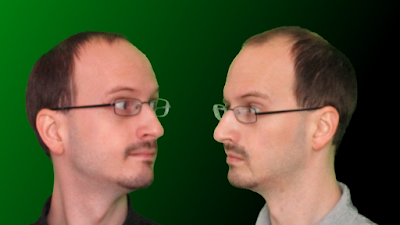

This feels like nonsense. After all, you know that you are you. This other person is clearly someone else, a new person with false memories. But this concept of a continuing self which is distinct from all others is an illusion. To demonstrate this, let’s ask what a self is supposed to be.

If the self is not found in the matter that makes up our bodies, maybe it is in our soul, a self-contained essence of identity that remains with us, unchanging, from the moment our lives begin until we die. However, as science continues to develop better tools to look into the body and the brain, we understand better and better how the mind works, but there is still no sign of a soul to be found. So it appears that souls are a relic from mythology and folk wisdom, and unless souls are a metaphor or an abstraction of something else, we have no reason to believe they exist.

Perhaps what the soul is an abstraction of is the continually evolving process of consciousness over time. Except our consciousness is not continuous. It turns off when we are asleep, and turns on again when we dream or wake. And we have lapses in consciousness now and then even when we are awake. To top it off, the experience we think of as “this present moment” is actually the result of the brain ordering and constructing an experience based on sensory information it received a fraction of a second ago over a period of a few milliseconds.

With some meditation practice and an open mind, we can discover that our conscious experience is not a homunculus, an internal receiver of perceptions and generator of thoughts and will. Instead, our conscious experience is the perceptions, thoughts, and will, which arise, exist for a moment, and then disappear again. Thus, the consciousness we have now is different from the consciousness we had ten years ago, or even ten minutes ago.

Furthermore, rare phenomena show that our consciousness is not necessarily bound within our bodies. I’m not talking about out-of-body experiences or anything like that; I mean things like connecting brains together to make a collective consciousness. Right now, we have very few examples of joined or split consciousnesses. We would hope so, because performing experiments in this area would be the ultimate personal violation.

Nevertheless, we do have a few points of data. Patients of split-brain surgery who have the two halves of their brain separated can develop two distinct personalities, one in each half of their brain. In terms of joining consciousness together, we have cranially conjoined twins whose brains are connected, and, to a degree, these twins share consciousness.

Science fiction goes crazy on these ideas with thought experiments of collectives, groups of people—perhaps hundreds, thousands, or even millions—who link their minds together and become one giant person. Famous examples include the Borg in Star Trek and the Formics in Ender’s Game.

In these stories, it is sometimes possible for an individual body to disconnect from the collective and become an individual person. But if that person has been in the collective for long enough, they are not the same person they were before they joined. Rather, they are a small version of the collective who now only has access to body and one set of senses.

Thus, it would appear that consciousness is not made up of distinct units, “selves,” that can link together and separate, but it is more like a liquid, which can join, mix, and separate like droplets and bodies of water. This analogy especially makes sense when thinking about the distant future when the vast majority of conscious life will live within an immense virtual reality network.

Coming back to us, here, today, we may see ourselves in a new light. Now, this model we’ve always taken for granted of distinct individuals, of you, me, that person, and the other person, does not seem so set in stone. We don’t all have our own unique, fundamentally separate existences from one another. Rather, it’s almost as if we are a collective already. All living things, lakes of consciousness. One, but for the space between us.

In this view, it can be said that there is life after death. Not an afterlife, nor is it quite reincarnation; it’s all the people and animals who are still alive. I am you, and you are me. We are the universe, and when one droplet of consciousness evaporates, there are still an ocean’s worth remaining.


I realize that a lot of what I said here sounds pretty weird, and I admit it does stray quite a bit beyond the realm of well-grounded science. But it’s not just something I thought up out of nowhere, nor am I repeating something I heard someone else say. I did take some liberties with narrative interpretation—it’s entirely subjective whether we consider everyone today to be a collective or individuals—but the liquid-like interpretation of consciousness is the most logically consistent analogy I can think of given my knowledge of current science and philosophy.

Friday, March 8, 2019

The Hard Problem of Consciousness

Consciousness:
The Hard Problem
Dualism
Physicalism
Idealism
Identifying Consciousness


Consciousness. It is the one part of reality that we experience directly, rather than as a mental representation. Consciousness is the experience of existing and experiencing. When we are awake, we are conscious. When we dream, we are conscious. We are not conscious when we are sleeping dreamlessly, or when we are in a coma, or when we are dead. Without consciousness there is no color, no sound, no taste, no beauty, no meaning; only physical reality.

So what is it, and how is it possible for it to exist?

This question has been debated by philosophers and scientists for thousands of years. The very existence of consciousness seems at odds with everything else we know about reality. Nevertheless, we know it exists, and we know it absolutely, which we cannot say about anything else.

There is plenty we do know about consciousness. We know that while you are thinking or feeling or tasting something, there is activity in the neurons in your brain, and each sensation correlates with a different pattern. It is reasonable to assume that in the future, we will have machines sophisticated enough to read exactly which neurons fire, and figure out how to know what is going on in someone’s consciousness, to read their mind, just by reading the patterns in their brain.

But that is only the Easy Problem of consciousness. To understand consciousness, we have to tackle the Hard Problem: how is it possible that consciousness exists at all?

There is a famous thought experiment called the Philosophical Zombie. In this experiment, we imagine a person who looks exactly like a regular human being, who acts the same, their brain works the same, and they can have conversations with us that are just as sophisticated as with anyone. When you ask the zombie if they are conscious, they say yes. But they are wrong. They have no consciousness. There is nothing it is like to be them. They experience no color, no sound, no light, no time. They are nothing more than a bunch of matter functioning as a complex machine.


Taking this a step further, we can imagine an entire universe full of philosophical zombies. Perhaps a universe just like ours, planet for planet, particle for particle, person for person. In this imaginary universe, there is an exact copy of you, and an exact copy of me. But no one is conscious. They believe they are conscious, and have conversations about metaphysics, but they are wrong.

Our search for the nature of consciousness will take different directions depending on whether or not the Philosophical Zombie thought experiment is valid. If it is, then consciousness must be its own physical substance, different from anything else that we know of. This is known as Dualism. On the other hand, if it is impossible for a zombie universe to exist, then consciousness is not its own substance, but a property of other parts of physical reality. This is called Physicalism. As this series goes on, we will examine theories of consciousness from the perspectives of dualism, physicalism, and more.

Friday, September 7, 2018

What is Good?

About a year ago, we did a series on morality, and concluded with Utilitarianism as a meta-ethical framework by which to decide which personal moral system is most appropriate for each circumstance. But when talking about Utilitarianism, I made the same mistake that most Utilitarian advocates make, and that is to define good by a word that means something else. Whether this word is happiness, pleasure, fulfillment, wellbeing, eudaimonia, or, in my case, satisfaction, it feels too limiting, like we’re shifting the definition of good to mean something else. So today, I am going to explain what I mean by “good,” and in the future, I will simply call it “good,” rather than any of those other less satisfactory labels.

We start by observing that we feel that some things are worthy of happening more than others. These things can take the form of circumstances, actions, attitudes, and plenty of other types of things. When presented with two of these things, we will judge one to be better than the other. Unless we are contemplating philosophy, this judgment is made by observing how we feel about it, and this feeling is stimulated by the comparison, just like our vision is stimulated by the light entering our eyes, and our hearing is stimulated by the sound entering our ears. In other words, we have a sense of right and wrong.

You might think, like a lot of philosophers throughout history, that having a sense of good means we must be perceiving some objective good that is out in the world and is independent from our perception. But there is no reason to believe our perceptions always show us objective things. For instance, the objects we see have no color, they just reflect different wavelengths of light. The colors come into being when our brains interpret the signals from the wavelengths of light enter our eyes. Similarly, good is not an inherent property of the circumstances, actions, etc. that exist in the world, but comes into being as the interpretations our brains make of those things. So then what is good? Good is when the sense of good is stimulated.

But there’s a problem that immediately jumps out at us. Different people perceive different things as good and bad. We see this all the time. People argue and fight because they disagree about whether something is good or bad.

There are three approaches to resolving this. The first is to look for universal moral goods, things that cause everyone’s sense of good to signal the same thing. The idea is that these are truly good, and everything else is conditional. The second approach is Relativism, the idea that there is no real good or bad, and it just depends on your point of view. The third approach is Deontology, which says everyone’s sense of good is equally valid, and no one’s good should be given more weight than anyone else’s. Building upon Deontology, we get Utilitarianism, which says when you add up everyone’s individual good, we get an objective total good.

One person’s sense of good is most strongly stimulated by learning about the universe. Another’s is most strongly simulated by training their body and working together with a team to rise through competitive ranks. Another’s is by doing work with their hands that has practical value to those around them. Deontology and Utilitarianism say that none of these are good intrinsically, but they are all good when paired with the people they are good for.

Friday, August 24, 2018

Why I Changed My Mind about the Quantum Multiverse

Recommended Pre-Reading:
Quantum Entanglement
Multiverses (Quantum Many Worlds section)

A truth seeker must always be open to new evidence. The new evidence must be added to the old, and all of it re-evaluated together. Sometimes the evidence in its greater context points in a direction other than what you thought was true, and when this happens, the wise person adjusts their beliefs accordingly. As a case in point, we’ll look at something I have had a strong opinion about on this blog, the quantum multiverse.

By Paul Anglada on Flickr
If you’ve read a lot of my science posts, you know I’ve been pretty hard on the quantum multiverse, also called the Many Worlds Hypothesis. In the multiverses discussion, I said I thought it was the least likely to be true out of the hypothetical multiverse types that come from physical theories. Since then, however, I have learned more about the arguments for its existence, most importantly the story of how the hypothesis came to be, and now I think it is reasonable to believe it exists.

Before we go any further, though, let’s remind ourselves what we are talking about. When quantum physics is mentioned, the layperson might think of the science of consciousness, or of parallel realities where events that were important to individual people or to human history played out differently. These are not quantum physics, they are purely science fiction, playing to our human bias that the universe revolves around us, and where “quantum” is used as a sneaky replacement for “magic.” Quantum physics, the real science, is the study of matter and energy at the scale of molecules and atoms and smaller.

When enough quantum particles interact together (millions, billions, trillions, and more), we get the classical physics that we know in our everyday life. We says that classical physics emerges from quantum physics. But classical physics is not the only thing that can emerge from quantum physics. Any property of quantum physics, when scaled up, can affect the macroscopic realm. Because of this, scientists and inventors have come up with technologies that use the unusual properties of quantum physics in technology, the most well-known example being the laser. Our experience of reality comes from the deeper reality of quantum physics, not the other way around. If quantum physics has implications that are counter-intuitive, we have every reason to take those implications seriously.

We’re going to talk about interpretations of quantum physics, so first things first, what exactly needs to be interpreted? It comes down to why we say quantum physics is weird: a quantum-sized particle can be in two states at once. What does that mean? Well, for example, an electron can be 50% spin up and 50% spin down at the same time. This is called superposition of states. It is like saying a basketball is spinning both clockwise and counterclockwise at the same time. It seems like a contradiction, and for macroscopic objects like basketballs it is, but for subatomic particles, it is normal. If you measure the electron’s spin, you will find it to be 100% either spin up or spin down, and then it will behave differently. But it was not 100% up or down before the measurement; the very act of measurement has changed the particle’s properties. This is called “collapsing the wave function,” and it is what needs interpreting.

For the Copenhagen Interpretation, that is the end of the story. The universe has probability baked into it, and measurements roll the dice. But the Copenhagen Interpretation has a problem: what counts as a measurement? If you try to measure the property of a particle by using another particle, the wave function does not collapse. Instead, the particles become entangled, that is, they are both in a combined superposition of states. For example, if you try to measure an electron’s spin using another electron, then both electrons will end up 50% spin up and 50% spin down. But here is where things get interesting. By using more traditional measuring devices, when we measure the electrons’ spins, we will find that one of them is spin up and the other one is spin down. We can’t know which is which beforehand, because there isn’t an answer beforehand. The only thing that is set in reality before the measurement is the fact that their spins will turn out to be opposite.

But what makes a traditional measuring device different from a particle? All measuring devices are made out of particles themselves, after all. So shouldn’t the machine we use become entangled with the electron as well? The machine only shows us one answer, not a superposition of answers, so that seems not to be the case. Why not? This is the famous measurement problem.

One proposed resolution for the measurement problem is that the collapse of the wave function happens when the experiment is observed by a conscious being. That is, the instrument used to take the measurement registers both spin up and spin down until someone looks at it, whereafter the entangled wave function of the particle and the device measuring it collapses, showing just one result. In other words, perception defines reality. However, this requires substance dualism, the idea that consciousness is fundamentally different from the rest of reality, that mind and matter are completely different things. People have had a dualistic view of mind and matter for all of recorded history. It is intuitive; our DNA comes pre-loaded with a disposition toward believing it. It just feels true. But feeling true has no bearing on whether something actually is true, and the lack of scientific evidence in support of dualism suggests that there is some kind of equivalence between consciousness and matter, which would mean the conscious observation interpretation of quantum physics is impossible.


One day in the late ‘50s, physicist Hugh Everett came onto the scene with a radical suggestion: what if the wave function does not collapse at all? What if any interaction between particles makes them entangled? This would mean that two interacting electrons become entangled; when they are measured, the instrument that measures them becomes entangled; when the scientist interacts with the instrument, the scientist becomes entangled; and when the scientist interacts with the rest of the world, the rest of the world becomes entangled. This would mean that after the measurement, the entire world exists in a superposition state, which is 50% reality where the electron is spin up, and 50% reality where the electron is spin down. Put simply, it can be thought of as if there is one universe where the scientists observe the electron to be spin up, and another universe where they observe the electron to be spin down. This is the essence of the Many Worlds Interpretation.

This sounds weird, and it’s only going to get weirder. As they say, extraordinary claims require extraordinary evidence. So what made me change my mind? What makes the Many Worlds Interpretation more reasonable than any other? It all comes down to consistency. When particles only interact with one another, they get entangled. This is a well-documented scientific phenomenon. The larger the number of entangled particles, the harder it is to control all of them, so the easier it is for something external to the experiment to “mess up” the entanglement. But what would it mean to “mess up” an experiment? It’s just more particles interacting with the entangled system. And we know that when particles interact with other particles, they get entangled. So we could think of it as the external world coming in and messing up the experiment, but if we want to be consistent, we should say the entanglement is escaping to the rest of the world, including the brain of the person doing the experiment.

This is extremely counter-intuitive. I certainly feel like I am in one specific state, not a superposition. But what would being in a superposition feel like in the first place? We might imagine two images playing over our eyes, like a transparent movie playing over another movie. But that would only happen if the information from both states came together in the same brain. Remember, our brain is also in a superposition, not working as a single machine in both states. So a person in quantum superposition would feel completely normal, as if they and the objects they see and interact with are in state A, and not state B. And they would also feel as if they and the objects they interact with are in state B, and not in state A. Both are true, and they would notice nothing weird at all, because the states of their brain are completely cut off from each other. In effect, the universe has split in two, and that is where the “multiverse” idea comes in. More generally, as I argued in the multiverses discussion, it is not the splitting of distinct universes, but an infinite-dimensional smear of universe-ness.

By Maria Morri on Flickr
And now, when I look back at my former self, I see a hypocrite. In the multiverses discussion, I said people are drawn to the Many Worlds Hypothesis because the idea that reality is simply probabilistic at the quantum scale is too weird. But I got it backward. The reason that people like my former self cling to the Copenhagen Interpretation is because the Many Worlds Hypothesis is too weird. But weird as it is, it is the only interpretation that solves all the puzzles of quantum physics and leaves no loose ends behind. It is the natural logical conclusion of entanglement, and it makes the measurement problem go away. Out of all the interpretations of quantum physics, those we discussed and those we did not, I now think Many Worlds is the most likely to be true.

But it’s just an interpretation, isn’t it? If it can’t be tested, then what is the point of debating it? Well first of all, here on A Scientist’s Fiction, we search for truth in whatever way we can, and if that means using pure logic, that is what we use. However, in this case, we don’t have to. We can test the quantum multiverse. After all, it’s not just parallel realities. That’s TV sci-fi. The quantum multiverse is an extension of regular old quantum entanglement, which we see in the lab all the time. It makes a prediction: if we have the right kind of experiment, we should be able to put a human being in quantum superposition. Researchers keep finding quantum properties in larger and larger systems, so it should be theoretically possible.

I don’t know how the exact details of such an experiment would play out, but it might go something like this. Imagine we send a human test subject into a room that is 100% soundproof, vibration-proof, and heat-proof. After we close the door, the subject sees either a red light or a blue light, triggered by the measurement of an electron’s spin within the room. To all outside observers, the subject would be in a superposition state of red + blue. Suppose this person was instructed to lightly touch one of two sensors, which connected to a second electron, telling it to either be spin up or spin down. The experimenters outside the room would then do tests on the two electrons, to see if they are in a superposition of states. If they are, then the human test subject is also in a superposition of states. Then they open the doors, the test subject walks out, and tells the researchers what color of light he or she saw. They then measure the particles, and indeed their spin is oriented in accordance with the prediction. This would mean that the test subject was entangled with the electrons, in a superposition of states, and now there are two universes, one where the subject saw red, and one where the subject saw blue. The quantum multiverse hypothesis would be supported by evidence from a prediction of its own.

Schrödinger's Cat
Changing my mind due to more complete evidence is something I am well-practiced at, so when it came time for the quantum multiverse, it was no big deal for me. However, for those less practiced, it can be frightening. Maybe after reading this you are not convinced that the quantum multiverse exists, and that’s fine. Skepticism is healthy, especially for topics as complicated as quantum physics. But it is also healthy to direct your skepticism toward the beliefs you already hold, and I encourage you as a fellow truth seeker to reexamine your beliefs every now and then. Whether you find them to be valid or in need of replacement, I can guarantee the practice will make you wiser and bring you closer to the truth.

Friday, July 27, 2018

What is Knowledge?


What does it mean to know something? We have this thing in our head called knowledge, which is a collection of notions about the world and how it works, and which helps us to act in ways that make sense. But we know that it is possible to be wrong, and wrong knowledge is not knowledge at all, but false belief. At this point in history, when we are waking up from our intellectual bubbles and seeing all the different views people have, many of which seem to go against common sense, it seems like a good idea to take a look at knowledge and find out what it is and how it works.

When we are children, knowledge is simple. Our parents and other people we trust tell us things, and we believe them. For the purpose of this discussion, I will call this method radical credulity. Of course, now that we are older, we understand that this way of thinking lets incorrect ideas in just as easily as correct ones. This is one reason we keep our kids in safe environments with trustworthy people.

A simple method to filter out ideas that are probably incorrect from ideas that are probably correct is to believe things that are reliably useful. This is called pragmatism. How do we know the Earth is more sphere-like than flat? Because treating the Earth as a sphere gets our airplanes to their destinations, while treating it as flat does not. The pragmatist view is that we believe things that let us reliably predict the consequences of our actions, so that we can effectively do what we are trying to do. It’s as the old defense of the scientific method says: we believe it because it works.

But pragmatism has its shortcomings. For example, most of the time, we live as if the Earth is flat, so there is not usually any problem with believing it to be so. However, there are circumstances where this belief could be catastrophic. Of course the pragmatist will say that we should treat the Earth as flat or round depending on the situation, and the real truth of its shape doesn’t matter. However, for many of us, it isn’t good enough to believe things because they are useful; we want to believe things because they are justifiably true, and pragmatism does not do this for us.

In the middle of the last century, psychologist Jean Piaget came up with a theory of knowledge called constructivism, which says we don’t simply acquire knowledge, we create it as a logical network. When we hear a new claim, we evaluate it by how well it fits with what we already know, and if we find no contradictions, we add it to the network. If we do find a contradiction, we either toss it out or reevaluate the belief that it conflicts with. Right away, we see something in constructivism that was missing from radical credulity and pragmatism: logic. The beliefs we hold are connected to each other by threads of non-contradiction.

However, as we all know, it is possible to have beliefs that are false. Adding a new belief that doesn’t conflict with a false belief doesn’t help us come to the truth. One way to attempt to rectify this is to take the beliefs that we are most confident and passionate about as an immutable foundation, and build our knowledge of the world around them. In philosophy lingo, these beliefs are called basic beliefs.

Of course, if people just take whatever they please as basic beliefs, we will find people with all kinds of beliefs that contradict each other’s, and they’ll stubbornly yell at each other until they’re blue in the face. Faced with this problem philosophers sought what could be called properly basic beliefs, truths which are so obvious and undeniable that it is impossible for them to be false. DesCartes famously took his own existence to be properly basic, and the philosophy of empiricism holds the validity of logic, mathematics, and observation as such.

Unfortunately, we run into another problem: we cannot agree on what beliefs should count as properly basic! Take any belief that is proposed as properly basic, and you will be able to find people who doubt it. Mathematics? Can be doubted. Objective reality? Can be doubted. “I think, therefore I am”? Can be doubted! What’s more, since properly basic beliefs are supposed to be the foundation upon which all other knowledge is constructed, the only argument that can be made for a belief to be properly basic is, “can’t you see it’s obvious?” Not exactly up to academic standards!

In the absence of anything that could justifiably be called properly basic, we might, with heavy heart, be tempted to conclude that knowledge is, in fact, impossible, and that everything is just mights and maybes. This is a pessimistic outlook, and not one most of us are comfortable with. In order to avoid it, we might choose a basic belief on radical credulity, usually called “faith” in this context. Or we might revert to pragmatism, and choose a belief that has proved reliable time and again as our basic belief.

I, however, subscribe to a third option, and that is to view knowledge in terms of probabilities instead of just yes or no. Although it may be impossible to know anything with a justified certainty of 100% with an infinite number of decimal places, we can be justifiably 90% certain, or 99.999% certain. We may not be able to calculate the numbers, but with practice we can guess the ballpark.

How is the level of certainty of a belief determined? By how well it connects into the knowledge network. Reality itself is one giant network where everything connects to everything else, so the larger a person’s knowledge network and the more interconnected it is, the more likely the beliefs in the network are to be true. To understand why, the jigsaw puzzle analogy is apt. When building a puzzle, there is a small chance that two pieces will fit, even though they don’t actually go together. But the chance that the same piece will fit incorrectly on two sides is much smaller. So to be sure you have the right piece, you want to try to connect it to the picture by more than one side. The chance of it being the right piece is even higher if there is a fourth piece connecting the two connecting pieces together, so that you have a square of four pieces. And the more pieces that can be added on to the connecting pieces, the higher the chance of each of them being the right piece.

Knowledge is like that, except there are plenty of extra pieces that don’t go to the puzzle, the chance of an incorrect connection is much higher, and the pieces can hook on to an arbitrarily large number of other pieces, which don’t have to be right next to each other. The knowledge puzzle also gets scaled up to more complex levels. With knowledge, you can have two packages of tightly-knit beliefs, but these packages only have a few connections between them. Imagine two balls of string connected to each other by three threads. Each ball is tightly connected, so they each individually have a high chance of being true, but their connection to each other is tenuous. If you discover that the two packages of beliefs contradict each other, either by learning something new or by thinking about them both in new ways, then you might have to make the tough decision to let one of them go.

When a contradiction is found between two sets of beliefs that one has, it is called cognitive dissonance, and depending on the complexity of the beliefs in question, as well as how attached we are to them, it can manifest as a physical headache. We instinctively want to get rid of the cognitive dissonance as quickly as possible. There are two ways to do this. The first, is to commit to whichever beliefs are most important to you, taking them, at least temporarily, as basic beliefs. The second takes longer, but it leaves you in a more stable place, and that is to take apart each package of beliefs and reevaluate them in the broader context of your total knowledge network, and by learning about the relevant topics from a variety of external sources.

A mind well-practiced in the art of knowledge construction will take time every so often to reevaluate the pieces of their knowledge network, to make sure it all fits together properly. There are many techniques to this, which we explore on this blog in the “Toolbelt of Knowledge” series.

There is still one teeny tiny issue with constructivism without basic beliefs, which you may have picked up on. Constructivism itself is a model, a sub-network of nodes within the larger network of a person’s knowledge. In particular, the belief that “the more solidly integrated a belief is within the network, the more likely it is to be true,” is itself a node in the network. This means that it must be subject to the same reevaluation process as everything else, or be taken as properly basic on faith.

But we don’t do that kind of faith here at SciFic. As you know if you’ve read “The Limit of Philosophy,” we prefer to race headlong into the trippy world of metalogic. So what happens when we allow ourselves to doubt the very method we use to determine what is true? Well, we just do the same thing we do with everything else: evaluate it. If it does not measure up to its own standards, then we get rid of it. If it is self-consistent, and we don’t have any alternative methods that are more self-consistent than this one, then we might as well use it. But one last question: why should we use self-consistency as a measure for whether a method of determining truth is valid? Because, as human beings, we are psychologically driven toward consistency. Of course, that’s not a logical reason, but remember, the most fundamental question is not “what is true?” but “what should we do?” and our action is driven by our unconscious psychology rather than logic.

As children, we are told all kinds of claims, which we accept on radical credulity. Then, we evaluate new things by a combination of how useful they are and how well they integrate into our networks of knowledge. A mature, practiced thinker will not take any claim as foundational, but evaluate and reevaluate every part of their network by how well it connects with the rest. That is knowledge.

Friday, May 18, 2018

What is God?


I grew up in a Christian home in rural United States, believing, as most people in that culture do, in the existence of God the person. This person called God had his own subjective conscious viewpoint. He had the ability to cause anything to happen merely by willing it to be so, including both temporary suspension of the laws of physics, and the creation of the entire Universe. This God was thought to be real and literal. In other words, I believed in a physical God, also known as a “personal God” or “literal God.”

Back then, if you had asked me if I thought God was physical, I would have said no, God is spiritual. If you had asked me what I meant by that, I would have said physical reality is made of one type of substance, and spiritual reality is made of another type of substance. However, that is a false dichotomy. After all, the part of physical reality my present and past selves agree about is made of multiple types of substances. There are particles, fields, and space-time, and maybe a few things we do not know about yet. However, the reason we group them under the umbrella term, “physical” is because the way in which they exist is the same. The God I believed in was not made of space-time, particles, or fields, but he was thought to exist in the same way. That is why I call this kind of God a physical God.

I viewed God as the answer to questions like, “why does the Universe exist?” and, “why do we exist?” The Earth was the way it was because God made it that way, with human beings in mind. Everything that happened, everything I did, was measured against what God wanted, and how it fit into his grand plan. However, after about 20 years of living like this, I started seeing things that did not add up with this view. I learned how ideas of God and gods appeared in cultures and developed over time, and I saw how my God was the same as any other in this regard. I saw sick people get prayed over. Some of them were healed, and some were not. I had ideas pop into my head about the future. Some of them came true, and some did not. Eventually I came to realize that things can happen by chance, that if there are a million opportunities for things with a one-in-a-million probability to happen in a day, we should expect to see one-in-a-million things happen every day.

As we learn and grow, our mental pictures expand, filling in more of the jigsaw puzzle of knowledge. Sometimes we replace ideas with new ones, which may or may not be more correct, but other times we come to see a larger view of the picture, one which encompasses the views we had before. We come to see those views more clearly, why we held them, and how they fit or don’t fit with the rest of reality.

One fateful day, I was hit with the realization that the Universe and everything in it behaves as it would without a physical God. I looked up evidence for the existence of God, which came in two forms. The first was from science, but these were all either conspiracy theories, or of the form, “this seems like too much of a coincidence, therefore God is responsible.” For instance, I have heard the argument that since the conditions in the Universe make life extremely unlikely, God must have created the Earth for us. These arguments don't stand up to probability, nor do they meet their burden of proof. The second form of evidence for God was in philosophical arguments, like the Ontological Argument, the Teleological Argument, the Cosmological Argument, and the Argument from Morality. However, all of these either have extraordinary claims in their premises without justification, such as “it is possible for a Maximally Great Being to exist,” or their conclusions do not follow from the premises. Ultimately, I had to admit that I could find no evidence that the physical God I had believed in for my entire life actually existed.

For a while, I felt bitter toward the culture I had been raised in and the people who had taught me what I perceived to be nothing but lies. I faced existential and epistemological crises. This period did not last long, but it was rough. It is no wonder people get defensive and afraid whenever someone says something that even hints at a conflict with their worldview.

This was a turning point in my life. From then on, I started studying all different fields of science and philosophy. I wanted to understand the world and humanity as broadly and in depth as possible. In my quest, I have come across many public intellectuals with deep and important things to say. Among them was the psychology professor Jordan Peterson, who introduced me to the concept of Jungian archetypes, the models of behavior built into the human unconscious that manifest in fictional characters.

With perfect timing, in one of those one-in-a-million events that I mentioned earlier, Jordan Peterson started a series of public lectures, which he posted to YouTube, about the significance of the Biblical stories from the perspective of evolutionary psychology. Instead of taking them as literal historical events, like I had for my entire life, he treated them as a window into the depths of the human mind, as stories passed down for hundreds of generations, undergoing a kind of natural selection so that only the most meaningful and resonant parts remained, the rest lost to memory. Freed from the blinders of literalism, the Biblical stories exploded with meaning like I never imagined.

My thoughts turned back to consider once again the idea of God. Of course, a physical God was out of the question; the more I learned of science and philosophy, the more solidly that coffin was nailed shut. However, things I had heard believers say before, but had made no sense to me, started to come back. The idea that morality could not exist without a god. The idea that everyone worships something, whether they profess to or not. And for the first time in my life, it all started to make sense. God is not a person, not in the physical sense. God is an archetype.

Archetypes are the embodiments of human behavior patters. We see ourselves in fictional and mythological characters, and in forces of nature. This is where the gods of Ancient Greece and other pantheons come from. Capital-G God is the archetypal embodiment of all of the best qualities of human nature. This is why religious people take “God is good” as a truism, and why they say that without God, morality does not exist.

Atheists sometimes point to the things God does in the Bible which are obviously evil, and say, “God is not good.” But those instances are a product of the limitations of human knowledge at the time they were written. Archetypes are not made-up, they are discovered and studied. Since Biblical times, humanity has gone through revolutions of moral philosophy, so our understanding of the best of human nature, God, has matured. It is only natural that parts of the ancient views of God will appear barbaric to us. They were trying to understand, and, not having the philosophical knowledge of millennia to draw upon, got some of it wrong.

So why do most people insist on believing, and requiring others to believe, in a physical God rather than an archetypal God? Or from another perspective, what could drive me to speak such heresy? The answer lies in our psychology. We have a natural instinct to search for the meaning in facts, and to take that which is meaningful as factual. Only in the past few hundred years, since the dawn of science, have we begun to learn the difference.

Some would call me an atheist, because I believe there is no physical God. Others would call me a Christian, because I actively try to learn about and model my life around the best and fullest aspects of human nature, which God represents, and because I find value in the philosophy and culture that has come from the Christian tradition. I don’t care about the labels myself. It’s the honest search for truth that matters; after all, that’s in accordance with the nature of God.

Friday, February 9, 2018

Where Secrets Lie – The Well of Images Part 2

Read Part 2: "Where Secrets Lie," at WritersCafe.org.

After months of hard work, I am pleased to announce "Where Secrets Lie," the second story in The Mentor, the Hero, and the Trickster, book 1 of The Well of Images.

Accepting Professor Berkeley's offer to take her on as a research assistant, Hope is dismayed when Berkeley forbids her from entering the Realms on her own, because of dangers unknown. Samuel, the only person who could be her delving partner, is completely disinterested. Can Hope find a way to convince him to join her, or will she have to brave the uncertain depths alone, behind her mentor's back?

When starting a new project, it can be easy to get wrapped up in beginner's enthusiasm. Getting through the first challenge is tough, but your excitement gets you through it. The hard part begins with the second challenge. You're already tired, and some of that enthusiasm is draining away. Worse, all of the parts you're most excited about don't happen until later, and you find yourself having to grind through the boring parts of the journey, while trying to make it look interesting enough to keep your readers' attention. With that in mind, getting "Where Secrets Lie" to a high enough quality level to share with the world is one of my most significant writing milestones. Here is to a successful future of the series.

The Well of Images is a fantasy series of short stories, following two college students in their adventures through the Unconscious Realms, full of symbolism and mythological archetypes. If you have not read part 1, or if you are from the future and want to read a later chapter, you can find them in the Finished Stories tab.

The Mentor, the Hero, and the Trickster:
1. Pandora’s Gate
2. Where Secrets Lie
3. Limits of the World
4. The Fool’s Gift
5. Loki’s Game

If you like "Where Secrets Lie," why not support me on Patreon? It means a lot to me to know that others find what I am passionate about to be meaningful.

Friday, December 1, 2017

Announcing: Short Story Series, The Well of Images

Read Part 1: "Pandora’s Gate," at WritersCafe.org

After years of blogging, practice writing, and listening to experts, I am proud to announce the debut installment of an original series of short stories, called The Well of Images, formerly under the working title of Project Soul. It tells of the adventures of two college students who discover that the Jungian collective unconscious is literal, and they have the ability to go there and explore. In this series of worlds made out of mind stuff, the characters meet mythical archetypes, face sides of themselves that they didn’t know they had, and confront deep questions about the natures of humanity and reality.

The series will be laid out with several “books,” which have overarching plots and themes, which are broken into “parts,” or “chapters,” which each contain their own plot. It is like a TV show, with the books being seasons, and the chapters being episodes. The first book, The Mentor, The Hero, and the Trickster, will have five parts, and the others may have more. I do not have a release schedule, since I do not know my own writing speed well enough to know the correct pacing, but I would not expect more than one part every two months. The first part, "Pandora’s Gate," is finished and available for reading.

November is over, which means National Novel Writing Month (NaNoWriMo) has come to a close. This year, I wrote drafts and scenes of The Well’s upcoming chapters. The default goal of the event is to write 50,000 words by the end of the month, but I kept instead to my personal goal to write at least 1000 words every day. I found this to be easier than last year, and it gave me better results too, leaving me with workable material instead of pure trash.

In a continuing story like this, there is no way to predict everything that will need proper setting up. I might look back on the early chapters with the wisdom of hindsight, and want to touch them up and make slight alterations to the events. Because of this, I’m reserving the right to come back and edit these early parts if I feel it is appropriate.

They say you need to write a million words in practice before your first book gets published. Right now, I’m at a few hundred thousand, and The Well will be the key to the rest. It is my first serious attempt at an original story with the knowledge I have gained from blogging and from listening to experts, and I feel like I am making good progress. Someday, I just know, I will be able to walk into a bookstore and find something with an eye-catching cover and my name on it, but for now it’s a step forward to post stories on the internet for free.

The Mentor, the Hero, and the Trickster:
1. Pandora’s Gate
2. Where Secrets Lie
3. Limits of the World
4. The Fool’s Gift
5. Loki’s Game

If you like "Pandora's Gate," why not support me on Patreon? It means a lot to me to know that others find what I am passionate about to be meaningful.