Showing posts with label God. Show all posts

Friday, August 28, 2020

God, the Personification of Our Relationship with Existence

When I was growing up, I believed God existed. This God was a superhero, and his powers were to know everything, to manipulate reality with his thoughts, and to be perfectly good in all ways. As I learned science and contemplated philosophy, I came to realize that such a superhero does not exist. For me, that was sufficient to start calling myself an atheist. However, I remain open to non-physical, naturalism-compatible interpretations of God, such as an archetype, the impersonal, unconscious principle that separates what exists from what does not exist, or today’s topic, a hypothetical person who knows and understands everything.


As human beings, we struggle with existence. We strive to understand our place in it, how we relate to those around us, to the world, and to the universe. When difficult times happen, we want to know why. As individuals, there is so much we don’t know; most of this world is beyond our comprehension, not to mention the rest of the universe. This can be absolutely terrifying, as is captured by the fictional genre of cosmic horror. But we can find relief from this fear by imagining that there is a person who knows and understands it all, and whom we can talk to and get advice and comfort from: a God.

Of the many ways we conceptualize God, one of them is as a friend, a mentor, or even a parent. We imagine God as a person with us, who has our best intentions in mind and understands and fully appreciates the world both as it is and as it could be, who understands the whole picture and our place within it. When we talk to this God, either by words or thoughts, we call it prayer. We act as though this God is with us always, seeing our thoughts and emotions without judgment or bias, and when we are tempted to do something we feel isn’t right, thinking of how God would see the situation helps us to follow our conscience.

Some atheists criticize this version of God for being nothing more than an imaginary friend. But “imaginary friend” has childish implications, and it comes across as an insult rather than a criticism. God is much more than an imaginary friend; he is an archetype, a mythological figure with the qualities of knowledge, compassion, and empathy taken to infinite extremes.

Believers will also bristle at the word, “imaginary,” since it has connotations of being made-up and arbitrary. But archetypes are not arbitrary; they are the personification of profound things. In my mind, God is not real, because a thing is only real if it is real in the same way as matter and light and space and time; that is, physical. But archetypes are discovered, not invented, and for some people that is enough to call them real despite being non-physical. Thus, an argument here would be pedantic.

This version of God is not specific to any religion. Archetypes do not depend on the narratives in which they are expressed. My favorite short story is “The Egg,” by science fiction author Andy Weir, where the main character dies and has a conversation with this version of God about humanity and its purpose.

Despite calling myself an atheist and having a lot of issues with religions, I still sometimes act as though I am sharing my experiences with a God, and I still pray from time to time. I am not ashamed of this, nor do I see it as being inconsistent. Because what ultimately matters is not beliefs, but actions and their consequences, and sometimes acting in a spiritual or religious way helps us cope with the difficulties of life, appreciate the good things, and find the meaning in existence. This view is called Spiritual Naturalism. Like all great mythology and fiction, God does not have to exist in order to be significant.

Friday, January 10, 2020

An Atheist's Best Argument For the Existence of God

When searching for truth, we often find that smart people are divided on the answers to any particular question. Truth, it turns out, is not always obvious, and finding it requires careful consideration of all reasonable possibilities. That’s why I’ve decided to start writing discussions about the best arguments against my points of view. We will start today with the existence of God.

I’ve written before about God the fictional archetype and God the principle of existence. The God I don’t believe in is God the real person, so that is what we will be talking about today.

There are many arguments in favor of God’s existence, some ancient, some modern. Very few, however, are persuasive to anyone who does not already believe God exists, and they are almost no one’s personal reason for their belief; rather, they are almost always used as rationalizations under the guise of “apologetics.” You can read some of them here if you would like.

Before we get to the argument I find most persuasive, let’s look at one often pointed to by other atheists, the argument from apparent design, also known as the Teleological Argument. I do not find it persuasive at all, and I will explain why. The best version of it goes like this:

A. Within the laws of physics, there are a number of parameters that sit on a razor’s edge. Just a small nudge upward or downward, and life could not exist.

Note: There are probably many configurations that would allow life of some kind, but they are vastly outnumbered by those that would not.

B. The probability that these parameters randomly landed on values that permit life is so low as to be nonexistent. It couldn’t have been coincidence.

C. Therefore, our universe was intentionally designed for life to exist.

The premises A and B are true. The universe is finely tuned for life to exist, and it couldn’t have been coincidence. But the conclusion that God made the universe does not follow from the premises. Just because it is a possible explanation doesn’t mean it is the true explanation. We also have to consider other possible explanations, and the more we find, the less likely God is to be the answer.

First, the laws of physics and the shape of our universe as we currently understand them suggest that there are at least four possible types of multiverses, each of which might have variations in the physical parameters. Perhaps even five or six, depending on how quantum gravity behaves in black holes and in higher dimensions. If even a single one of these exists, we have another possible explanation. If the chances of life existing in a given universe are 10 to the power of a big number, but the number of universes that exist are 10 to the power of a much bigger number, then there is no surprise that we exist. So if we allow the four most plausible types of multiverses as possible answers, then what the Teleological Argument really says is that there is a 1/5 chance of the universe being intentionally designed.

I want to pause for a moment and deconstruct a myth often heard from religious apologists: “Scientists posit multiverses as an excuse not to believe in God.” This is baseless slander. Multiverses are predicted results of physics theories—some of them quite well-established—or philosophical deliberations that are not related to the question of God. Physicists who want there to be only one universe have to add extra fluff to the theories in order to force the multiverses to go away; a practice that is scientifically sketchy. Furthermore, there are many scientists and other people who believe in the existence of both God and a multiverse.

Back to the argument, Multverses are not the only possible answers. If we’re going to consider intentional design as a possibility, we have to consider other supernatural explanations as well. For instance, the universe might have been unconsciously created by a sleeping God. Or, it might be impossible for conscious observers not to exist, so the universe was required by necessity to have parameters such that conscious observers would come to exist.

These possibilities mean that the real results of the Teleological Argument at best give intentional design a 1/7 chance of being the answer. That’s less than 15%. And it doesn’t factor in all of the billions of different kinds of gods and supernatural creatures which could have intentionally created the universe. It also runs into the problem of deduction: even if we could definitively rule out all of the possibilities we have thought of except for God, we could never rule out the possibility that there are more we have not thought of yet. This is why I do not find the Teleological Argument the least bit persuasive.

If the argument most people point to as the most persuasive is not persuasive at all, then what is? Well, there is one thing that keeps me questioning every once in a while. It is the same reason most believers really believe: a feeling that God is talking to me. Sometimes, I have intuitions that I should or should not do something. I don’t know why, I just know it is true. When I ignore it, I suffer. When I listen to it, things go well. These intuitions have a natural explanation: our senses take in much more information than we can consciously process, so our unconscious takes over and feeds our conscious minds its results in the form of feelings. There is also no reason to believe they are from any particular god over any other. Yet the feeling, when trained upon itself, feels like it is the voice of God. Others may not find this convincing, and it may not be rational, but to me, this is the most compelling argument for the existence of God.

Friday, August 16, 2019

The God of Physics

“The first gulp from the glass of natural sciences will turn you into an atheist, but at the bottom of the glass God is waiting for you.”
–Werner Heisenberg, pioneer of quantum physics.

The Helix Nebula, an amazing piece of Creation 700 light years away.
God is a complicated topic. When most people think of God, they think of God the person, a superhero-like entity who has the power to will things into existence, and to exert control over things and people once they exist. They also imagine God as the epitome of knowledge, wisdom, and goodness, a living archetype of the perfect human being. But many would say God is more than this, that there is a facet of God these two descriptions don’t capture. This is the God we are going to talk about today, the God of the universe, woven throughout the fabric of nature.

To understand this conception of God, we go back to a discussion we had a year and a half ago about the natures of things. Everything that exists has a nature, a “way that it is.” This brings up a question: why are the natures of things what they are, instead of something else? Why does General Relativity describe the nature of gravity so well, whereas Modified Newtonian Dynamics, an alternative theory, does not? Why is the electron charge what it is, instead of some other value? As Stephen Hawking famously said, “What breathes fire into the equations?” There must be something, some transcendental principle of existence that differentiates between that which exists and that which does not. This principle is what physicists call God.

“I want to know how God created this world. I am not interested in this or that phenomenon, in the spectrum of this or that element. I want to know His thoughts; the rest are details.”
–Albert Einstein

These are the equations of electromagnetism, the foundation which gives rise to light.
People have debated endlessly over whether God exists or not, most of the time getting nowhere. To help alleviate the frustration associated with this topic, I want to coin a couple of terms: open definition and closed definition. A closed definition is when you start with a clear conceptualization of something, and ask, “does it exist?” An open definition is when you start by observing something and giving it a name, and then ask, “what is it like?”

If we take God as described in a holy book, and say, “This is what God is like, and you either believe it or you don’t,” that is a closed-definition God. A closed-definition God is fair game to scientific investigation. It is often said, “You can’t put God in a test tube,” but in most cases that is not true. If God has the power to reshape nature by his will alone, then unless he is purposely trying to hide from us, we will be able to find signs of his meddling in nature; God’s fingerprints, so to speak. However, these are nowhere to be found. If we ask, “What would the universe be like if this God didn’t exist?” the answer is, “pretty much the same.” Nature goes along its merry mechanical course The weather is a result of currents and patterns and cycles in the atmosphere and ocean. Canyons are carved out by water eroding the rock away over centuries and millennia, which we can tell by examining the rock layers in the canyon walls. Life functions on biology, which is emergent from chemistry, which is in turn emergent from physics. Human societies function on psychology and tradition, shaped by our evolution and environments. Everything does what it does, moves the chain of cause and effect forward.

On the other hand, an open-definition God is another story entirely. If we look at the world and say, “Amazing! Why is it here?” and we call the answer “God,” whatever it is, then no one has grounds to say this God doesn’t exist. In fact, by its definition and the very existence of reality, this God must exist. However, we start out knowing nothing about this God. It is open for discovery and paradigm shifts and all of the things that breathe wonder into science and philosophy.

Through the early 20th century, it was fashionable for scientists and philosophers to talk about God. Today, it’s common for people in those fields to profess atheism, or at least disinterested agnosticism. This is because the emphasis of “God” has shifted back toward the personal aspect, and attention is being drawn to the negative social and political consequences of religious narratives. Sadly, much of the scholarly wonder at the mysteries of the universe has gone with it. Rare is the scientist who strives to discover the true interpretation of quantum physics, or the actual nature of physical reality.

This could change if more people realized God is not a package deal. God the person, God the archetype, and God the principle of existence are three separate concepts, and each may or may not exist independently of the others. If one does not see sufficient evidence supporting a personal God or and archetypal God, one can still believe in a universal God. For instance, I believe in the existence of God the archetype and God the principle of existence, but not God the person. I usually don’t call them God, but that’s just semantics.

“God is not He who is, but That which is.”
–Baruch Spinoza, Enlightenment philosopher

There are many great mysteries left in the universe, and sometimes adherence to religious narratives gets in the way of exploring them. But an uncompromising denial of religious narratives is sometimes no better. We need to realize that, whether you call it God or existence or fundamental reality, there is a transcendent wonder in striving to understand the mystery at the bottom of everything.


Friday, May 18, 2018

What is God?


I grew up in a Christian home in rural United States, believing, as most people in that culture do, in the existence of God the person. This person called God had his own subjective conscious viewpoint. He had the ability to cause anything to happen merely by willing it to be so, including both temporary suspension of the laws of physics, and the creation of the entire Universe. This God was thought to be real and literal. In other words, I believed in a physical God, also known as a “personal God” or “literal God.”

Back then, if you had asked me if I thought God was physical, I would have said no, God is spiritual. If you had asked me what I meant by that, I would have said physical reality is made of one type of substance, and spiritual reality is made of another type of substance. However, that is a false dichotomy. After all, the part of physical reality my present and past selves agree about is made of multiple types of substances. There are particles, fields, and space-time, and maybe a few things we do not know about yet. However, the reason we group them under the umbrella term, “physical” is because the way in which they exist is the same. The God I believed in was not made of space-time, particles, or fields, but he was thought to exist in the same way. That is why I call this kind of God a physical God.

I viewed God as the answer to questions like, “why does the Universe exist?” and, “why do we exist?” The Earth was the way it was because God made it that way, with human beings in mind. Everything that happened, everything I did, was measured against what God wanted, and how it fit into his grand plan. However, after about 20 years of living like this, I started seeing things that did not add up with this view. I learned how ideas of God and gods appeared in cultures and developed over time, and I saw how my God was the same as any other in this regard. I saw sick people get prayed over. Some of them were healed, and some were not. I had ideas pop into my head about the future. Some of them came true, and some did not. Eventually I came to realize that things can happen by chance, that if there are a million opportunities for things with a one-in-a-million probability to happen in a day, we should expect to see one-in-a-million things happen every day.

As we learn and grow, our mental pictures expand, filling in more of the jigsaw puzzle of knowledge. Sometimes we replace ideas with new ones, which may or may not be more correct, but other times we come to see a larger view of the picture, one which encompasses the views we had before. We come to see those views more clearly, why we held them, and how they fit or don’t fit with the rest of reality.

One fateful day, I was hit with the realization that the Universe and everything in it behaves as it would without a physical God. I looked up evidence for the existence of God, which came in two forms. The first was from science, but these were all either conspiracy theories, or of the form, “this seems like too much of a coincidence, therefore God is responsible.” For instance, I have heard the argument that since the conditions in the Universe make life extremely unlikely, God must have created the Earth for us. These arguments don't stand up to probability, nor do they meet their burden of proof. The second form of evidence for God was in philosophical arguments, like the Ontological Argument, the Teleological Argument, the Cosmological Argument, and the Argument from Morality. However, all of these either have extraordinary claims in their premises without justification, such as “it is possible for a Maximally Great Being to exist,” or their conclusions do not follow from the premises. Ultimately, I had to admit that I could find no evidence that the physical God I had believed in for my entire life actually existed.

For a while, I felt bitter toward the culture I had been raised in and the people who had taught me what I perceived to be nothing but lies. I faced existential and epistemological crises. This period did not last long, but it was rough. It is no wonder people get defensive and afraid whenever someone says something that even hints at a conflict with their worldview.

This was a turning point in my life. From then on, I started studying all different fields of science and philosophy. I wanted to understand the world and humanity as broadly and in depth as possible. In my quest, I have come across many public intellectuals with deep and important things to say. Among them was the psychology professor Jordan Peterson, who introduced me to the concept of Jungian archetypes, the models of behavior built into the human unconscious that manifest in fictional characters.

With perfect timing, in one of those one-in-a-million events that I mentioned earlier, Jordan Peterson started a series of public lectures, which he posted to YouTube, about the significance of the Biblical stories from the perspective of evolutionary psychology. Instead of taking them as literal historical events, like I had for my entire life, he treated them as a window into the depths of the human mind, as stories passed down for hundreds of generations, undergoing a kind of natural selection so that only the most meaningful and resonant parts remained, the rest lost to memory. Freed from the blinders of literalism, the Biblical stories exploded with meaning like I never imagined.

My thoughts turned back to consider once again the idea of God. Of course, a physical God was out of the question; the more I learned of science and philosophy, the more solidly that coffin was nailed shut. However, things I had heard believers say before, but had made no sense to me, started to come back. The idea that morality could not exist without a god. The idea that everyone worships something, whether they profess to or not. And for the first time in my life, it all started to make sense. God is not a person, not in the physical sense. God is an archetype.

Archetypes are the embodiments of human behavior patters. We see ourselves in fictional and mythological characters, and in forces of nature. This is where the gods of Ancient Greece and other pantheons come from. Capital-G God is the archetypal embodiment of all of the best qualities of human nature. This is why religious people take “God is good” as a truism, and why they say that without God, morality does not exist.

Atheists sometimes point to the things God does in the Bible which are obviously evil, and say, “God is not good.” But those instances are a product of the limitations of human knowledge at the time they were written. Archetypes are not made-up, they are discovered and studied. Since Biblical times, humanity has gone through revolutions of moral philosophy, so our understanding of the best of human nature, God, has matured. It is only natural that parts of the ancient views of God will appear barbaric to us. They were trying to understand, and, not having the philosophical knowledge of millennia to draw upon, got some of it wrong.

So why do most people insist on believing, and requiring others to believe, in a physical God rather than an archetypal God? Or from another perspective, what could drive me to speak such heresy? The answer lies in our psychology. We have a natural instinct to search for the meaning in facts, and to take that which is meaningful as factual. Only in the past few hundred years, since the dawn of science, have we begun to learn the difference.

Some would call me an atheist, because I believe there is no physical God. Others would call me a Christian, because I actively try to learn about and model my life around the best and fullest aspects of human nature, which God represents, and because I find value in the philosophy and culture that has come from the Christian tradition. I don’t care about the labels myself. It’s the honest search for truth that matters; after all, that’s in accordance with the nature of God.

Friday, April 13, 2018

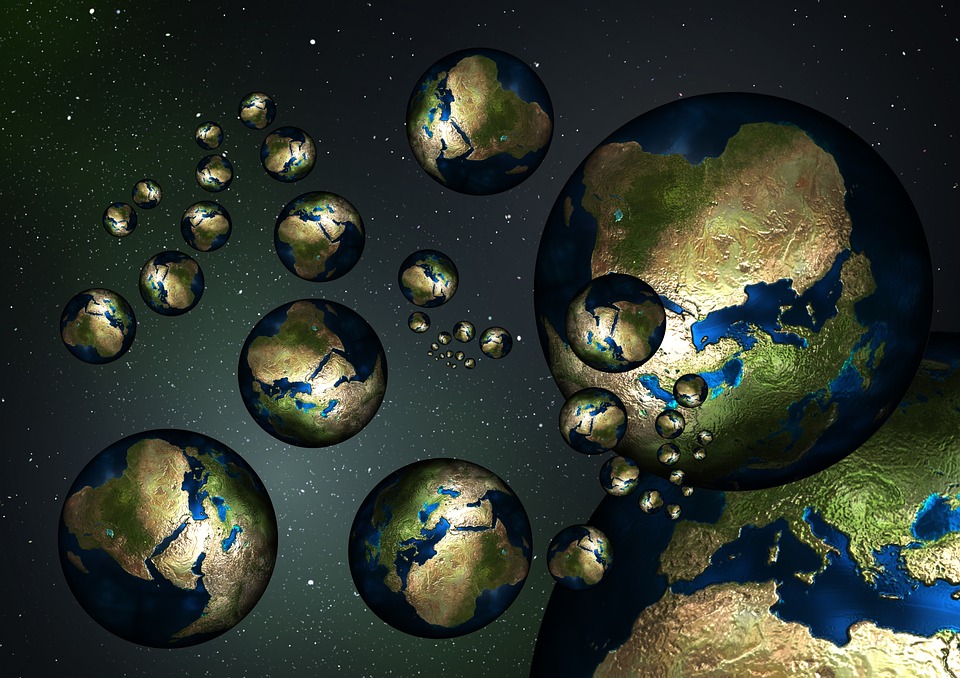
A Multitude of Multiverses

Long ago, we believed the Earth, the World, and the Universe were just about the same thing. The heavens were above, and the watery abyss below, and the Earth stood in the middle on its immovable foundations. In the more scholarly parts of the world, the Earth was known to be a sphere, but still thought to be the center of the Universe, with the sun, moon, and stars revolving around it. Since then, a series of world-changing scientific revolutions showed that the Earth revolves around the sun, the sun and all the visible stars are just a tiny section of the Milky Way galaxy, which is one of 50 in the Local Group, which is one of 100 galaxy clusters in the Virgo Supercluster. Yet the observable universe is so vast that 10 million superclusters fit inside it.

Click to enlarge.

The observable universe is as far as we have been able to see. However, there is no reason to believe reality ends there. Time and again, the Universe has been discovered to be bigger than we thought, so why should it be any different now? Perhaps if we could look far enough in space, back in time, through another dimension, or outside of the space-time continuum, we would find the whole of physical reality to be as much bigger than we think it to be now as our current picture is to the view that Earth is most of reality—many universes, or a multiverse.

How would a multiverse come to be, and how could we know about it? You might think that if something is outside of what is observable to us, then by definition we cannot observe it. However, most multiverse hypotheses are not theories themselves, but the logical conclusions of other theories, which make other, more testable predictions. It actually turns out to be very difficult to come up with a theory that encompasses the entire observable universe throughout space and time without getting a multiverse or two on the side.

Today, we will look at several possible reasons why multiverses might exist, including physical and philosophical. We will also examine the arguments for why this universe might be the only one.

Arguments for a multiverse:

Quantum Many Worlds
The multiverse that most people are familiar with from science fiction is the Many-Worlds interpretation of quantum physics. There have been many a Star Trek episode where a hole opens up in space in front of the Enterprise, and another Enterprise emerges, complete with all of the crew members, but everything is just a little bit different. It is a handy way to write a “what if” story, where in the other universe a key moment for the story played out differently.


Let’s look at the science behind the Many-Worlds hypothesis. Now the average person gets exposed to quantum physics either from science fiction or from modern mystics, both of whom use the word “quantum” as a substitute for “magic;” an empty term meant to convince people the speaker knows what they are talking about. Quantum physics is often described as strange and weird, the same adjectives that are used to describe consciousness, supernatural creatures, spooky coincidences, etc. But just because the same words are used does not mean they have anything to do with each other. Matter can be solid, liquid, gas, or plasma, but that does not mean all matter is made of earth, water, air, and fire. Quantum physics is a real science, the study of the basic building blocks of matter and energy at the scale of atoms and their parts. So let’s leave all of our preconceptions behind and take a look at the real weirdness of quantum physics.

Before quantum physics, the Universe was thought to be deterministic. There was a thought experiment called “Laplace’s Demon,” in which it was imagined that if there were a mind that knew the positions and velocities of every particle in the Universe with infinite precision, that mind would be able to use Isaac Newton’s laws of motion to predict everything that happened in the Universe until the end of time. Everything was thought to be determined ahead of time—not planned or fated, but flowing naturally by the laws of physics with no possibility of changing course.

The essence of the weirdness of quantum physics is that it throws determinism out the window. With classical physics, if you set up two experiments exactly the same, they give you exactly the same result every time. That’s determinism. But in a quantum experiment, you can set up two systems exactly the same, and they can give you different results. For instance, sodium-24 is an unstable atom that decays into magnesium-24, with a half-life of 15 hours. This means that if you have a bunch of sodium-24 atoms, then in 15 hours, roughly half of them will have turned into magnesium-24. This means that if you look at an individual sodium-24 atom, there is a 50% probability that it will decay within 15 minutes, and a 50% probability that it will not. This probability is baked into the fabric of reality, and does not depend on some internal clockwork of the nucleus. Rather than deterministic, quantum physics suggests that at the fundamental level, the Universe is probabilistic.

For myself, I am perfectly happy with accepting quantum physics as probabilistic, that reality itself has an element of chance that cannot be explained away. This view is known as the Copenhagen interpretation of quantum physics. But many people see this as ignoring the question, and insist that there must be some explanation that resonates with a deterministic intuition (or a consciousness-based reality intuition, but that is a topic for another time). One of the most popular explanations is what we have been waiting for, the Many-Worlds interpretation.

The Many-Worlds interpretation of quantum physics says that every time a particle does something that is probabilistic, a new universe branches off in which each possibility happens. If there is a 50% chance that a particle goes to the right and a 50% chance that it goes to the left, then there will be two universes, one in which the particle goes to the right, and one in which it goes to the left.

Schrodinger's Cat. The release of the poison is triggered by the radioactive decay of an atom, so according to the Many-Worlds hypothesis, there are two universes, one in which the cat is alive, and one in which the cat is dead.

The Many-Worlds hypothesis is often explained in terms of choices. It will be said that when you get up in the morning, there will be one universe in which you have cereal for breakfast, and one universe in which you have toast. But this is a misrepresentation. It is not merely choices that cause branching universes, but any time any particle does anything probabilistic. Few people pause to consider the massive implications of this. There are 10^27 atoms in your body alone. That is more than the number of stars in the observable universe. According to the Many-Worlds hypothesis, these atoms are creating branching universes all the time, sometimes at rates much shorter than seconds. The sheer number of universes that would exist under the Many-Worlds hypothesis is beyond comprehension, even for someone like me who spends a lot of time thinking about the size and scope of the universe.

I personally don’t subscribe to the Many-Worlds interpretation, because particles do not behave according to discrete probabilities, but probability densities. To explain what that means, I’ll take us back to the unstable sodium-24 atom. With a 50% chance it will decay within 15 hours and a 50% chance it will decay after 15 hours have passed, that means there will be two universes, right? Not so fast. If we change the time frame—say, 30 hours—then there is a 75% chance it will decay before, and 25% chance it will decay after. This would mean there are three universes in which the atom decays before 30 hours, and one universe in which it decays afterward. But we can change the time again, say 20 hours, 15 minutes, and 22 seconds, and run the probabilities again. In fact, we can set up our time windows to be arbitrarily small, each with its own infinitesimal probability. This would mean that for a single atom, an infinite number of universes would be created. In 50% of these infinite universes, the atom decays before 15 hours, in 25% of the universes, it decays after 30 hours, etc.


Following the Many-Worlds interpretation to its logical conclusion, we don’t end up with a set of discrete universes, but a continuous infinite-dimensional smear of universe-ness. This does not mean it is not true, but if the reason to consider the Many-Worlds interpretation was because the idea of probability being an inherent feature of reality was too weird, it fails, because the explanation it provides is even weirder.

Hubble Volumes
Now for something that is definitely true, but may or may not count as a multiverse depending on your definition. Far off in the depths of space, there are two distances that could be considered the edge of the universe. These distances are spheres that are centered around the Earth, or rather, centered around whoever is doing the observing no matter where in the universe they are. The first is the particle horizon, which is the distance light has had time to travel in the age of the universe. Our universe began 13.8 billion years ago, which means that from 13.8 billion light years away, light from the beginning of the universe is reaching us now. As time goes on, the particle horizon expands at the speed of light. This makes sense, because when the universe was a million years old, the particle horizon was a million light years in radius, and when the universe is a trillion years old, it will be a trillion light years in radius.

But there is another sphere which is important too. The universe is not just sitting still, but it is expanding. The farther away two points are from each other, the faster they are moving apart (assuming they aren’t held together by gravity or other forces). This means there is a distance from Earth at which space is moving away at the speed of light, which is called the cosmic event horizon. Because nothing can travel faster than light, nothing that passes across the cosmic event horizon can ever affect Earth or send signals that could affect Earth.

Whichever is smaller at any given time, the particle horizon or the cosmic event horizon, contains the observable universe. Right now, the cosmic event horizon is around 16 billion light years away, so we have a couple more billion years of new light reaching us before things start vanishing across it.


There isn’t one single observable universe. Rather, every point in space has an observable universe centered around it. Our observable universe is centered on Earth, 13.8 billion light years in all directions. But if we went to the Andromeda galaxy next door, its observable universe would be 13.8 billion light years in all directions centered on it. When talking about the observable universe centered on a point other than the Earth, it becomes confusing, so instead we will call it a Hubble volume, after Edwin Hubble who discovered the expansion of the universe. A galaxy on the edge of our Hubble volume would have its own Hubble volume centered on it, and we would be at the edge of its Hubble volume. Now imagine a galaxy on the opposite side of that Hubble volume. We now have two Hubble volumes that do not overlap. In a sense, we have two different universes. And since we have no indication that there is an end to space, there may be an infinite number of non-overlapping Hubble volume universes. If you interpret this as a multiverse, there is no question that a multiverse exists.

Inflation
During the first Planck-time moments of the big bang, our present cosmological paradigm says the universe expanded at insane speeds many times faster than light. This is called inflation. Within the inflation, a small volume crystallized into what we know as normal space, the parameters of physics freezing into place. This volume continued to expand to become our universe, including everything within our Hubble volume and far beyond.

It might be that elsewhere, far away from us during the inflation era, other universe seeds crystallized into universes with different physical parameters. It could even be that inflation happens forever in space and time, constantly birthing new universes in its infinite expanding alternative-space. Each of these bubbles within inflation would contain many Hubble volumes, and so each of them would be its own Hubble volume multiverse.

Theory of Everything
The universe as we know it had a beginning, the big bang. It might have been the beginning of time, or it may have been a transition from another kind of universe. Either way, when we try to calculate back in time to the earliest moments of the big bang, our current understanding of physics doesn’t work. That’s fine; after all, we have two theories, Quantum Field Theory and General Relativity, and they don’t fit together. Although in this era of the universe they respectively describe the extremely small and the extremely large, the instant of the big bang falls under both of their domains.

In order to understand the beginning of the universe, we need to bridge the gap between Quantum Field Theory and General Relativity. Right now we have two major contenders for such a Theory of Everything: String Theory and Loop Quantum Gravity, though neither of them have been tested. Both theories predict the existence of a multiverse, so if either of them is true, our universe is not alone.

But let’s consider the possibility that both String Theory and Loop Quantum Gravity are false, and some other Theory of Everything that we have not thought of yet is correct. Such a theory must be able to describe the beginning of the universe, either from Nothing or from another universe.  No matter what it is, whatever principle or substance caused our universe to come to be would logically cause a multitude of other universes to be created for the same reason. In fact, I think it would be quite difficult, if not impossible, to formulate a theory of how the universe began that did not leave us with a multiverse.

Metaphysics
If truly no physical law acts upon a State of Nothing, then Nothing cannot remain as it is, nor can there be any limit on what would come from it, because such a limit would count as a law of physics. If that is true, then everything that is logically and mathematically possible must exist, though in completely separate spacetime continua. These possible-made-real universes would range from those with the conditions for life like our own to emerge, to many kinds of universes where life is impossible, to universes that blink out of existence the moment they appear, to the really bizarre, like universes where a single particle corkscrews through space eternally, or where time loops back on itself and events repeat in an eternal cycle.


Arguments against a multiverse:

It is untestable
The most common criticism against the existence of any kind of multiverse is that it can never be tested. If these other universes are disconnected from ours, how could we possibly be able to measure them? It is a fair point, and reminds us to approach the topic with due skepticism, but it isn’t really an argument against a multiverse’s existence. Furthermore, there are some kinds of multiverses that we might, in fact, be able to detect. Gravitational wave detectors might be able to pick up signals from before the big bang, which would confirm that our universe was born from another universe. If String Theory is true, then we might be able to see signs that our 3-brane universe bumped into another 3-brane universe traveling through a fourth dimension. So while some types of multiverses really are untestable, like the physical existence of all things possible, there are some types of multiverses that we simply do not have the technology to test yet.

Strong Anthropic Principle
If our universe is the only one, then there are no other spacetime continua, no extra dimensions, and nothing at all, including space and time, before the big bang. However, in the laws of physics there are several physical constants, which describe the relative scales of things. For instance, the speed of light links space and time, the fine structure constant determines the strength of the electromagnetic force, and Planck’s constant sets the size of atoms. The number of possible combinations of physical constants that can support life is massively dwarfed by the number of combinations that prohibit life from existing. If there is only one universe, then it would be ridiculously unlikely for that one universe to be able to support life. This problem doesn’t have an official name, but I call it the Teleological Paradox, meaning the paradox of apparent design.

If there is a multiverse, then everything that can happen does happen, and the Teleological Paradox goes away. But if there is only one universe, there must be another resolution. One possibility is the Strong Anthropic Principle, the hypothesis that it is impossible for conscious, intelligent minds not to exist. If this is the case, then it is not correct to say the Universe came into being with the conditions for life, but rather the necessity of intelligent minds caused the Universe to come into being.

The Strong Anthropic Principle breaks causality as we know it. In all the rest of our experiences, causality goes from past to future. The Strong Anthropic Principle, on the other hand, says that future events (the existence of intelligent minds) cause the past (the beginning of the universe). The claim that intelligent minds must exist is also arbitrary; there is no more reason that intelligent minds necessarily exist than that elm trees necessarily exist, or that ringed planets necessarily exist. The only reason intelligent minds are chosen as the basis is to patch the Teleological Paradox. Furthermore, we might expect the Strong Anthropic Principle to make a much smaller universe, perhaps just a dwarf galaxy or star cluster, because the rest of the universe isn’t necessary for life. So although the Strong Anthropic Principle has no logical contradictions, it is a very weak explanation for why the universe can support life.

Intelligent Design


Another possible way for our universe to be the only one is if it was created intentionally so that we might exist by a personal God who exists independently of physical reality. But consider this: we have seen through our telescopes that the Universe is vast beyond comprehension. Remember, the universe is expanding, which means the farther something is from us, the faster it is moving away. Almost all of the trillions of galaxies scattered all over the observable universe will be pushed farther and farther away, until they cross the cosmic event horizon, which, remember, is the distance at which the expansion is faster than light. Once this happens, it will be physically impossible to reach them, or even see them anymore. If the Universe was created for us by an intelligent designer, we would either expect these galaxies to be reachable someday, or to not exist. If the goal was to create a universe where intelligent life would arise, it would be far easier to create a single galaxy, or even a single solar system, because that is all that is needed.

Perhaps God created all of those far-off galaxies to show his grand splendor, that the more technologically advanced we get, the greater we find the universe to be, and the more awe we feel for its creator. That makes sense, but let’s follow it through to its full implications. If God created multitudes of galaxies beyond the Virgo Supercluster to display his majesty, then why not for the same reason create a multitude of equally splendorous universes? I think that, even if the cause of the universe was that it was designed by a God, we still have good reason to believe there is a multiverse.

Instinctive Design
Finally, there is the option of some kind of unconscious mind, like the Force or a sleeping God, which created the universe with the right conditions for life out of instinct rather than intent. It may be that this kind of being would create one universe, since one is all that is needed for life. Being instinctive rather than intelligent, it might end up filling the universe with galaxies as a by-product. However, I would expect a universe created by such a being to be teeming with life on every planet, moon, and asteroid, and so far we have found no evidence of life from anywhere besides Earth.

Conclusion:

There are many physical and philosophical theories that hint toward the idea that our universe is not the only one, that there may be several universes, or an infinite number, all with different properties, dimensions, and contents. If this universe is the only one, we run into the Teleological Paradox, that the conditions being right for intelligent life to exist is too improbable to be coincidence. Each of the Teleological Paradox’s possible resolutions predict either that we would more likely find ourselves in a universe that looks quite different from this one, or that we have a multiverse anyway. There is no evidence that a multiverse exists, but with all the possibilities, I would not be surprised if one day we discover, in the depths of time and space or in the hearts of black holes, other universes lying hidden.