Thursday, June 18, 2020

Realism, Anti-Realism, and Irrealism

Does the universe exist? Is math real? Which Star Wars timeline is the true Star Wars? These questions fall under the philosophical field of ontology, the contemplation of what exists and how. In this post, we will look at what I consider to be the three main ontological categories that concepts can fall into: Realism, Anti-Realism, and Irrealism.


Realism


We have talked extensively about Realism on this blog, so today let’s take a look at the basics of the theory in its most abstract form. Anything that is real has a property called existence, which means it has way-that-it-is, independent of perception, knowledge, and belief. Real things are not contained by boundaries of reductionism and holism, which means it is equally valid to consider all of Reality at once, or to divide it into an infinite number of infinitesimal pieces.

Reality can be relative, but it is consistent. This means things can “look” different from different “perspectives,” but they “look” the same from the same “perspective” at any one moment in time. I use quotes here, because it doesn’t actually require anyone to be there to observe it.

A thing that is real exists, and it is consistent with itself and in its relation to all other parts of Reality.

Anti-Realism


This will come as no surprise to anyone, but not all things are real. However, it turns out that some unreal things are very useful for describing reality, in particular conceptual frameworks that are non-contradictory within themselves. A mental construct that does not exist, but is self-consistent is called anti-real.

The prime example of something anti-real is math. People argue sometimes whether math is real or not, but I think they would be delighted to find out that there is another ontological category it fits into. Math does not exist in objective reality, but it behaves like something real; it is consistent with itself.

Math is a lot more than numbers. It also includes vectors, functions, groups, sets, and all kinds of things. What ties all of math together is its process: we begin by defining a number of axioms, and determine as much as we can that follows logically from those axioms. This, by definition, is consistent. If there is ever a contradiction in a mathematical construct, the offending object is deemed invalid, or the axioms need to be reevaluated. There is no number in the real numbers that is both smaller than one and larger than two.

Logic is anti-real. Some would say scientific paradigms are anti-real, though it would be more accurate to say science uses anti-real models to describe real things.

A thing that is anti-real does not exist, but it is consistent with itself and in its relation to all other things within its conceptual framework.

Irrealism


Things that exist and are consistent are real. Things that are consistent but do not exist are anti-real. And we have one more realm to examine: that which is irreal neither exists nor is consistent.

Essentially, Irrealism is a tool of interpretations and descriptions. It says that, if two or more descriptions have gaps, but they account for each other’s gaps, then even if the descriptions contradict each other, they form a valid composite description when taken together.

If you’re like me, you find Irrealism highly confusing. The best way I know of to get a feel for it is by looking at a bunch of examples.

The most intuitive example of Irrealism I can think of is fiction. When you and I read a book, the version of the story in your imagination is very different from the one in my imagination. These two versions contradict each other in many ways. Yet they still count as valid interpretations of the same story. Thus, fiction is irreal.

A clear view of a story’s irreality can be found in retconning, when a book or a movie later in a series contradicts something that happened early in the series. Arguably, the events of a first book ripple into the fourth book, so when the fourth book declares that something that happened in the first book is wrong, we have a scenario that requires both that the first book is right and that the first book is wrong. In the worst case scenarios, both sides of the contradiction must be true in order for the fourth book to make sense! Thus, the established canon of the fourth book is irreal.

It has been quite hard for me to think of examples of irrealism that the average person will understand. After ret-conning, all I could come up with involve frontier physics and philosophy, so that’s what the rest of this section will be about. So, warning, heady topics ahead.

Irrealism was originally proposed as a theory to reconcile the two major metaphysical theories, Physicalism and Phenomenalism. Physicalism says that the true reality is physical reality, and Phenomenalism says that the true reality is that which is experienced by conscious observers.

The difference between physicalism and phenomenalism can be illustrated by the question, “If a tree falls in the forest and no one hears it, does it make a sound?” According to Physicalism, it does. The sound wave is there in the air whether or not anyone is there to hear it. But according to Phenomenalism, if no one hears it, there is no sound, because things only exist if they are experienced.

Phenomenalism has trouble explaining why things are consistent between times when they are being observed. Physicalism explains that, but has trouble explaining consciousness. Metaphysical Irrealism says that’s okay. Despite the fact that they contradict one another, they cover each other’s gaps, and therefore the composite Physicalism+Phenomenalism is a valid representation of the truth, and there is no single non-contradictory theory that accounts for all of reality.

What about quantum physics? Most claims about reality citing quantum physics are bogus, but there is one sense in which Irrealism might be applicable. There are two major interpretations of quantum physics: the Copenhagen interpretation and the Many-Worlds interpretation. Copenhagen explains probabilities, but not the collapse of the wave function. Many-Worlds explains the collapse of the wave function, but not probabilities. A quantum irrealist would say that even though they contradict one another, all questions are explained between them, so the truest representation of quantum physics is the composite Copenhagen+Many-Worlds.

And one more physics example. General Relativity explains how things behave in extremely high gravity, and Quantum Mechanics explains how things behave at the very small scales. However, they do not play nice together. If we try thought experiments with both extremely high gravity and very small scales, we get contradictions between the theories. A physical irrealist would say, if we never have to deal with things in the quantum gravity regime, then it’s perfectly reasonable to say the composite theory GR+QM is the truest description there is.

Why It Matters


You may have your own opinion on where Realism, Anti-Realism, and Irrealism apply. But you may also be wondering, “what does it matter?” The common answer to this is that, if we understand how things really are, we can use that knowledge to more effectively achieve the outcomes we want. As evidence, we can point to technology; knowing how the world works lets us take materials and put them together to make tools that work for our purposes.

But that’s not an argument for metaphysics, it’s an argument for pragmatism. The point of pragmatism is to focus on what is useful, not what is true. And according to a research team led by the psychologist Donald Hoffman, usefulness and truth are rarely the same thing.

The results of a study of evolutionary simulations, summarized in a Ted Talk.

Personally, I am motivated to search for true descriptions because I have a passion and a talent for it, and doing so fills me with energy and excitement. However, I have no illusion that this makes me superior in any way to people who don’t have the interest or skills to contemplate metaphysical theories. It just happens to be one of the ways I pursue fulfillment, and other people have their own paths to fulfillment.

However, there is one domain where Realism is both true and deeply important: suffering. Suffering is something experienced directly by conscious beings, and it is most definitely real. When people and animals suffer, turning our gaze away does not make the suffering stop being real. It is an objective fact that subjective suffering exists where it exists. Thus, it is extremely important to recognize the suffering of others as real, and to do what we can to alleviate that suffering and help each other on the path toward relief, meaning, and fulfillment.

Friday, June 12, 2020

Faster-Than-Light: Antigravity and Exotic Matter

It is almost universally believed among experts that traveling faster-than-light (FTL) is impossible. But if it weren’t, how would we do it?


Relativity and the Speed of Light


The speed of light is special. The reason it is special has nothing to do with light; it is the fixed feature of the universe against which we measure space and time. Our human brains naturally think of space and time as absolute. It makes sense to us to believe that if two things happen at the same place but different times, or two things happen at the same time but different places, then that’s the way it is no matter how you look at them.

But space and time are not absolute, they are relative. Space is easier to comprehend. Suppose you are standing by a train track. As I pass by in a train car, you snap your fingers twice. To you, in the reference frame of the surface of the Earth, the two snaps happen at the same place. But to me, in the reference frame of the train car, the snaps happen at different places.

In the station's frame the snaps happen at the same place, but in the train's frame the snaps happen in different places.

There is no objective reference frame by which to determine whether something is stationary or moving. Everything is stationary from its own viewpoint.

What about time? The relativity of time is harder to wrap our heads around, because it only appears when observers are moving significantly close to the speed of light relative to each other.

Let’s go back to the train example. You hold your arms out to their full length, and snap both your hands at once as I pass by. In my reference frame, however, you snap the fingers of the hand that points forward along the track first, and the hand that points backward second.

We aren’t talking about the difference in how long it takes for sound and light to get to our eyes and ears. The discrepancy is still there after we account for that. In your reference frame, you snap the fingers of both of your hands at once, but in my reference frame, you snap them at different times.

In the station's frame the snaps happen at the same time, but in the train's frame the snaps happen at different times. This is not because of light lag; it is found to be true after we account for light lag.

It is a fact baked into the fabric of the universe that there is no objective “here,” and there is no objective “now.” The speed of light is the absolute which ties together all perspectives of space and time. It does not matter where you are, nor what speed or acceleration you are going, the speed of light is the same for you as it is for everyone else.

Chasing Light Beams


Suppose you turn a flashlight on and off, sending a pulse of light out into space, and then chase after it. You accelerate and accelerate and accelerate, but no matter how fast you go, that light pulse is still retreating away from you at the speed of light. You can never catch it.

What is your trip like in the reference frame of Earth? It is an objective fact that you never catch the flashlight’s pulse. Therefore, in the reference frame of Earth, you speed up and speed up, but the closer you get to the speed of light, the less you speed up. No matter how much you accelerate, you never reach light speed.

This is the trajectory of an object with constant proper acceleration under Special Relativity. The shape is a hyperbola, and it never becomes parallel with the light beam it chases. The dashed line is the asymptote, shown as a visual aid.

However, you can, in fact, travel across the universe. In Earth’s reference frame, you are experiencing time dilation. Time is running slower on your ship than it is on Earth. In your reference frame, the universe is undergoing space contraction. The distance to the stars in front of you is shrinking—not just that you’re getting closer, but there is less total space for you to go through. The distance from Earth to your destination is shorter in the ship’s reference frame than it is in Earth’s reference frame.

In a sense, this can almost feel like traveling faster than light, even though light always races ahead of you. But because of the way the time dilation and space contraction work out, it still takes years to travel light-years according to your departure and destination reference frames. We don’t just want to visit Alpha Centauri, we want to get back in time for work the next week. How do we do that?

Both science fiction writers and scientists have pondered this conundrum. I myself wrote my undergraduate thesis on the topic. There are three families of FTL methods: space warping, wormholes, and hyperspace. Space warping involves shortening the distance between the beginning and end of the journey. A wormhole is a shortcut between points in space. And hyperspace is a hypothetical more-than-three-dimensional space, in which our 3D universe is just a slice. All of these deserve their own discussions, so today we will focus on an essential ingredient for making and using these things, exotic matter.*

Negative Energy and Imaginary Mass


Exotic matter sounds exciting. What is it? If we put the space-time curvature for a warp drive or a traversable wormhole into the Einstein field equations, we find we need to generate antigravity. In order to get antigravity, we need negative energy. You might think negative energy means negative mass, because E = mc2, but that equation is just a special case of the real equation,


As you can see, the mass in this equation is squared, so in order to end up with a negative energy, the mass must be complex. I don’t mean difficult to explain, we’re talking imaginary numbers, the square roots of negative numbers. Yeah, now you know why it’s called exotic matter.

Dark Energy


All right, so how do we make exotic matter? Do we have any clues to suggest it exists? Yes, in fact. Just a hint, but it’s more than nothing (or should I say, less than nothing?). The universe is expanding, and not only that, it is speeding up. Under attractive gravity, it should be slowing down. But because it is speeding up, we know there is a repulsive antigravity, some kind of “dark energy,” pushing everything apart.


We don’t know what this dark energy is. It is one of the biggest unsolved mysteries in physics. It could turn out to be completely useless. Or, it may be that it can be used to create exotic matter, or harnessed directly as negative energy.

Zero-Point Energy


There is one phenomenon people often point to as negative energy in the lab: the Casimir effect. So let’s talk about it, and see if it really is the magic ticket that will get us to the stars.

To begin, a little background knowledge. What we think of as empty space is not, strictly speaking, nothing. It has a number of quantum fields overlapping one another. For a deeper discussion of quantum fields, check out part 1 of our quantum physics series.

As it turns out, even when there are no particles, the quantum fields aren’t at 0 energy. An energy of absolute 0 leads to a contradiction in the math. Thus, the fields always have a buzz of vibrations far smaller than any particle. This is zero-point energy, also known as quantum foam.

The quantum foam is influenced by objects. If, for instance, there are two metal plates with empty space between them, these plates act as boundary conditions for the zero-point waves in the quantum fields. It’s like the harmonics of a guitar string, except instead of a string, it’s empty space. In empty space without the plates, there are no limits on the frequencies allowed in the quantum foam, but between the plates, only the harmonics are allowed.

If that was confusing, here is the bottom line: between the plates, the energy of the empty space is less than the energy of the empty space surrounding them. This is the Casimir effect.


The argument goes, if there is less energy between the plates than in normal empty space, that’s negative energy, so it should be usable for space warping and stuff like that. Here’s the problem, though. When it comes to gravity, it’s not the relative energy that matters, it’s the absolute energy. The zero-point energy in the Casimir effect may be less than the normal zero-point energy, but it is still more than absolute zero. Thus, although the Casimir effect looks like it creates negative energy, it is really still positive energy, and cannot be used for FTL technology.


As it turns out, getting negative energy is really, really hard. When it comes to FTL travel, we’re pretty much dead in the water. Of course, we don’t have any proof that exotic matter can’t exist, so there’s the possibility it’s hiding out somewhere in what’s left of the unknown. Maybe dark energy can provide a thread to follow, but that’s a big maybe. As things stand, it looks pretty certain that we’ll be stuck taking the slow route. Of course, that doesn’t mean we can’t use our imagination, and you can bet we will return to the topic of FTL in the future.

*We currently have no reason to believe hyperspace exists, nor any idea how to use it if it does. Exotic matter may be necessary, or may not be of any use at all.

Friday, June 5, 2020

Quantum Physics 2: Multi-Particle Waves

Quantum Physics:
Fields, Waves, and Particles
Multi-Particle Waves

Welcome to the second part in our series about quantum physics! If you haven’t read the first part yet, I highly recommend it, as we will build upon the concepts we learned there. This discussion also takes a non-reductionist view, so you may want to take some time to digest last week’s discussion of object metaphysics before reading this one.

Image found here. Cropped.

To recap, last time we discussed how the universe contains a number of overlapping quantum fields, each one of which is present throughout all space. These fields contain quantities like momentum, energy, and electric charge, which travel around the fields in waves. The fields can trade this information through interactions, and the probability of interaction is correlated with the amplitude of the wave. And finally, there is a smallest possible amount a wave in a quantum field can interact by, and this amount must interact all at once and all in the same place. That “smallest amount of interaction” is what we call a particle.

In this post, when we say “particle,” it is understood that we are talking about collections of information within a wave, not little balls bouncing around.

Quantum Superposition


When the waves of two particles overlap, they add together in superposition. When in superposition, two particles are not two separate waves that happen to be in the same place; they are one wave with two particles’ worth of information.

For example, let’s look at the simplest kind of particle, photons. They are simple because they do not interact with other photons. Imagine two photons on a collision course. Before the intersection, they are flying along as normal. After they have crossed paths, they continue to fly along as if nothing happened.

Remember, photons are waves in the electromagnetic field, and there is only one electromagnetic field. At the moment of intersection, when the two photons are in the same place, their wave amplitudes add together to form a superposition wave that contains the information of the two photons, but is not itself a photon. This information causes the wave to split once again as if they had never joined in the first place.

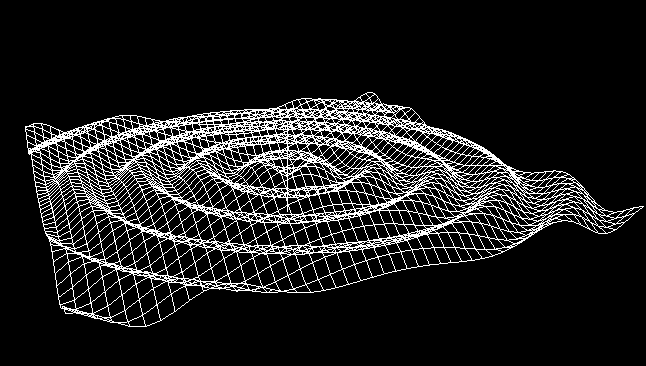
A superposition wave. The final wave contains the information of the first two, yet it is still a single wave. Image found here. Cropped for better framing.

The key concept here is that when two or more particles are in a superposition wave, they aren’t really two particles, they are one wave with two particles’ worth of information. This is where the reductionist view causes problems, and it is the key point of today’s entire discussion. So if you don’t feel like you understand it well, I would strongly recommend lingering on this section, and perhaps rereading last week’s sections on reductionism, holism, and associative equivalence, until you do.

Bosons and Fermions


There is no limit to the number of photons that can superimpose in the same place, but there is for electrons. Electrons cannot superimpose over one another in the same total state. I do not mean that they repel each other due to their negative electric charges. It’s deeper than that.

In the lingo, a particle’s “state” is the total of its information about its properties: its position, momentum, energy, etc. Two electrons can have the same values in some of these, for instance, position and energy, but there must be at least one property that is different between the two. If you try to plug into the Schrodinger equation a superposition wave that contains two electrons with all of the same properties, in the exact same state, you end up with a contradiction, like 0 = 1. This is called the Pauli exclusion principle because electrons exclude other electrons from being in the same state.

Electrons and photons illustrate two categories all particles fall into. Bosons can exist in the same state in the same place. Fermions cannot. Photons are a type of boson, and electrons are a type of fermion. If this is confusing, don’t worry, it will make more sense after we have looked at some examples.

Lasers


Image found on Wikipedia.

We all know lasers, beams of single-color light packed so tightly that the bright spot where it lands is about the same diameter as the aperture it emerges from. A laser is a very strong coherent electromagnetic wave traveling in the same direction. This can be thought of as a vast number of photons all packed into the same place, superimposing on one another, and giving the wave a very high amplitude.

The higher intensity of the laser, the higher the number of photons superimposing into the wave. Can you guess what the limit is for how many photons can be packed into a single laser beam? Because photons are bosons, they never crowd each other out. Thus, we can keep increasing the power until the concentration of the light is so high that its energy creates a black hole! Don’t worry, though, that would take over a billion times more power than the entire world puts out in a year, all concentrated into one laser beam. That’s a lot of superposition.

Atoms


Each element on the periodic table has a smallest unit, an atom. Atoms are formed when electrons bind to positively charged nuclei. The possible states an electron can have within an atom are quantized; there are only certain specific states allowed, anything else gives a contradiction when put into the Schrodinger equation. If this is confusing to you, I recommend reviewing the pixel analogy from Quantum Physics part 1.

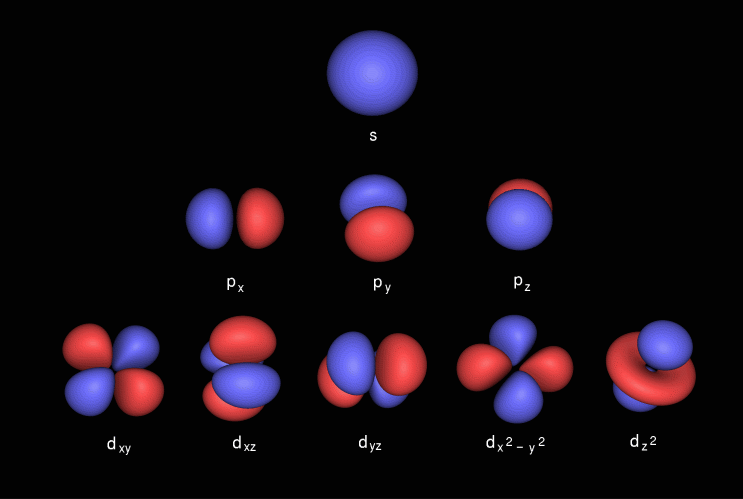
Because electrons are fermions, all electrons in an atom must be in different states. The three things contributing to an electron’s state in an atom are energy, angular momentum, and spin. If you have taken chemistry classes, you have probably heard of the electron states by another name: orbitals. The states with 0 angular momentum are called s orbitals, the states with the smallest non-0 angular momentum are called p orbitals, and then come the d orbitals and the f orbitals. Most of the time, the electrons are in the lowest available energy states.

This image shows the wave modes in the electron field. In real atoms, these get added together in a superposition wave containing all the electrons’ worth of information.

Each orbital letter type has specific energy levels allowed to it. The lowest possible energy for an electron in an atom is the 1s orbital, and the second is the 2s orbital. Then come the three 2p orbitals. There are no 1p orbitals, because trying to put them into the math gives us contradictions. There are one of each s orbital, three of each p orbital, five of each d orbital, and seven of each f orbital. And because electrons have two possible spins, there can be two electrons in each orbital.


Electron Spin


We mentioned something mysterious in the previous section: electron spin. What is it? It’s not angular momentum, as that is a different property. Spin is the property which determines how a particle interacts with magnetic fields. The term is confusing, because nothing is actually spinning; the electron is a spread-out wave with no central point for an axis. It is called spin for historical reasons.

In this section, we will talk about magnetic fields as if they are separate objects from one another, because that makes spin much simpler to explain. Keep in mind, however, that it is more true to say there is one magnetic field with different strengths throughout the universe, and that it is a part of the electromagnetic field.


When an electron interacts with a magnetic field, there are two possible outcomes: the electron’s own magnetic field could be aligned with the external magnetic field, or it could be aligned opposite. These are called “spin up” and “spin down.” Other alignments are impossible, because they give mathematical contradictions.

If you pick an axis, you might think an electron has a set spin, up or down, along that axis. However, it does not. Remember how we talked about electron waves, and the probability of interaction being proportional to the wave’s amplitude? The same thing is true for its spin. If the electron has not yet interacted, then it has an amplitude for spin up and an amplitude for spin down. Just like the electron does not have a single definite position before it interacts, it also does not have a definite spin.

Non-Spatial Probability Amplitudes


Let’s not let what I just said slip by. In an electron wave, there is a position component and a spin component. The position has an amplitude, and the spin also has an amplitude. If the electron interacts in such away that its spin is not involved, the position component of its wave collapses, but the spin component does not. This means an electron can move around and interact with other objects, but keep its spin in a non-determined state.

If I am not mistaken, the wave function of a particle has components for all properties that have more than one value, whether it feels intuitive to conceptualize them as waves or not. Polarization of light is the other well-known example. In a particle interaction, only the components of the wave function for the properties involved in the interaction collapse. The rest remain in superposition.

This means that if something interacts with an electron by its electric field, and not by its magnetic field, its wave will collapse to the position of the interaction, but its spin will still be undetermined.


Quantum Entanglement


Now that we have looked at superposition and the fact that each of a quantum wave’s qualities has its own probability amplitude, we are primed for one of the coolest and most famous aspects of quantum physics: entanglement.

Suppose two electrons are in a helium atom. What we have is a single wave with two electrons’-worth of information. Two units of interaction ability, and two opposite spins. Now we remove the wave from the atom and separate it into two, each with one unit of interaction ability; we can comfortably say that electron A is over there and electron B is over here.

However, if we choose our interactions with the electrons such that their spins are not involved, then the spins are still in superposition. As far as the spin is concerned, the two electrons are still part of the same wave. The only spin information this wave has is that there are two spins, and they are opposite. Which electron has which spin has not been determined, and their probability functions have not collapsed!


This phenomenon, when the position components of a multi-particle wave have separated, but the components of one or more of their other properties has not, is quantum entanglement.

What does this mean? What effects does entanglement have on human experiences? When we measure—cause an interaction with—the entangled property of one of the particles, we know what the other one will be when we measure it too. If we measure the spin of electron A, then we know before measuring the spin of electron B that it will be the opposite.

Most people wonder how the measurement of one electron can affect the properties of another electron instantaneously, ignoring the speed of light. Even Einstein was uncomfortable with it, calling it “spooky action at a distance.” But here’s the catch: the measurement of an entangled property does not affect the other particle. There is no causation between quantum entangled properties, only correlation. If we view entanglement in terms of superposition waves, we find it is not spooky, and it is not action at a distance.

We humans feel that if two things are guaranteed to correlate, then there must be some common cause. Either information is being transferred instantaneously from one particle to the other, or there is some kind of unmeasurable information that determined the outcome when the two particles were together. However, this is nothing more than a human assumption. There is a reason why the spins correlate, but not a cause. The reason entangled properties correlate is because if they didn’t, there would be a contradiction in the math. That is sufficient to make it true. Causation is found almost everywhere within reality, but non-contradiction is absolute.

If you aren’t sold on the connection between math and reality, check out the four-point argument I make at the end of last year’s post on the subject.

A common question people ask is whether quantum entanglement can be used for faster-than-light communication. There has been a lot of discussion about this in the literature, but the bottom line is that no, it cannot. We discussed one of the most compelling reasons to me in a previous post about the relationship between faster-than-light travel and time travel, the paradox that there is no objective way to determine whether the message would go from A to B or B to A.


So there you have it. Between this post and the one that came before, quantum physics explained in 4,500 words. If you understand it, then congratulations! You understand the basics of quantum physics as well as the experts, and perhaps even better than some. You also have a little insight into how the world of our experience emerges from it. If you have questions, feel free to ask them in the comments. There are still things we have not talked about, such as quantum computers, which are interesting enough to get their own discussion. Also, if you take what is said in these two posts at face value, it is known as the Copenhagen Interpretation. There is an alternative view called the Many-Worlds interpretation, which I go back and forth on, as you can see in my argument for it and subsequent argument against it.

So yeah. Quantum physics explained from scratch so that non-experts can understand it. Take that, Feynman!

Friday, May 29, 2020

The Subjectivity of Objects

Objects are everywhere. Houses, trees, windows, computers, people. Our language revolves around objects. We conceptualize the world in terms of objects. And today, I’m going to go full-on philosopher, and ask, “What are objects?”

Platonic Forms


In Ancient Greece, Plato described objects in terms of the theory of Forms. It was said that, for every type of object—house, door, cat, human—there is a perfect version of it, its Form. The Forms were said to exist non-physically and timelessly. Thus, reality was thought to be made of objects attempting to mimic their corresponding perfect Forms.

The theory of Forms may be useful in some contexts, but it doesn’t do well at describing physical reality. In the relatively static ancient world, it made sense, but in modern times with historically rapid technological and scientific progress, not as much. Has there always been a Form of a spaceship? A cell phone? The internet? What about the way some languages have words for objects that others don’t? It seems much more likely that Forms only exist as concepts within our minds, not in external objective reality.

Reductionism and Holism


In the era of science, another theory has arisen: reductionism. We observed that things are made out of parts, and those parts are made out of smaller parts, and the chain continues quite awhile. Finding the fundamental building blocks of the universe became a goal of modern physics, and some came to the belief that these building blocks are the true reality, and everything emergent from them is just our perception, less real or not real at all. This view is called reductionism.

Counter to reductionism, there is holism, the view that any system that functions as a whole and has properties that are different from the properties of its parts is a real object. Some stronger versions of holism even claim that certain higher-level emergent objects are more real than the parts they are made of.

Reductionism and holism are both perspectives and metaphysical theories. As perspectives, whether they are valid or not depends on the context. Today, we are examining them as metaphysical theories.

Associative Equivalence


Which is true, reductionism or holism? Are higher-level objects real, or are only the smallest, most reducible parts they are made from? To explore this question, let’s take a detour into math. Consider the following expressions:

3
1 + 2
2 + 1
(1 + 1) + 1
1 + (1 + 1)
1/2 + 2 + 1/2

What is the difference in the ideas each of these expressions represent? The answer: nothing! They all represent the number three, divided into arbitrary pieces.

Let’s take this analogy to physical reality. If we cut a sandwich into four pieces, does it become four sandwiches? If we put four full-sized sandwiches together at the corners, do we get one big sandwich? The answer is not a question of metaphysics, it is a question of semantics. It only depends on how we decide to define the words.

Just like how the number of numbers we divide a math expression into does not change what it represents, neither does reductionism describe a different reality than holism. Holism is merely putting the parentheses in different places (and, as we will see in next week’s quantum physics discussion, reductionism ends up doing that too). As metaphysical theories, neither reductionism nor holism measure up. They are both equally valid descriptions of the same reality!

Thus, we come to a profound realization: the universe is not inherently made out of objects; objects are human constructions. The universe is one thing, and it is infinitely many things. There is no difference. It’s all up to how we look at it.


For me, to see a door as a door, and as wood, and as wood cells, and as organic molecules, and as atoms, and as subatomic particles, and as interacting quantum fields, and to know that all of these are equally true, and none is more or less true than any other, is awe-inspiringly profound. To see myself as one person, and as two halves of a brain, and as a trillion cells, and as a part of the universe where the boundary between me and everything else is just a mental construction; that is nothing short of spiritual.


A Scientist’s Fiction is featured on Feedspot’s list of top 50 science fiction blogs! If you have some free time, and are interested in science and science fiction, why not check out some of the other creators there?

Friday, May 22, 2020

Your Brain is a Virtual Reality Machine

What is the difference between reality and virtual reality? At first, the answer seems obvious: reality is real and virtual reality is made up. It’s right there in the definitions of the words. But when we get down to the nuances of the meanings of these terms, we will find out that there may not be nearly as much of a difference as we first think.


Teasing Apart Reality and Perception


Being human, we have an instinctive intuition about what reality is. We look around, and we see it. We hear it, touch it, smell it, orient ourselves within it. Our senses tell us what reality around us is like, and in our consciousness, we perceive it. This instinct is called naive realism.

To make naive realism concrete, we look at an ancient theory of vision: eye beams. Back before the days of modern science, people believed we saw things by emitting invisible beams from our eyes. Anything these beams touched, we perceived in our vision. Perception was thought to take place out at the location of the things we perceive, and thus, our perceptions showed us reality.


Modern science has shown us that, to the contrary, perception happens in the brain. Our eyes do not emit beams. Instead, light bounces off the objects and brings information about their colors and textures into our eyes. Our eyes receive that information and translate it into electrical signals, which travel up our optic nerves into our brains, where our brains take the information and construct a representation that makes sense to us. The same is true for the rest of our senses.


Thus, what we think of as reality is not actually reality; it is a representation of reality created in our brains out of the information brought to them by our senses. When you see an apple, you see something red, round, and delicious over there. But “redness,” “roundness,” “deliciousness,” and “over there-ness” are just concepts created in your mind; they are not real qualities! Sure, there is something out there corresponding with each of these qualities, but it is different from the qulia that represent it. This theory of perception and reality is called representational realism.

Brains, Reality, and Virtual Reality


What is virtual reality? Those of us who have tried it have the experience of putting on a headset with screens in the eyepieces so close to our eyes we can’t tell they are there. These screens produce images that give the illusion that we are in a different place. The things we see in virtual reality are not material objects, they are illusions fed to us by a computer.

There’s an old thought experiment that asks, how do you know you aren’t a brain in a vat of nutrients, and that everything you perceive isn’t just being fed to you through your sensory nerves? Well, according to science, you are! The vat is your skull. Your brain is being fed electrical signals through your sensory nerves, which are translations of information received by your sensory organs.

Reality, like virtual reality, is made of information. The ultimate information in reality is a set of relationships between mathematical constructs, which we think of as matter and energy. The ultimate information in virtual reality is a set of relationships between mathematical constructs, which we call electrical signals in the computer. The concept and image of an apple in your brain is not like the electrical signals in the computer. But neither is it like the information making up the material apple. It is an equally false, and equally true, representation of both.


Thus, the only difference between reality and virtual reality is the type of information that exists “out there.” In terms of what we naively think of as reality, the images and sounds and colors and spaces and all that stuff, there is no difference! This “reality” created in our brains is a virtual reality, generated to help us process the information coming from our senses so that we can survive and thrive. There is one major difference between a material apple and a virtual apple: you can eat a material apple. But as to the question of which is more real, they are both mental constructs made from real information out there.

Friday, May 15, 2020

Broadening our Perspectives with Game Theory

Toolbelt of Knowledge: Theories
Darwinian Evolution
Game Theory

It’s been awhile since we’ve added to the Toolbelt of Knowledge, perhaps because there is so much we can explore in the space of ideas with what we’ve already covered. Today, I’ve decided to add to the longtime-lonely Theories category with another theory that can show us a new perspective on behavior, actions, and ethics: Game Theory.

What is Game Theory?


By its name, we might think Game Theory is a theory of games. It’s not, though. Most commonly, Game Theory is described as a theory of goals, outcomes, and strategies, though it can also be thought of as a theory of acting in accordance with our values. Game Theory is a theory of choices and consequences, actions and effects. The reason it is called “Game Theory” instead of “Strategy Theory” or “Choice Theory” is that games are structured with rules and goals for the players, and so it is easy to apply Game Theory to games. In this blog post, any time we mention “games,” we mean game theoretic systems, unless it is obvious by the context that we are talking about games in the fun-and-games sense.

There are three elements to a game theoretic system: Agents, the people, animals, AI programs, etc. who make decisions; the choices available to them; and the predicted outcomes of each combination of choices. The outcomes are usually written as a list of numbers, such as (3, 10, -1, …). Each number represents how satisfied each person is with the results.

You might see a problem here: in a game, this can represent the number of points each player ends up with, but how does it apply to the rest of life, where outcomes are not so easily quantified?

The answer, in my view, is that Game Theory should not be considered a theory of winning, but a theory of actions and consequences. Instead of numbers, we might put emojis representing how each person feels about the results. Or, we might directly represent the outcomes, rather than trying to quantify them. This can make it more difficult to compare the outcomes, but there are still times when we can comfortably say A is better than B, such as if A includes intense happiness and B includes despair.

Let’s look at some of the concepts of Game Theory, and some of the systems we can apply it to.

Positive-Sum, Negative-Sum, and Zero-Sum


There are three possible ways the total amount of “points” at the end can compare to the total amount at the beginning. If there is more at the end, it is a positive-sum resource; if there is less at the end, it is a negative-sum resource; and if the amount at the end is the same as the beginning, it is a zero-sum resource.

A note on terminology: you have probably heard the terms “positive- etc. sum game” instead of “positive- etc. sum resource.” A _____-sum game is more tied to the way the agents look at the game. For instance, if we say someone is “playing a zero-sum game,” it means they are trying to gain more by taking from others, rather than trying to increase the pot for all.

To illustrate each of these resource types, let’s look at the economy of a hypothetical island nation. This nation is self-reliant, it doesn’t trade or interact with anyone else.

The people of this island want to make it thrive. So they work the farms, build houses, mine for minerals, chop down and plant trees, educate their children, and all the other things a society needs in order to thrive. At the end of the year, they have more seeds, more knowledgeable people, more metal and wood and other resources than when they started with, and they are ready to start the next year and continue to reap increasing returns. This is a positive-sum game.

The land on the island is a zero-sum resource. There is a fixed amount, so if every acre is owned by someone, the only way for a person to acquire more is to get it from someone else.

And finally, the island’s coal supply from the coal mine is a negative-sum resource. The best use for coal is to burn it for electricity, but the more the nation uses, the less there is left to use. In order to continue to thrive in the long term, they must get off the negative sum game of coal power and find a positive sum game with renewable energy sources.

Short, Long, and Infinite Games


There are essentially three ways to strategize about a game-theoretic scenario. Short games are where we try to score as many points (metaphorically or literally) as possible as quickly as possible. A 100-meter dash is a short game; the goal is to get to the finish line before as many of your competitors as possible.

In a long game, the idea is to bide your time, waiting for the right moment to make the pivotal move. In a long game, we make short-term sacrifices for long-term payoffs. Chess is the archetypal example of a long game, as the ultimate goal is to trap the king, and it is common practice to sacrifice one’s own pieces in order to trap the other player in a snare.

An individual person’s life is a long game. The ideal life, according to present-day America and some other places, is to work hard at education, take out some loans for college, get a job, take out some loans for a car and a house, and slowly work off our debts until we break net positive and start accumulating wealth later in life.

An infinite game, on the other hand, is one that doesn’t end. The goal of an infinite game is to stay in the game as long as possible. Those who score points in infinite games are not people, as people have finite lifespans, but longer-lived things like countries, religions, and social causes.

Wars may end. Civil rights may be won. Oppressive regimes may be toppled. But their ripple effects continue, and in order to understand the way things are in the present and move toward a better future, we must study the past. Though the threads of history change, none of them end. History is a collection of infinite games.

Dominant Strategies


Sometimes, a single action can lead to positive results for all possible outcomes. These are called dominant strategies. Let’s look at a few examples.

Suppose we have a scenario where there is one choice: to light a candle or not to light it, and one risk: the candle might fall over. There are four possible scenarios.

1. We do not light the candle, and it does not fall over.
2. We do not light the candle, and it falls over.
3. We light the candle, and it does not fall over.
4. We light the candle, and it falls over.

If the fourth outcome happens, the house catches on fire, but in the other three outcomes it does not. We notice that if we do not light the candle, there is no outcome that results in a house fire. So if our goal is to not have a house fire, the dominant strategy is to not light the candle.

Another example can be found in cooking. If we are cooking a pan full of food, such as stir fried vegetables, we want to cook every piece equally on all sides. The surefire way to do this is to flip each piece individually. But if we do that, it takes too long, and by the time we’re done with the last piece, the first one is burnt. A better way to get it all cooked evenly is to stir the whole pan, making all of the pieces tumble around. Instead of having to plan each time exactly how to deal with each piece of food, stirring the pot or pan works every time. It is a dominant strategy.

Of course, in real-life situations it is often hard to find dominant strategies, since there are usually a very high number of factors and choices. Still, we can use this concept to look for strategies that have high probabilities of leading to good outcomes for a wide variety of ways a scenario might go.

Instrumental Goals and Ultimate Goals


There are two types of goals we might have in game-theoretic scenarios. An ultimate goal is what we are after, the outcome that would give us the most satisfaction from the game. Along the way, we pick up instrumental goals, things that help us achieve our ultimate goals.

Suppose my ultimate goal for today is to finish writing a blog post. In order to do that, I pick up a number of instrumental goals. I make coffee, because caffeine helps me think faster and more clearly. I eat food for similar reasons. I cross the street carefully, because it would be very difficult to finish my post if I am in the hospital or dead.

Of course, there are other reasons to do these things; other games being played. I’m playing the long game of life, in which writing is my major marketable skill, and finishing blog posts is an instrumental goal in service of the goal of making a living as a freelance writer, which is an instrumental goal in service of the goal of pursuing my passion as a science fiction author, which is . . . You get the picture. It’s not always clear what one’s ultimate goals are, or if their web of instrumental goals loops back on itself, or goes on forever.

The distinction between instrumental goals and ultimate goals comes from artificial intelligence research, not Game Theory. But they are useful in the same way as the rest of the ideas we’re looking at today, so I thought it made sense to add them to the Game Theory bundle.

Prisoner’s Dilemmas


Most of us are taught that being selfish is bad, and that we should share and be kind to others. Game Theory has several mathematical models supporting these ideas, the most well-known among them the prisoner’s dilemma. Abstractly speaking, a prisoner’s dilemma is any situation in which people acting in their best interests at the expense of others makes things worse off for everybody.

I won’t use the famous prison example today; you can find a million explanations of it with a quick google search. Instead, let’s look at another example: water rationing. Suppose there is a drought, and a town that usually has plenty of water for everyone starts to run low. The water supplier puts out a public notice, telling everyone that if they don’t limit their water consumption, the supplier will have to start temporarily shutting off the water for several hours at a time.

Each person is faced with the following conundrum:
1. Limit water and there is no shutdown.
2. Limit water and there is a shutdown.
3. Do not limit water, and there is no shutdown.
4. Do not limit water, and there is a shutdown.

In either case, whether or not there is a shutdown, an individual gets to use more water if they don’t limit their own consumption. Therefore, the dominant strategy is to ignore the public advice and use as much water as they want.

However, if too many people make this choice, the water will be rationed by the supplier, making things worse for everyone than if they had all limited their own water consumption. Hence the dilemma: the best possible outcome requires everyone to make the choice that is not the best for themselves.

The way to deal with prisoner’s dilemmas is through trust and self-sacrifice. We have to make the decision that is bad for ourselves, trusting the others to do the same. This is one of the reasons why it is important to treat others well and build relationships, even for people who only care about themselves. If everyone makes the hard choice to do the right thing, everyone ends up better off than if someone makes the selfish choice.


When considering things like political issues, our plans for our own lives, how we treat others, and stuff like that, it can be helpful to consider the questions from a game theoretic perspective. I may feel like this choice is right, but will its consequences actually line up with my values? Am I treating this situation like a zero-sum game, when it could be taken as a positive-sum game? Could a little sacrifice and trust on my part lead to a better outcome for everybody? These questions put things in a new perspective, and can lead to wiser choices and better outcomes.

Friday, May 8, 2020

The Six Critical Elements of Story Crafting

In my journey to become a published author, I have heard a lot of advice on story crafting. There’s so much it’s hard to keep track of it all, and the parts that spread the most readily are not necessarily the best. So this week I thought I would take a break from the science and philosophy and talk about the six major elements I focus on while writing a story, and which determine for me how good a story is. And also to plug some of the good books I’ve been reading lately. Let us begin.

Presence

Image found here
Every medium for stories has its strengths and weaknesses. A book or short story’s only tool is words, and the strength of words lies in their power over the readers imaginations. To achieve the element of presence, a writer must paint a picture with those words so vivid that the readers forget they are looking at paper and ink, and instead feel like they are there with the characters.

I felt present in stories a lot more when I was a kid, perhaps because my imagination was more active in filling in the gaps. As an adult, I haven’t felt this as much, although it may be more prevalent in the more literary genres. Of those I have read, H. P. Lovecraft was a master of presence in his horror stories crafting the entire experience of each around a mounting sense of dread. On a more adventurous note, Dune by Frank Herbert has quite vivid presence, if I recall.

Immersion

Subtly different from presence, the element of immersion is how believable the story is. Not necessarily how realistic it is, but how well the world and characters fit together and feel like something bigger than what is written on the page. Immersion breaks when the characters act uncharacteristically or too one-dimensionally, when laws of science or magic are carelessly broken, when the economic or social systems make no sense, and when there are plot holes.

The great fantasies, such as The Wheel of Time by Robert Jordan, A Song of Ice and Fire by George R. R. Martin, and The Stormlight Archive by Brandon Sanderson, excel at immersion. For near-future sci-fi, David Brin is a master of immersion in Earth and Existence.

Aesthetic stimulation

Concept art for the Avatar movies by Dylan Cole
Writers are not limited by trivialities like funding or the laws of physics. We can make statues a mile high, space ships the size of continents, the most gorgeous natural environments imaginable, exotic aliens, plants, and animals, and everything and anything we can imagine. I personally like messing with space and gravity. I am of the belief that even with our culture of today immersed in science fiction and fantasy, we have still barely scratched the surface of the aesthetic potential of our imagination. I’m including emotional stimulation in this category.

Pioneers into literary aesthetics include Shad Brooks in Shadow of the Conqueror, as well as Brandon Sanderson in The Stormlight Archive, particularly book 3, Oathbringer. On the older side of things, Hyperion and The Fall of Hyperion by Dan Simmons had their moments of incredible aesthetics.

Intellectual stimulation

Image found here
I love to think, and stories are a great playground for thought. The element of intellectual stimulation includes themes, moral dilemmas, scientific and philosophical concepts, and new perspectives on things we’ve come to take for granted.

Intellectual stimulation is important, but as we all know, stories are not essays. If the description or dialog waxes on about a scientific or philosophical idea, it’s boring. Stories have the unique ability to explore ideas through setting and the actions of the characters, and keep readers engaged that way.

Science fiction is great for intellectual stimulation. First and foremost, Earth and Existence by David Brin each put a large number of the struggles of our present society and contemporary philosophy into accessible story-rich juiciness. Ursula K. Le Guin paints a fantastic social thought experiment in The Left Hand of Darkness. Iain M. Banks set his Culture series in a galactic utopia, exploring a lot of the questions we easily overlook in our present societies as our attention is occupied by other things. And along those lines, I’ll throw in a TV show too: Star Trek is all about exploring the spaces of mind, meaning, and humanity.

Structural Coherence

Novels are collections of scenes and beats, and these all have to go together in ways that make sense when viewed as a whole. There is a lot of craft that goes into the element of structural coherence, including pacing, the ordering of the scenes, and which scenes are included and which left out. At the end, a structurally coherent story has everything it needs, no more and no less.

Most successful novels are good at structural coherence, so it’s especially jarring to find one that isn’t. We might find extra scenes or conversations bogging down the flow and which should have been cut, or topics that did not receive as much attention as they needed. A set of stories that do structural coherence surprisingly well are the I Am Not a Serial Killer series by Dan Wells. These book feel like they wander, but when we get to the end, we see how every scene has been deliberately used to serve the plot and the character development.

Payoff


Image found here
Themes, character arcs, plot threads, major features of worldbuilding, and flavors of the story should all be explored in many dimensions, and come to a culmination at the climax. It is not only at the climax where this matters, but all of the foreshadowing and development along the way as well. The payoff may be the most critical of the elements, as it is what will determine the emotions the readers leave the story feeling, whether they are inspired to look at life differently, and how psyched they will be to read more of the author’s stories.

The Wheel of Time had some of the best payoff of any story I've read at the end of the series, though it lacked a little during the middle. Most of Brandon Sanderson’s books have great payoff, particularly regarding the development of the magic systems. Ender’s Game by Orson Scott Card is a masterpiece of payoff through and through. And Artemis by Andy Weir makes very good use of many dimensions of its setting in a moon colony.

These six elements are the breath of life for a good story. Pacing, characters, setting, prose, the reason all that stuff is important is to serve these elements. Stuff like the three-act structure, the hero’s journey, and tropes and archetypes are, I believe, tools of analysis of finished stories, not things that are necessary to worry too much about when constructing them. For me, a story is good if it feels present, immerses me in the world, stimulates aesthetically and intellectually, is structurally coherent, and pays off on all the things that make it unique. Any rules, models, and guidelines are, in my view, meant to support these things.